


Aerospace America was on site in August at the Space and Missile Defense Symposium in Huntsville, Alabama, for the first time in at least a decade.
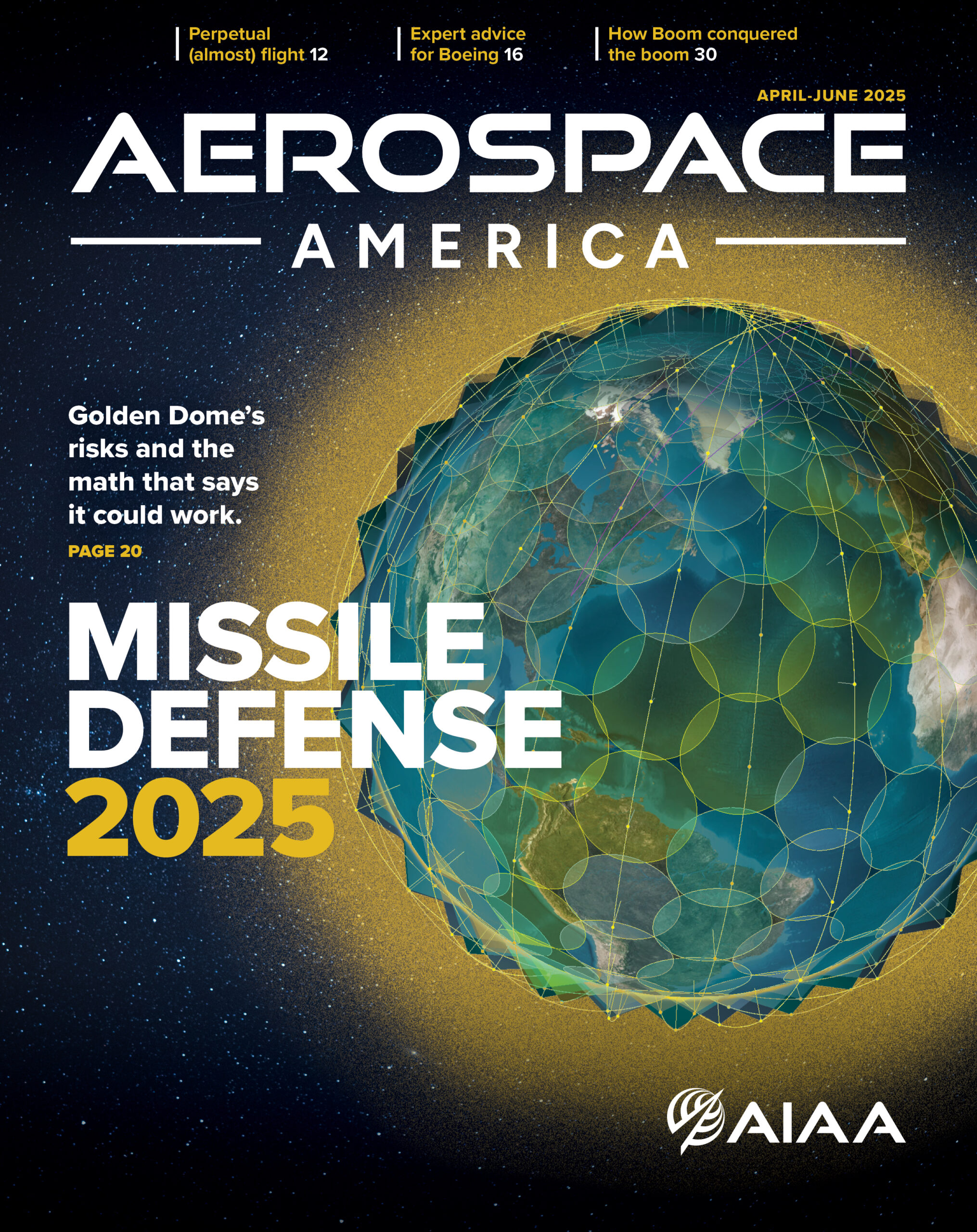
It’s a sign of our expanded defense coverage, but also heightened interest in Golden Dome, the planned multilayered missile shield that’s intended to be operational by early 2029.
Staff reporter Aspen Pflughoeft was on the ground in Huntsville for what organizers described as the conference’s largest crowd at 9,785 attendees. She reported a packed venue, with nearby spots running low on food.
One of the event’s biggest stories stemmed from remarks by Gen. Michael Guetlein, who oversees Golden Dome. He told attendees the initiative has its “first operational site” at Fort Story, Virginia, and has conducted two tests, including one at White Sands Missile Range, New Mexico. However, Guetlein did not detail the particular equipment assessed.
We will be watching closely — and bringing you more news — as the effort progresses.
Inside the issue
Another sign of our expanded defense coverage? This issue’s cover story, which takes a detailed look at the U.S. Air Force’s Collaborative Combat Aircraft program. Author Jen Kirby notes this type of effort to produce so-called loyal wingmen able to perform a variety of tasks is gaining traction not only with other U.S. military services, but also militaries around the world.
She takes a look at the progress thus far and what experts are watching in the coming months as the program moves into production.
Also in this issue: examining whether this might finally be the time for space nuclear. Jon Kelvey digs into previous attempts to harness fission power and propulsion to shed new light on the Trump administration’s plans for NASA’s Space Reactor 1-Freedom and Lunar Reactor-1 programs.
Both are advancing quickly, with what appear to be the key ingredients — beyond the technology itself — to achieve their goals.
For another feature, Charlotte Ryan examines the potential of expanding the role of artificial intelligence in commercial aviation. Some of the largest companies are looking at how they can best harness AI, and regulators are weighing how it fits into their work. Ryan reports on the existing FAA and European Union Aviation Safety Agency approaches to addressing AI use and what might be coming next.
For our Engineering Notebook department, Keith Button writes about work at the MIT Lincoln Laboratory to develop technology to avoid collisions like the one between a ground truck and an aircraft that occurred earlier this year at LaGuardia Airport. The lab is developing an in-cab warning device for these vehicles that would make it easier and faster for drivers to be aware of potential collisions.
Finally, don’t miss Associate Editor Cat Hofacker’s Q&A with Jimmy Kenyon, head of NASA’s new Research and Technology Mission Directorate. This consolidated hub of the agency’s work on aeronautics and space R&D oversees many of the technologies NASA envisions as crucial to its Moon Base initiative.