


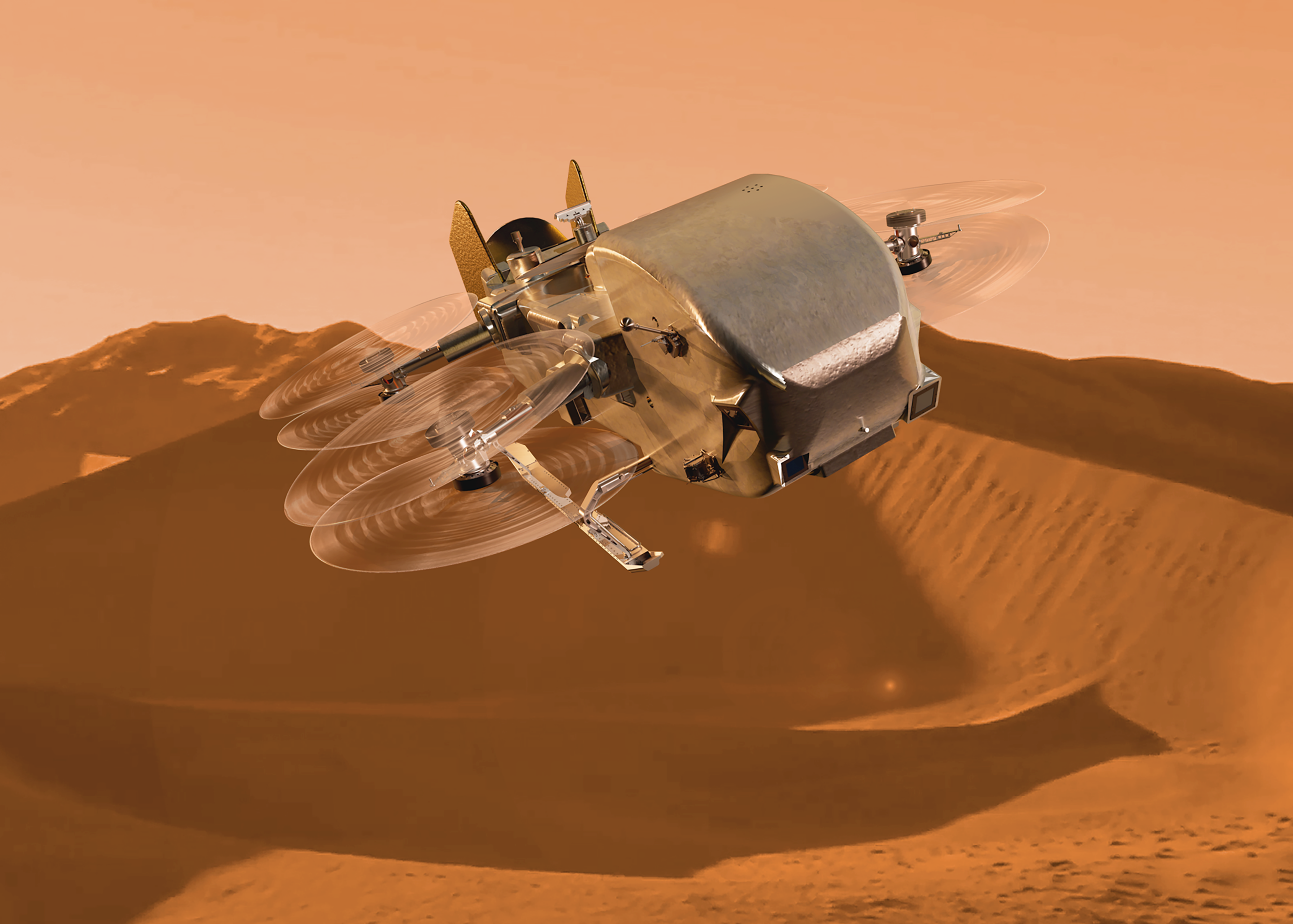
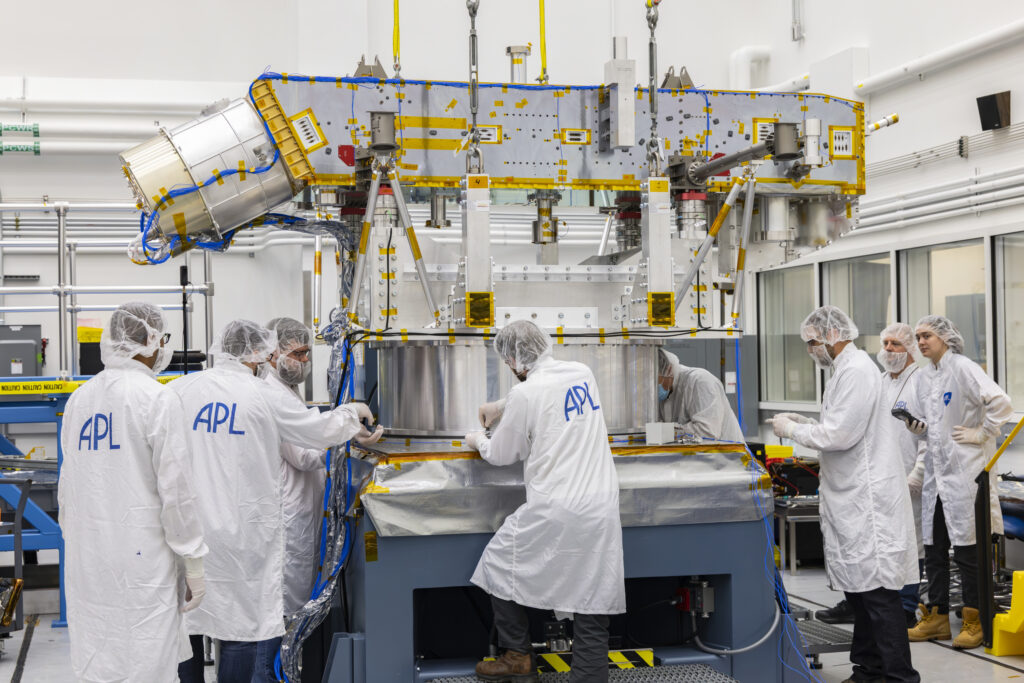
APPLIED PHYSICS LABORATORY, LAUREL, Maryland — Under the bright lights of sterile clean rooms here on the Johns Hopkins University campus, NASA’s Dragonfly rotorcraft is taking shape, as technicians navigate integration and testing of the probe’s primary structure.
Several days before my visit on Oct. 21, technicians had installed the first pieces of bright orange insulation around the body of the car-sized probe, scheduled to launch toward Saturn’s moon Titan in 2028. Johns Hopkins’ Applied Physics Laboratory is the prime contractor for the $3.5 billion mission.
“We flipped it over, installed 16 pieces on the underside, and now it’s right side up again,” Ken Hibbard, APL principal project systems engineer, told me as I peered through windows at the lab’s Space Integration Test Facility. “The lander will be mostly completed by the end of May, with some items — such as the flight battery and flight rotors — arriving later by design.”
Several weeks earlier, technicians had attached the landing gear skids to the rotorcraft body. Where a car’s axles might be, there are four rods that will eventually support eight rotors that will spin up to support Dragonfly during its descent through Titan’s dense atmosphere and its short, hop-like flights across the surface.
In a room adjacent to Dragonfly’s assembly area is a 1.5-meter-high table topped with a steel plate, humming and vibrating loudly. Hibbard said this is where technicians were preparing to begin vibration testing of Dragonfly’s insulated entry, descent and landing covers. As it plunges through Titan’s atmosphere under parachutes, the rotorcraft must detach and spin up its rotors to begin flying midair. The covers then close over the attachment mechanism.
“We have to build everything to not only withstand conditions on Titan, but also the extreme vibration of launch and the years-long journey through space,” Hibbard said.
If all goes as planned, Dragonfly is scheduled to touch down on Titan in late 2034, then spend at least three years exploring the moon’s icy dunes and landscapes shaped by slushy bodies of hydrocarbons, including liquid methane. Temperatures on the surface can reach minus 185 degrees Celsius (about minus 300 Fahrenheit), so Dragonfly will carry a MMRTG, short for multi-mission radioisotope thermoelectric generator, the heat from which will be held in by that foamy insulation shell.
APL technicians are installing the roughly 700 pieces of insulation in overlapping layers, surrounding Dragonfly’s curves and instruments.
“It is a very meticulous process,” said Dahway Lin, the APL team lead on Dragonfly thermal properties. “The foam team includes a lot of people checking to see: Is that seam sealed out properly? Did a gap open up when you put these two pieces of foam down? And depending on how big the gap is, we have ways of filling the gap up to make sure that no warmth makes it out. You build up the layers of foam and make sure the seams are offset.”
Because Dragonfly is still being assembled, the foam can only be added in spots where it won’t block access for technicians in the future, Lin said.
With this insulation, Dragonfly will be like a child well-swaddled on a winter walk to school. But there is also the risk of the probe overheating during calm days on Titan, if there are no super-cooled breezes to help circulate the air. So, a few days before my visit, APL installed an insulated “warm duct” running the length of Dragonfly and a “cool duct” that will be more exposed to the cryogenic air on Titan to counter the warming, Hibbard said. Diverters can open either duct depending on whether Dragonfly needs to warm up or cool down.
Once assembled, Dragonfly is slated to spend several days inside APL’s Titan Chamber. The lab built this 4.57-meter tall, wide and long pressurized chamber to test Dragonfly in conditions that emulate what the rotorcraft will experience on Titan.
The chamber can’t replicate Titan’s gravity, Lin said, but can mimic the moon’s atmospheric conditions — chiefly the extreme cold — by blasting the probe with cryogenically cooled air and sometimes aerosolized liquid nitrogen.
After those tests are complete, Dragonfly is to be shipped to Lockheed Martin in Colorado “in late May or early June for full-system integration and environmental testing,” Hibbard said. These assessments are to include the Lockheed-built protective aeroshell for atmospheric entry and descent, and the cruise stage.
Dragonfly’s descent through Titan’s dense atmosphere will take a little over two hours, a drastic departure from the seven-minute-descent for Mars missions, many of which include aeroshells also built by Lockheed. Therefore, Lockheed’s testing aims to ensure Dragonfly’s aeroshell can withstand a longer period of heating.
“On Mars, you get your heating build-up and then you jettison everything, and it’s over in a few minutes,” said John Ricks, Lockheed’s Dragonfly program manager. “On Titan, that heat will have a little longer to sink in, but you’re also hitting an atmosphere that’s so much colder than Mars that it cools off reasonably quickly. So we have designed for those dynamics, and that’s part of what we will test.”
After those tests, Dragonfly “will be destacked, and the lander will return here [to Maryland] in early 2028 for the flight battery installation and final thermal closeout,” Hibbard said, adding that the Lockheed-built segments will be shipped directly to Kennedy Space Center in Florida, and the lander is expected to ship there in March 2028. All will be restacked and launch-ready in Florida by July 5, 2028, Hibbard said.
Both for launch and surface operations, one of the biggest challenges will be the probe’s thermal management, he said.
“We have a challenge in that we’re designing a lander that is essentially a sealed thermos bottle to live on Titan, and I have to prevent it from overheating at other times in the mission,” Hibbard said. “I have to work really hard to not overheat it here on Earth leading up to launch and to not overheat during launch when you’re still trapped in this rocket that’s ascending through the atmosphere.”