


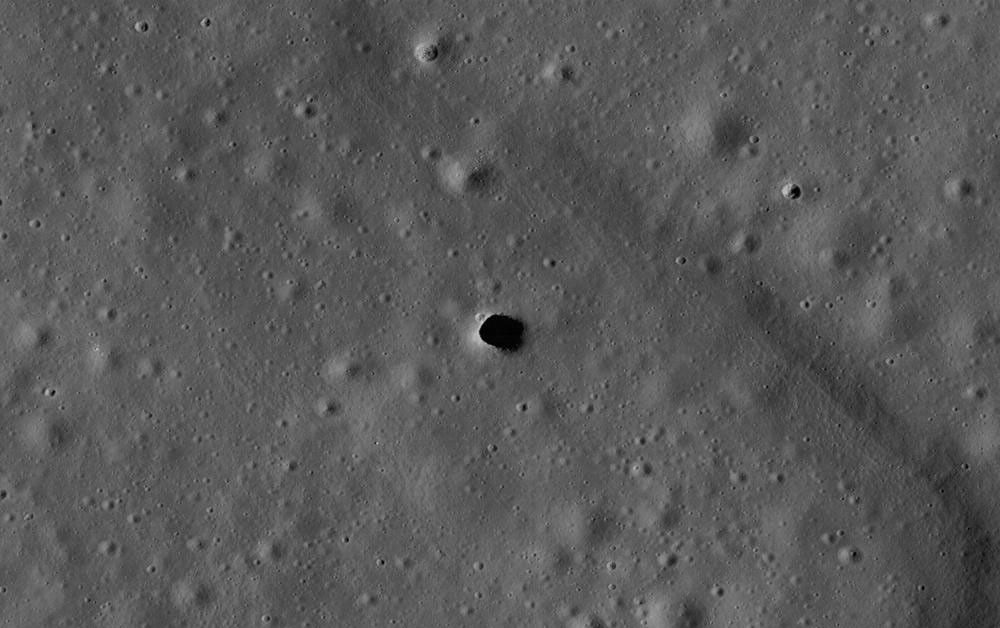
NASA is moving forward with plans to send a suite of instruments to the moon to confirm the existence of a large cave — essentially a tube left behind by lava flows from ancient volcanic activity — that researchers believe is beneath the opening of a pit on the lunar near side.
Plans call for launching a rover in 2031 carrying ground penetrating radar, a gravimeter and seismometer, along with optical cameras, to explore a hole known as the Marius Hills pit, which was discovered in 2009 by the Japanese lunar orbiter SELENE (also known as Kaguya in Japan). The pit is believed to provide access to a possible lava tube, based partly on shadows in orbital imagery that suggest an overhanging roof.
If such a cavern exists, it could potentially offer astronauts natural protection from radiation and the dramatic temperature changes experienced on the lunar surface, according to NASA and the Planetary Science Institute (PSI) in Arizona, which is leading development of the instruments. The suite is named GIMLI for Geophysical Instruments for Marius Lunar pit Investigation — a nod to the dwarf in J.R.R. Tolkien’s The Lord of the Rings.
“The main goals are to detect whether there is in fact a void space down there, and then to try to get the dimensions of it,” said Nathaniel Putzig, GIMLI principal investigator and associate director and senior scientist at PSI. If the cave exists, he said, further missions would be needed to determine if it could be a safe spot for habitats or other activity, like astronaut science.
NASA on Sept. 30 announced it had selected GIMLI for development. PSI won the award with a bid under the $40 million project cap with an additional reserve.
“It is important to gain a full scientific picture of the Moon’s resources and features – which includes lava tubes,” NASA told me in an emailed statement attributed to Jake Bleacher, chief exploration scientist. “However, the agency currently is focused on building a Moon Base in the lunar South Pole region, where no evidence of lava tubes has been found. While lava tubes are not part of current habitat planning, continued research could help inform future exploration opportunities elsewhere on the Moon.”
As Putzig describes it, a commercial lander yet to be chosen will deliver GIMLI to the Marius Hills region near the pit, which is located in the northern hemisphere. A rover, also yet to be selected, will then drive to the rim of the pit to begin observations with the three instruments.
Depending on the health of the rover and its power source, it could then drive a crisscross pattern atop the area believed to contain the lava tube. If the pit exists, the sensors should be able to indicate how deep the pit is, the location of its floor and roof, and how stable the roof is. Roof stability would be important for crew safety if it were ever to be occupied.
“By going for multiple instruments that look for void spaces in different ways, if they all show evidence of void space, that increases your confidence that it’s real,” said Gareth Morgan, a senior scientist at PSI and a geophysicist with expertise in radar science.
Occupying a lava tube on another planetary body has been a concept limited to science fiction, but the idea could offer major benefits, Morgan said.
“If you think about how much expense goes into just regulating the temperature of a spacesuit or structure, a very large cave does that for you,” he said, referring to previous NASA investigations that estimated the temperature in such a cave could be a constant comfortable 17 degrees Celsius (63 Fahrenheit). “The advantages of having humans in there, it could save a fortune in engineering costs.”
In a first since the Apollo era, GIMLI is to also carry an active-source seismic instrument known as a thumper that will impact the surface to send vibration or seismic waves through the ground and reflect off the underground surfaces.
The instruments will be based on existing technology, Putzig said, and all but the radar are to be constructed by Honeybee Robotics in Colorado, a company owned by Blue Origin. The University of Oslo in Norway has been tapped to build the radar, he said.
Svein-Erik Hamran, director of the University of Oslo’s Center for Space Sensors and Systems, said in an email the center has “for many years worked on different GPR systems for planetary exploration,” including the RIMFAX GPR on NASA’s Mars Perseverance rover mission.
“We’re reusing a lot of well-developed technologies here, and that’s part of trying to meet the five-year timeline. We can’t just start completely from scratch,” Putzig added.