

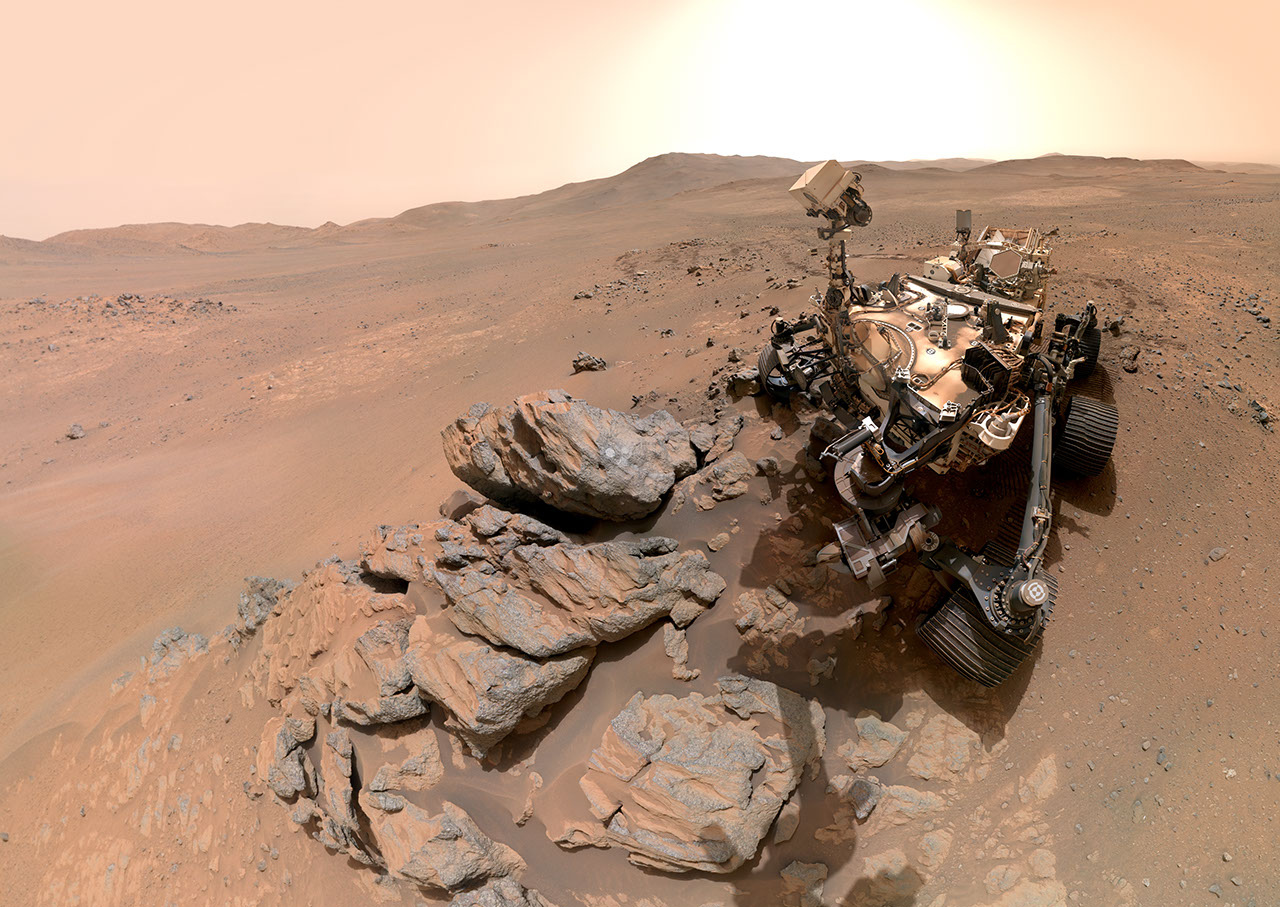
An AI-based software update that delivered an autonomous mission planning capability to NASA’s Perseverance rover in late 2023 has boosted its science productivity by more than 10%, engineers at the NASA-funded Jet Propulsion Laboratory report in a Science Robotics paper published today.
This software, named OnBoard Planner, addresses a perennial challenge for mission controllers overseeing deep space missions: maximizing operations amid challenging conditions and communications latencies. It takes up to 22 minutes for commands to reach Perseverance on the surface of Mars, so controllers upload as many as three days’ worth of tasks at a time. These plans build in extra time to account for various Martian conditions, like temperature fluctuations that may influence how long it takes the rover’s batteries to preheat certain science instruments.
“The conservatism results in higher predicted consumption of rover resources, which leads to a reduction in the amount of activity that operators are able to include in a sol,” or each Martian day, the paper reads.
OnBoard Planner was designed to eradicate the need for these conservative predictions and, instead, monitor in real time temperature and rover resources, among other conditions. The onboard AI then determines when and if the rover can insert new science activities — from a list presupplied by mission controllers — into its itinerary.
To do this, the software harnesses a technique called artificial intelligence constraint-based search, which scans the current surface weather and rover-state parameters, then decides which activities are best to perform and when, based on those parameters. In the paper, the JPL team says the update has led to a 10.5% rise in Perseverance’s “discretionary activity.”
“At its core, discretionary activity is a metric for rover productivity, representing how much actual exploration and science – driving, drilling, imaging and spectroscopy – we can accomplish in a day, as opposed to basic survival overhead,” Daniel Gaines, a principal member of the AI Group at JPL, whose team developed the software, said by email. “A 10.5% increase means that for the exact same daily energy budget, the rover is delivering over 10% more science on Mars.”
This also allows Perseverance to “conserve more battery energy for future operations,” he added.
Some of the rover’s components are heated and powered by its nuclear-powered Multi-Mission Radioisotope Thermoelectric Generator. “Other components, such as cameras and motors, which have been designed to survive the cold Martian environment when they are not in use, have separate battery-powered heaters to warm them before use,” Gaines said. “And with energy a constrained resource on the rover, we only heat these other components when we need to use them.”
The OnBoard Planner update was followed by another early this year, said Gaines. The NASA/JPL mission team decided to use resources had Perseverance previously devoted to the Ingenuity helicopter, which concluded operations in early 2024 after one of its rotor blades was damaged during its final flight.
“Our engineers recently repurposed the processor in the Helicopter Base Station to run Global Localization, helping the rover to autonomously pinpoint its position on Mars, which helps it drive further,” Gaines said. This capability was first demonstrated operationally in February.
Cristina Wilson, a roboticist studying human-robot field workflows at Oregon State University, whose team has been studying the tasking of legged robots as Mars rovers, said by email that the software’s success “shows how autonomous planners can increase science yield and quality on planetary surface missions.”
“Scientists will still retain responsibility for defining the objectives and priorities that guide autonomous decisions, but this work sets the stage for robots to take on more responsibility for how those objectives are accomplished,” she added.