

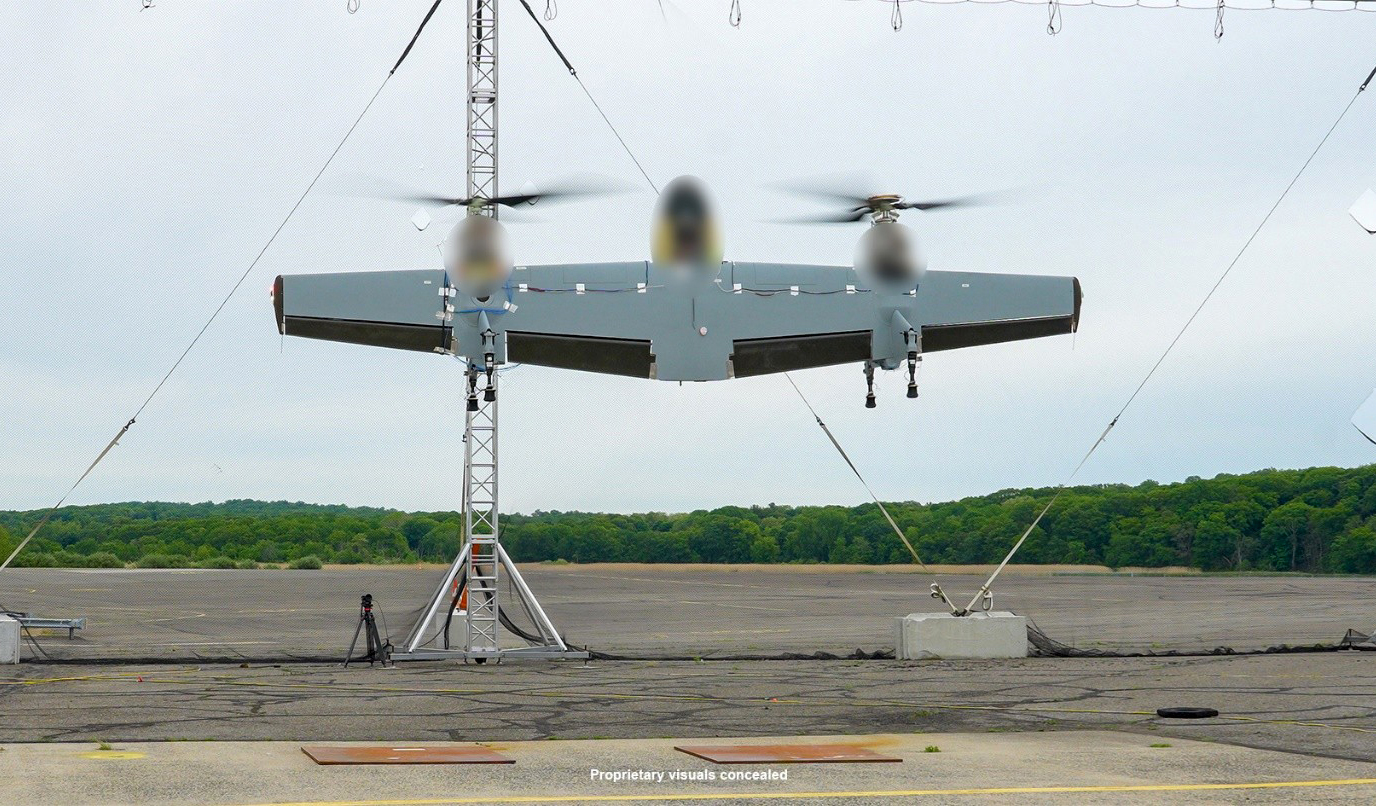
For the U.S. military and other customers interested in a vertical takeoff and landing aircraft with the endurance of a fixed-wing plane, Sikorsky hopes its flying wing drone in flight testing might fit the bill.
The Lockheed Martin-owned Sikorsky is one of four companies currently flying prototypes under DARPA’s $47 million EVADE program (Early VTOL Aircraft Demonstration), which aims to demonstrate applications for unoccupied vertical takeoff and landing aircraft up to 150 kilograms and to fast-track their development. The fifth participant concluded flight tests in August.
Among the objectives is for the prototypes to be able to fly for 12 hours over a range of 23 kilometers while carrying a 27-kg payload. DARPA has not set an end date for the flight tests; instead, each design is to continue flying until it has met the program milestones, said Lt. Col. Phillip “Donna” Smith, DARPA’s program manager for EVADE and a former Harrier jet pilot with the U.S. Marine Corps.
“We are in a ‘Fly as soon as you’re ready’ concept,” Smith said, describing the cadence as a continuous “fly, fix, fly” cycle. In this phase, Sikorsky and the three other companies are flight testing at their home locations to work through design changes and updates. They are then demonstrating the modifications for DARPA at the NAVAIR headquarters in Patuxent River, Maryland.
“When they’re ready to fly, they travel out to Maryland, do a set of flight test objectives, and then go home again, retune, retweak, make any changes from their lessons learned, and then do it all over again,” Smith said.
Once DARPA’s requirements have been met, further development of any of the aircraft will depend on customer demand, he said.
Designing Nomad
For Sikorsky’s aircraft, named Nomad, company engineers turned to a tail-sitting flying wing concept they first developed in collaboration with Lockheed Martin’s Skunk Works division about 12 years ago, said Igor Cherepinsky, director of Sikorsky’s VTOL technologies group.
That version, developed for DARPA’s VTOL X-plane program, weighed 4,500 kg and featured rotors driven by turbine engines. Funding from Sikorsky and DARPA ran out before it was completed.
Nomad features the same rotor-blown wing concept, with lift augmented by the air flows pushed over the wing by the two rotors. “We knew what it needed to look like; we also had done a lot of work on aerodynamics,” Cherepinsky said.
Sikorsky completed initial flight tests with the Nomad prototype in July, then began the DARPA demonstrations. In between those flights, Nomad has been flying at the company’s Connecticut facility, where the objective is to push the aircraft to faster and faster speeds, Cherepinsky said.
“As you go along, you correct your math models and understanding of aerodynamics, and then you land, you reprogram the system to account for that and you keep going,” he said.
He said Sikorsky has also flown Nomad for potential customers, whom he declined to name. The company says it is pitching Nomad to U.S. military branches, the Department of Homeland Security and for forestry and civilian organizations.
The main challenge in developing Nomad was choosing the power plant for the rotors, Cherepinsky said. The company’s engineers settled on a hybrid configuration: a piston engine that is boosted by an electric motor during hover flight. During horizontal cruise, the piston engine then generates power to recharge the motor’s batteries.
As for designing for the transition from vertical to horizontal flight, “let’s just leave it at the fact that it was challenging,” Cherepinsky said. “The control system does a lot of work to make sure that the aircraft doesn’t just fall out of the sky. It’s not a natural thing.”
Nomad’s rotor-blown wing design appears to be a crucial ingredient for that transition, said Moble Benedict, an aerospace engineering professor at Texas A&M University who is familiar with the public information on Nomad, but not affiliated with Sikorsky.
For a rotor-blown design in which nearly the entire wing is in the downwash of the two rotors, a drone can transition from vertical to horizontal flight at slower speeds, he said. That’s because the air flow pushed across the wing increases the effective speed of the wing, which allows the wing to provide lift even when it is tilted at a steep angle.
For a tail-sitter VTOL such as Nomad, he said, the downwash effect can also potentially help a rotor-blown wing drone maintain control during vertical flight by partially deflecting horizontal wind gusts, which could otherwise push the wing like a sail.
Nomad’s rotors are also articulated, according to Sikorsky. That’s a key feature for a fixed-wing VTOL without a traditional tail, Benedict said: In horizontal flight, these articulated rotors can provide control over the drone pitching at a downward or upward angle. To pitch the aircraft downward, for example, the rotors would be controlled to cut through the air more at the top of their rotation, with a steeper angle of attack, versus a shallower angle at the bottom of their rotation.
This same concept applies in vertical flight, Benedict said: As with a helicopter’s blades, when a VTOL’s articulated rotors are controlled during hover flight with a steeper angle of attack on one side of their rotation, they can tilt the drone forward or back or to the left or right.
DARPA’s requirements
In addition to the long-range flight requirement, DARPA asked the EVADE participants to design aircraft capable of withstanding rough flight and landing conditions: landing on a pitching deck in winds gusting to 45 knots, for instance, or flying between city buildings or through canyons and natural valleys with swirling winds that would easily flip and destroy a traditional VTOL drone.
“That’s the difficulty,” Smith said. “How do you have both?”
From a customer’s point of view, the appeal of a combined fixed-wing and VTOL design is its potential to carry more weight over greater distances than is possible with a VTOL-only drone, said U.S. Army Capt. Christopher Chelson, space operations officer and innovation integration officer at the Joint Readiness Training Center at Fort Polk, Louisiana. He oversees multi-domain operations for large-scale training exercises for Army brigades, during which drone prototypes and other new technologies are fielded and evaluated.
“The immediate payoff for that is just payload,” said Chelson, who is not affiliated with DARPA, Sikorsky or the EVADE program. “There’s always going to be an appetite for VTOL capability for the Army, because the Army is going to be operating in constrained terrain: ‘I want something/need something to be able to lay it inside of a brush of trees or a small clearing.’ That’s super important, and flying in between buildings.”
The priority of EVADE is to streamline the path to initial deployment by the U.S. military or other potential Pentagon customers, in part by starting the airworthiness certification process while the drones are still in development, Smith said. The program also dropped its flight demonstration requirement for landing on a ship in rough seas, for now, although the companies did demonstrate those capabilities in simulations, he said.
“We reduced those and said: ‘OK, make a land-based aircraft as fast as possible,’” he said.
Once they’ve demonstrated their base designs through EVADE, companies can work directly with potential customers to refine the aircraft to meet specific mission needs, Smith said.
“This is a pickup truck version,” he said. “If a customer wants longer range, they’re going to ask for: ‘Hey, instead of a payload, I want fuel tanks.’ If they want a camera imager of a certain type or size, that has to be integrated.”