


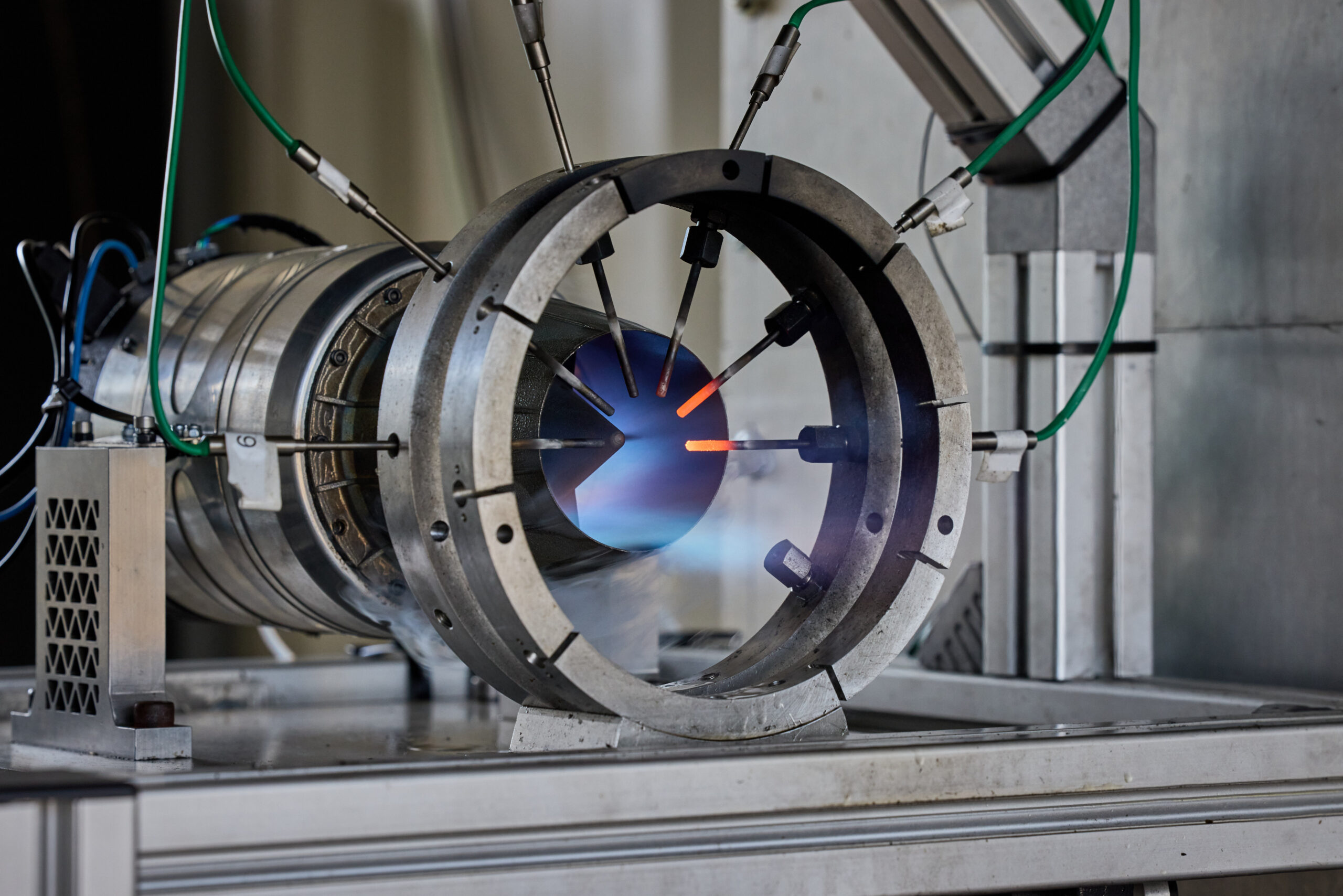
Alloyed, an Oxford, U.K., startup, is incorporating digital modeling, 3D printing and digital computer numerical control machining to more quickly supply small turbojet engines for drones.
The company is now ramping up to higher-rate production for its 3-kilogram, 300-Newton thrust engine, which it flight tested and began delivering to customers earlier this year. In parallel, engineers are testing an 1,100-N thrust version that is slated to enter production by the end of the year, said Rob Joles, commercial director of Alloyed’s propulsion division, known as Argive.
Changes in drone warfare tactics over the last two years have led to increased demand for small turbojet engines, said Jamey Jacob, an aerospace engineering professor and drone researcher at Oklahoma State University who isn’t affiliated with Alloyed. This push has been aided by 3D-printing methods that make such engines cheap to build and electronic control technologies that make them easier to fly, he said.
Russia and Iran have each deployed self-destructing attack drones propelled by small turbojet engines, according to media reports. The shift to these variants from slower-moving propeller versions has created a need for speedy interceptors propelled by cheap, small turbojet engines.
The turbojet drones have 10 times the range of electric-powered rotorcraft designs that have come to dominate the Russia-Ukraine war, Jacob said. “You have an ability now to have a relatively low-cost cruise missile; that’s essentially what these are.”
Another appeal of the small turbojet engine is its relative simplicity to manufacture compared to the piston engines of the older, propeller-driven versions of the self-destructing attack drones, Jacob said. There are only three basic components: a compressor, combustion chamber and turbine.
“It’s much easier to 3D print and build on these than you do with a piston engine,” he said.
Joles said Alloyed’s processes allow it to quickly design, build, modify and spin up mass production for new turbojets and their components.
“What our platform allows is continual iteration and development of the engine because all the tooling is digital, so you’re not committing to expensive fixed tooling,” Joles said. “Even our engines that are in production are still subject to upgrades and to iterations, and we’re able to do that because the design, development and production of them is all digitized.”
Alloyed’s approach
Alloyed was spun out of Oxford University in 2017 as a computational designer and manufacturer of proprietary metal alloys, such as formulations of aluminum, nickel, niobium and magnesium for the hot sections of jet turbine engines. As the company’s engineers developed expertise in high-temperature alloys and 3D-printing methods, they decided in 2024 to expand into manufacturing small turbojet engines, Joles said.
“We saw the opportunity to apply that ourselves by manufacturing the components for jet engines, and then ultimately making whole jet engines ourselves,” Joles said.
Alloyed designed and started bench testing its 300-N engine in 2025, and earlier this year began designing the 1,100-N variant. The smaller engine can fit in a 2.5-meter-long drone capable of flying about 300 kilometers, Joles said, and the larger engine can propel a 3-m-long drone over a longer range, with a takeoff mass of 600 to 700 kg, although the specific aircraft sizes and ranges depend on their missions.
Alloyed has multiple customers signed up to buy each design, Joles said, but the company has only publicly named Oxford-based MGI Engineering. MGI in 2025 announced its intent to use Alloyed’s 300-N engine on its SkyShark drone.
Alloyed is also developing two other engine sizes. “There is an ever-increasing thrust requirement as customers look to extend range, payload and speed on their vehicle platforms,” he said.
“The war in Ukraine is driving the overall propulsion requirements for vehicles, because it is where there is the greatest rate of technological change of how drones are being designed and employed,” Joles added.
However, the company is also seeing interest in engines for reusable and longer-range drones for reconnaissance and non-military applications, he said.
From design to fielding
Alloyed designed and fired up its first engine on a test stand within 10 weeks early in 2025, Joles said. Now, the company can adapt its base engine design to a customer’s requirements and produce a flight-ready engine in about two months.
Alloyed’s engineers design and build a first version of an engine, run it through digital simulations, physically test it, feed those test results into the engine’s digital model, adjust the design as needed and then repeat the build-and-test loop.
For bench testing, an engine is bolted to a scaffolding-like metal frame with wires and metal probes attached to sensors, Joles said, which record temperatures, pressures and flow rates at different sections of the engine. Those tests are conducted outside for normal conditions and held inside to test under hot or cold conditions. Once an engine has advanced to flight testing, the engineers install it aboard a drone and fly it at an airfield near Oxford, controlling it from the ground by joystick.
One of key challenges in the design process is understanding how the components interact once the engine is fired up, because of the fine tolerances and extreme temperatures, pressures and RPMs involved, Joles said.
“You can model and simulate lots of aspects of jet turbine design, but really the proof is in making the thing and making sure that it performs,” he said.
The digital design loop allows the company to alter an engine’s design to minimize cost, which is a key consideration for interceptor or other drones built to last for only one flight, Joles said. The design can call for thinner 3D-printed components or cheaper alloys that only need to withstand a short period of extreme heat and wear, for example, or the design can simplify many complex components into fewer, 3D-manufactured pieces to reduce assembly costs.
“You’re constantly trying to play on the edge of: How do I make this as low cost as possible while still hitting the performance metrics?” Joles said.