

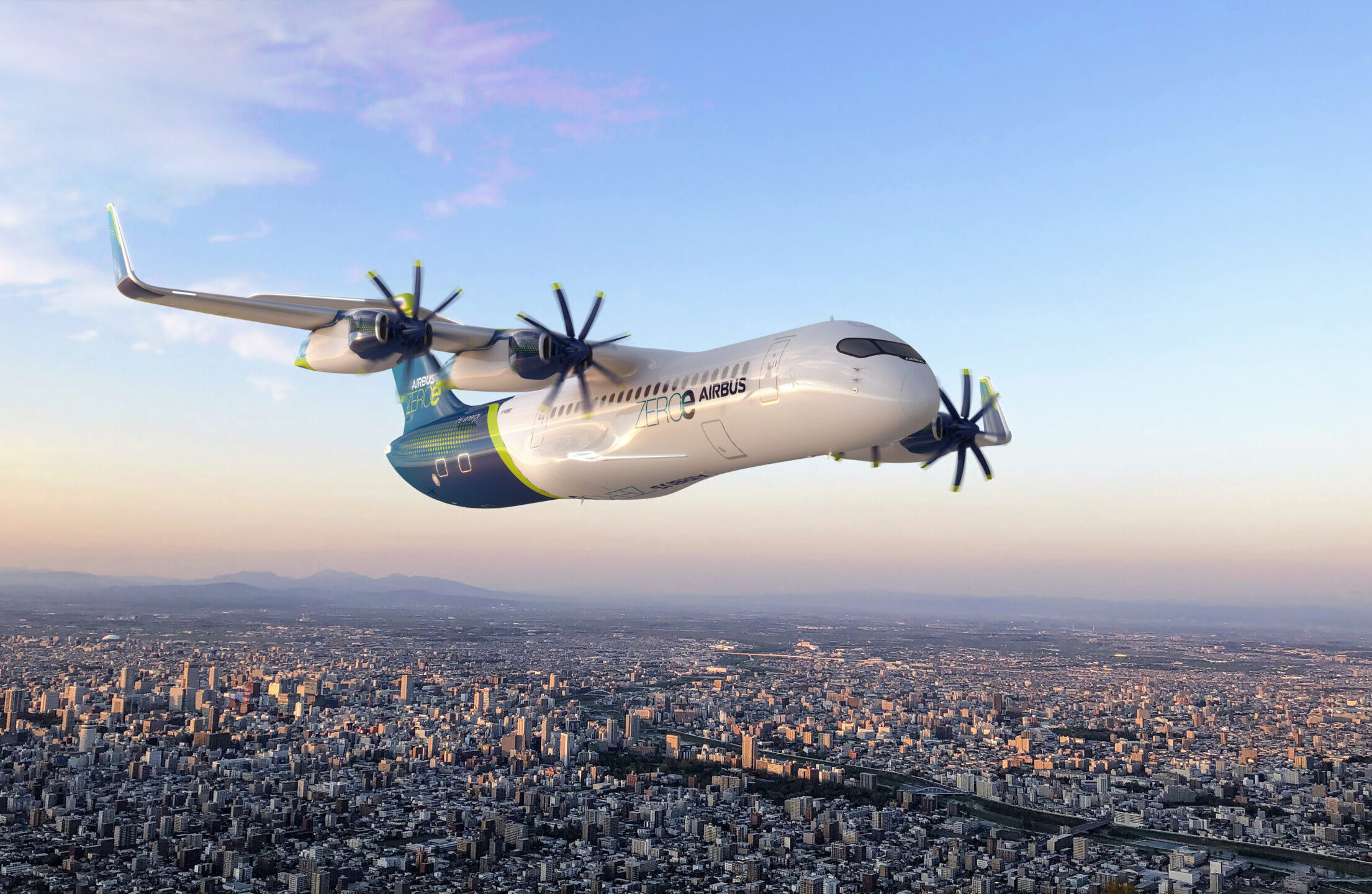
TOULOUSE, France — Airbus has revised the plan for its first hydrogen aircraft and is now aiming to debut a regional propeller design powered by fuel cells sometime in the 2040s.
The announcement, made last week during a media event here, marks the latest shift in the company’s ZEROe program, which began in late 2020 with a goal to debut a larger passenger airliner in 2035. Airbus over the last several years has been evaluating a range of concepts, most recently a 100-seat version of the fuel-cell-powered design.
Speaking at the Toulouse event, Lars Wagner, head of Airbus’ Commercial Aircraft business, said the first ZEROe plane is slated to have roughly 80 seats and a range of approximately 1,000 nautical miles. He declined to give more details, citing competition concerns, but Airbus in July announced it would form a joint venture with MTU Aero Engines “dedicated to the development and commercialisation of a fully electric hydrogen fuel cell engine,” according to a press release.
Although the 80-seat ZEROe aircraft has reduced capacity and range compared to Airbus’ core single-aisle fleet, Wagner expressed confidence in the market demand. He noted the 1,000-nm range is sufficient for key European routes.
“Customers will switch,” he said. “Eighty [seats] is our entry into the zero-emission market, and the beauty of fuel cell technology is it is capable of scaling up to a bigger size.”
The company selected hydrogen fuel cells instead of liquid hydrogen because direct combustion produces nitrogen oxides and contributes to the formation of contrails. Storing liquid hydrogen aboard the aircraft also poses design challenges, because the fuel requires four times as much space as conventional jet fuel, as well as extremely low temperatures to keep it from evaporating.
Wagner said plans call for flight testing a 20-seat aircraft before scaling up the design to 80 seats. Although “there is growth potential to go higher” as fuel cell technology improves, he noted the ZEROe design is likely to remain a regional aircraft in the near term so as not to directly compete with Airbus’ next-generation single-aisle, slated to enter service in the second half of the 2030s.
“I need to be aware that I don’t create competition internally, so we have these two platforms which will continue to be in parallel in the 2040s,” he said.
Hydrogen has emerged as one of the main contenders for decarbonizing aviation, as it doesn’t produce carbon dioxide during combustion and is more energy dense than traditional jet fuel. But various challenges remain, including the lack of existing infrastructure for transporting and storing the fuel at airports. These are among the reasons Airbus last year backed off its initial 2035 target, with executives saying neither the technology nor the ecosystem would be ready in time.
The partnership with MTU is also meant to help secure “European sovereignty” in hydrogen fuel cell development, Bruno Fichefeux, Airbus’ head of Future Programmes, told the Financial Times in July. He referenced competition from countries like China and the U.S., which executives echoed at the Toulouse event.
China’s latest five-year plan puts “explicit emphasis on accelerating the development of hydrogen,” according to the Australia-based East Asia Forum.
“We know from other industries that what China puts on their five-year plan, they execute,” Wagner said. “We’re looking at what’s happening, and we want to continue to be No. 1, and that goes with innovation, that goes with technology, that will go with an empowered workforce.”
The company aims to have the joint venture with MTU operational by next year.
“It’s becoming a reality,” said Wagner. “We are doubling down on the propulsion system, which is also strategic for us. It’s the first time we are involving ourselves in becoming an engine OEM,” or original equipment manufacturer.
“We need to obviously see hydrogen coming up as an infrastructure,” he added.