


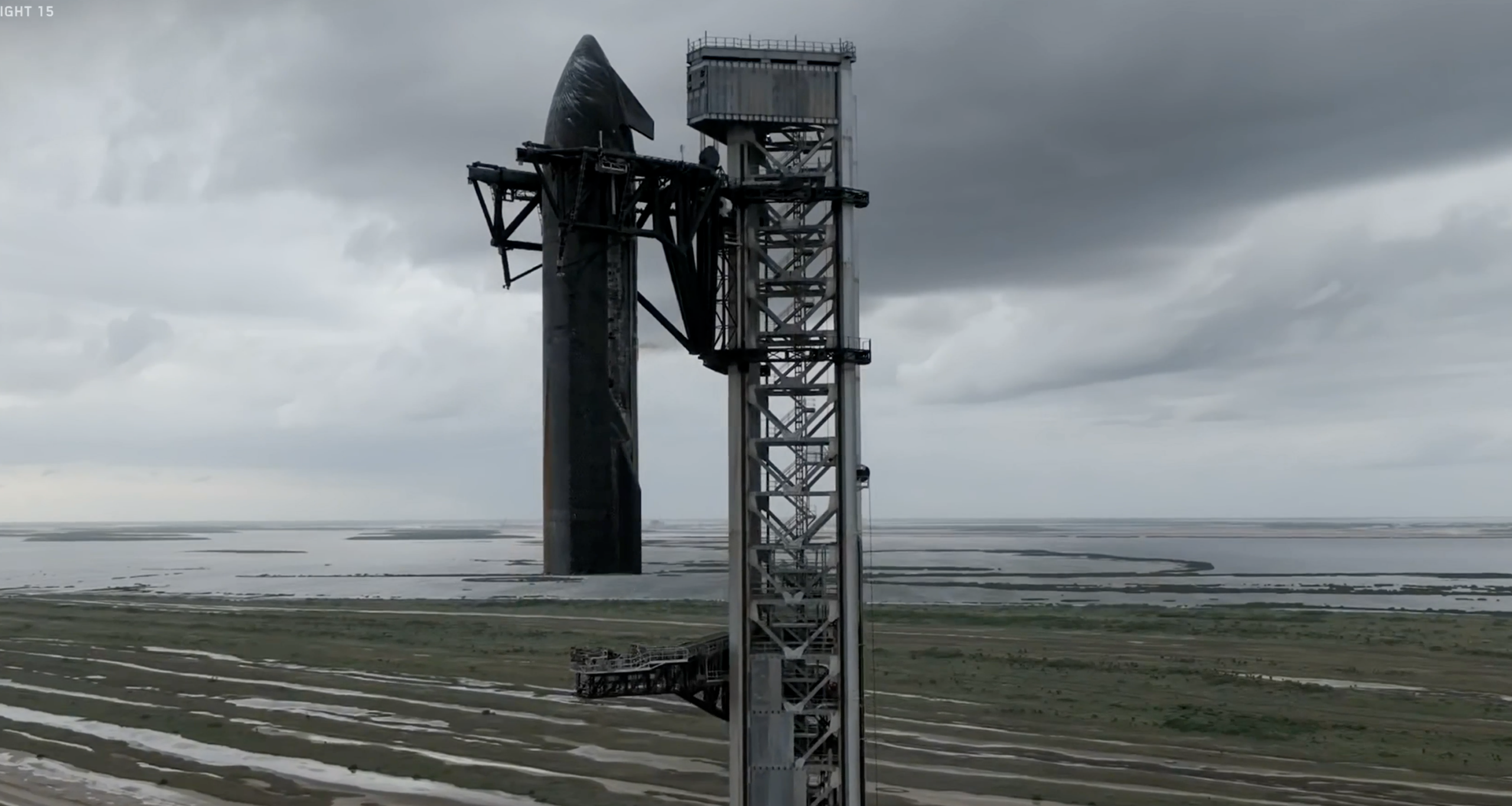
SpaceX on Saturday completed the first recovery of a Starship upper stage at its launch tower in Boca Chica, Texas, marking a significant step toward the company’s goal of complete reusability.
Flight 15 commenced at 4:47 p.m. Central on Friday, with the Super Heavy booster sending the upper stage — also called the ship — toward orbit before separating about 2 minutes into the flight.
SpaceX had planned on Super Heavy returning to the Starbase launch site for an upright landing within the chopstick arms of the Mechazilla tower a few minutes after separation; however, an undetermined issue prompted an abort. Instead, Super Heavy descended toward the Gulf of Mexico, exploding just before splashdown.
“Early indications are that the booster ended its boost back early due to a low fuel mass alarm. The team is still investigating the root cause on that,” Kate Tice, SpaceX’s director of quality management and training, said Saturday on the company’s livestream. “It indicates that the booster appropriately and autonomously followed safety protocols and protected the pad.”
The primary objectives for Flight 15 were the return and catch of both stages at the launch site and the deployment of 26 V3 Starlink satellites. Although the booster’s ending put the first objective out of reach, Starship successfully deployed the Starlinks.
The ship completed 14 revolutions of Earth before coming in for a landing at 3:29 p.m. Central on Saturday. The 22.5-hour flight marks the second time a Starship has orbited Earth, and the first ever recovery of a ship at the launch site, which SpaceX describes as a critical benchmark “in making Starship a reliably, rapidly, reusable rocket.”
“That was the missing link, the holy grail of spaceflight,” SpaceX’s Dan Huot said at the conclusion of the mission livestream. “We caught a Starship and now everything changes.”
The reentry process began around 2:20 p.m. Central, when Starship restarted one of its six Raptor engines for a 10-second reentry burn, decelerating the vehicle and setting it on a trajectory over the Pacific Ocean. The ship reached 100 kilometers altitude shortly after 3 p.m. Central, and the mission livestream camera began to show the orange glow of heated gas flowing around the vehicle’s windward side, which is protected by 18,000 hexagonal ceramic tiles.
SpaceX has extensively studied and modified the heat shield tiles in the hope they will not need to be replaced between flights, Tice said, as “SpaceX’s ultimate goal is to immediately land the rocket and launch it again, just like an airplane.”
Starship’s reentry path took it across Baja and Northern Mexico, before passing north of South Padre Island in Texas and executing a “swoosh” maneuver to approach Starbase from over the Gulf of Mexico. The ship performed a “belly flop,” descending parallel to the ground before firing its engines in a landing burn and coming to rest within the Mechazilla arms.
Reliable and frequent orbital flights of Starship are crucial to SpaceX’s plans for building out its Starlink broadband constellation, particularly as the company plans to retire its Falcon 9 rocket, which has become the workhorse of space launch for the U.S. and global markets. Starship is also central to NASA’s plans to return humans to the moon, as the space agency has awarded $2.9 billion in contracts to SpaceX to supply lunar lander Starship variants for Artemis crewed missions.
A test article of the Starship lander is slated to fly next year in the Artemis III mission, originally intended to be the program’s inaugural moon landing. NASA now plans for the mission to be a two-week demonstration in low-Earth orbit, testing docking maneuvers between the Orion capsule and test versions of the Starship and the Blue Origin Blue Moon landers.