

As crewed aircraft and spacecraft become increasingly advanced, one biological reality remains: Humans are not designed to fly.
Astronauts frequently get motion sick upon reentering Earth’s atmosphere. Experienced aviators often get headaches or nausea from aircraft simulators. Military pilots periodically get so disoriented they fly in a downward spiral without realizing it — sometimes fatally.
These phenomena are traced to the inner ear’s vestibular system, which senses movement, and the way the brain processes this information.
“The brain can do this really well on Earth,” said Aaron Allred, a bioastronautics researcher with the University of Maryland. But in flight, “it can oftentimes come up with errors.”
One such error is spatial disorientation, which occurs when a pilot incorrectly perceives the orientation or movement of their aircraft, Allred said. Pilots must learn to override their physical perceptions when this happens and instead react based on the information from their instruments.
“Despite current training efforts, [spatial disorientation] mishaps persist in the U.S. military,” according to a 2024 study Allred co-authored. For the Navy, this “remains the number one source of Class A mishaps,” meaning flight incidents resulting in loss of life, permanent total disability or more than $2.5 million of damage.
Another less consequential but more common vestibular error is motion sickness, Allred said. “Whether it’s cybersickness, simulator sickness, boat sickness … the state-of-the-art science is that it’s all the same thing,” occurring when sensory input entering the brain conflicts with the input the brain expects to receive.
Most of today’s pilot training simulators have such a mismatch: convincing visuals with little or no physical movement.
NASA, DARPA and the Air Force Research Laboratory, among others, are hoping a technology known as galvanic vestibular stimulation (GVS) could offer a solution. This approach uses electrodes on the wearer’s head to essentially trick them into feeling like they’re moving when they aren’t.
Virginia-based Luna Labs has worked with these government entities and others since 2021 to develop and begin producing GVS headsets it hopes will set a new baseline for aviation training.
Movement without moving
GVS-type simulation has long existed in medical contexts. A Mayo Clinic laboratory spent over 20 years proving the basic premise, ensuring it was safe and mapping how various electrical currents result in different feelings of movement.
The technique began gaining traction in aerospace through a 2021 NASA study on how to mitigate spatial disorientation of astronauts returning to Earth.
Scott Wood, a NASA scientist who worked on the study, said the goal was to move from training by PowerPoint and lecture to “more of an in-flight simulation setting … so that we could train not only the crew members that are flying but also people who are building stuff for these astronauts on these missions.”
Luna Labs participated in this effort, licensing the Mayo Clinic’s research as the basis for its GVS headset, then spent five years developing a version that can integrate with virtual reality simulations. Executive Chris Tison said the resulting design — now managed by a subsidiary company known as 3WAVES — has received, in total, $3.5 million in government funding from DARPA, AFRL and others.
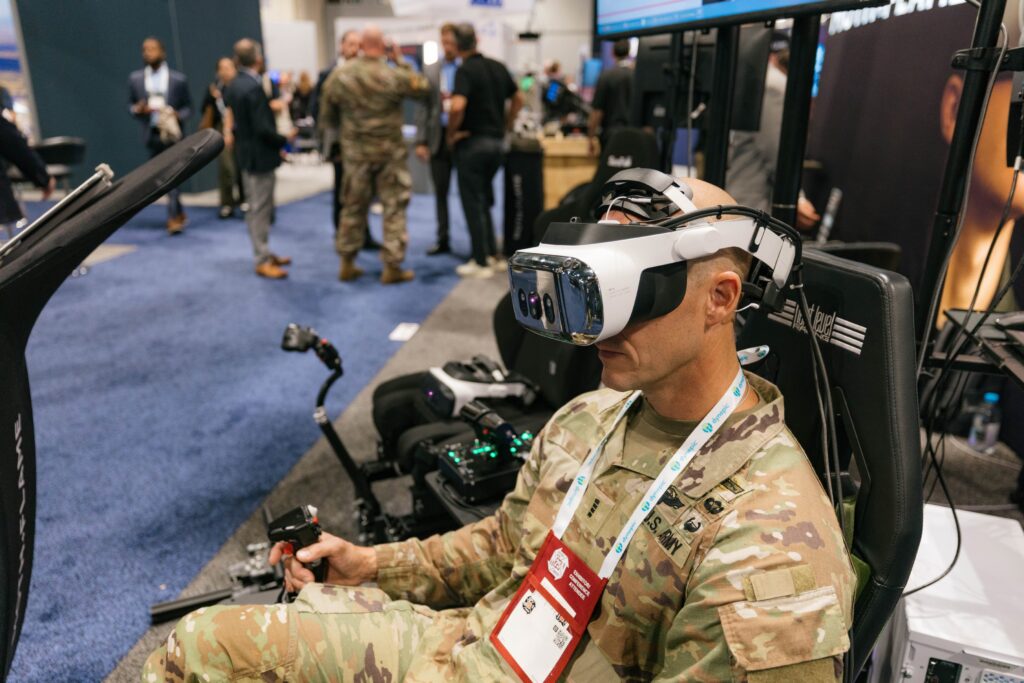
The 3WAVES headset attaches to virtual reality goggles, said J. David Remer, the company’s head of engineering. It has two electrodes that sit behind the wearer’s ears and one on their forehead. Software algorithms match the electrical currents coming through the electrodes to the visuals.
Remer said the company plans to release a version of the headset in early 2027 that’s been updated to meet the Pentagon’s standards and to offer more advanced hardware circuitry.
Jeff Parker, 3WAVES CEO, said the company is also preparing to ramp up production next year from dozens of headsets to hundreds and “on upwards.”
The Air Force Research Laboratory, which awarded 3WAVES a contract in 2025 following an AFWERX challenge, is now using the company’s headsets for other GVS testing.
Evaluation time at AFRL
So far, much of the research on GVS has focused on its potential for mitigating spatial disorientation. Stephen McGee said his team at AFRL is taking a different approach. Their study will try to answer the question: “Does this [GVS] improve learning and training and readiness outcomes?”
There are two mechanisms by which GVS could contribute to improved performance: making the simulation more effective by making it more immersive, and allowing trainees to stay in flight simulations longer by mitigating cybersickness.
Publicly released data on the rate of cybersickness among military pilots is scant; anecdotally, McGee said, “it is something that I constantly hear.”
Pilots might even be more susceptible than the general population, he added. Further research is needed, but the current theory is that because pilots have actual flight experience, “they know what they should be feeling [in simulations] and they’re not feeling that, so it’s a stronger disconnect between their sensory systems.”
Over the next several weeks, study participants near AFRL’s facilities in Ohio are to don virtual reality goggles and complete a flight simulation twice, once with a 3WAVES’ GVS headset and once without. The simulation “increases in difficulty” as it goes on, McGee said, to allow researchers to compare participant performance across the two versions.
The study will include pilots and non-pilots as participants, McGee said, to allow researchers to compare the effectiveness of GVS across the two groups.
“Come December,” McGee said, “we should be able to start analyzing some of this data.”
3WAVES’ Parker and Remer argue that even modest GVS benefits can accrue exponentially as the Pentagon leans more heavily on simulator training to practice advanced flight tactics, coordinate large force exercises and prepare additional operators of first-person-view drones.
To McGee, the future of any GVS technology “depends on what the data tells us.” Does it only decrease sickness for trainees? Or does it both decrease sickness and increase performance?
If GVS lives up to its potential, “this type of work has legs for the future of all type of XR [extended reality] training,” he added. “I see this as just taking off.”