


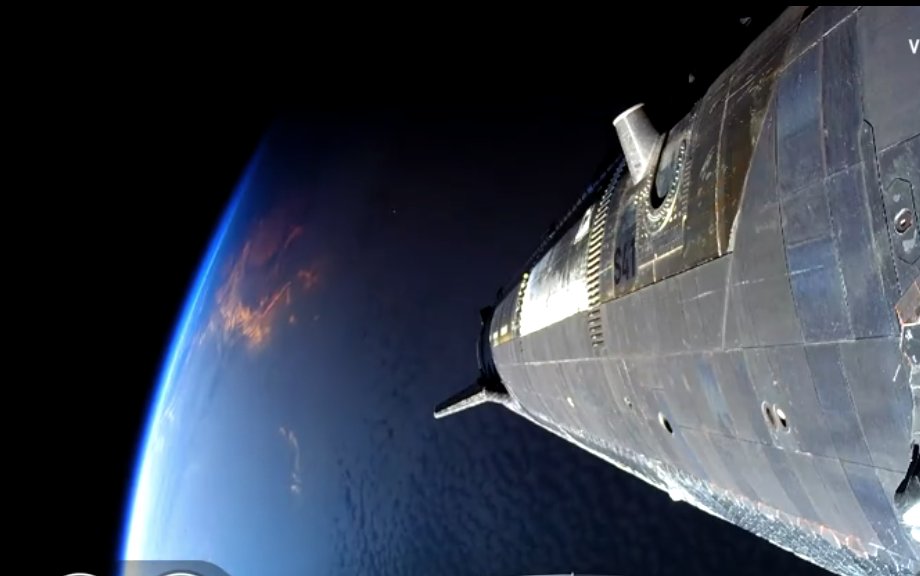
SpaceX’s behemoth Starship rocket splashed down Monday at 10:58 a.m. Central near Hawaii, capping the design’s first time orbiting Earth and its longest flight to date.
The roughly 3-hour flight commenced at 7:48 a.m. Central from the company’s Starbase facility in Texas. The Super Heavy booster splashed down in the Gulf of Mexico 7 minutes later, while the ship continued to orbit, releasing the first batch of V3 Starlink satellites that are to join the operational constellation.
Flight 14 marked a “pretty cool milestone,” Dan Huot, SpaceX communications manager, said during the company’s livestream. “Starship’s first orbital flight, the first of many.”
SpaceX originally planned for the flight to last 10 hours, but abandoned that timeline after a Raptor Vacuum engine on the upper stage, or ship, cut out earlier than intended after launch. Mission controllers briefly considered putting the ship on a suborbital trajectory, but ultimately decided to go to orbit and release the Starlinks.
That decision was made after technicians looked “at all indicators of health on those remaining engines,” Huot said, “particularly the three center sea-level engines that we need for the orbital insertion burn and for the deorbit burn.”
Since 2023, SpaceX has conducted 13 suborbital flights of integrated Starships to “maximize public safety while allowing for maximum learning” about the new design, the company said in the Flight 14 mission description. Along with reaching orbit and deploying the Starlink satellites, the flight’s primary objectives included a deorbit burn of the ship using a single Raptor engine while in space, and a controlled reentry, descent and splashdown in the Pacific Ocean.
Until now, such flights lasted no more than 65 minutes. Today’s orbital flight means “the next phase of developing Starship to be fully and rapidly reusable can begin,” SpaceX said.
SpaceX’s published flight plan was to travel about 275 kilometers above Earth, and the altitude icon on the livestream indicated the ship achieved that.
The deployment of the 26 Starlinks was also “wildly successful,” Huot said, and he confirmed the satellites were transmitting as planned.
SpaceX has $2.9 billion in NASA contracts to supply Starship lunar lander variants to land astronauts on the moon starting in 2028. Internally, the rocket is central to the company’s plans to continue growing its Starlink broadband constellation. The V3 satellites have “10x the capacity compared to a single launch of V2 mini Starlink satellites on Falcon 9,” the company said.
Three of the satellites have cameras “to scan Starship’s heatshield” so engineers can assess potential improvements for future missions — particularly tiles with new designs, such as new attachments, SpaceX said. Also of interest is assessing areas of the rocket equipped with curved tiles “to reduce heating in gaps between tiles,” the mission description read.