


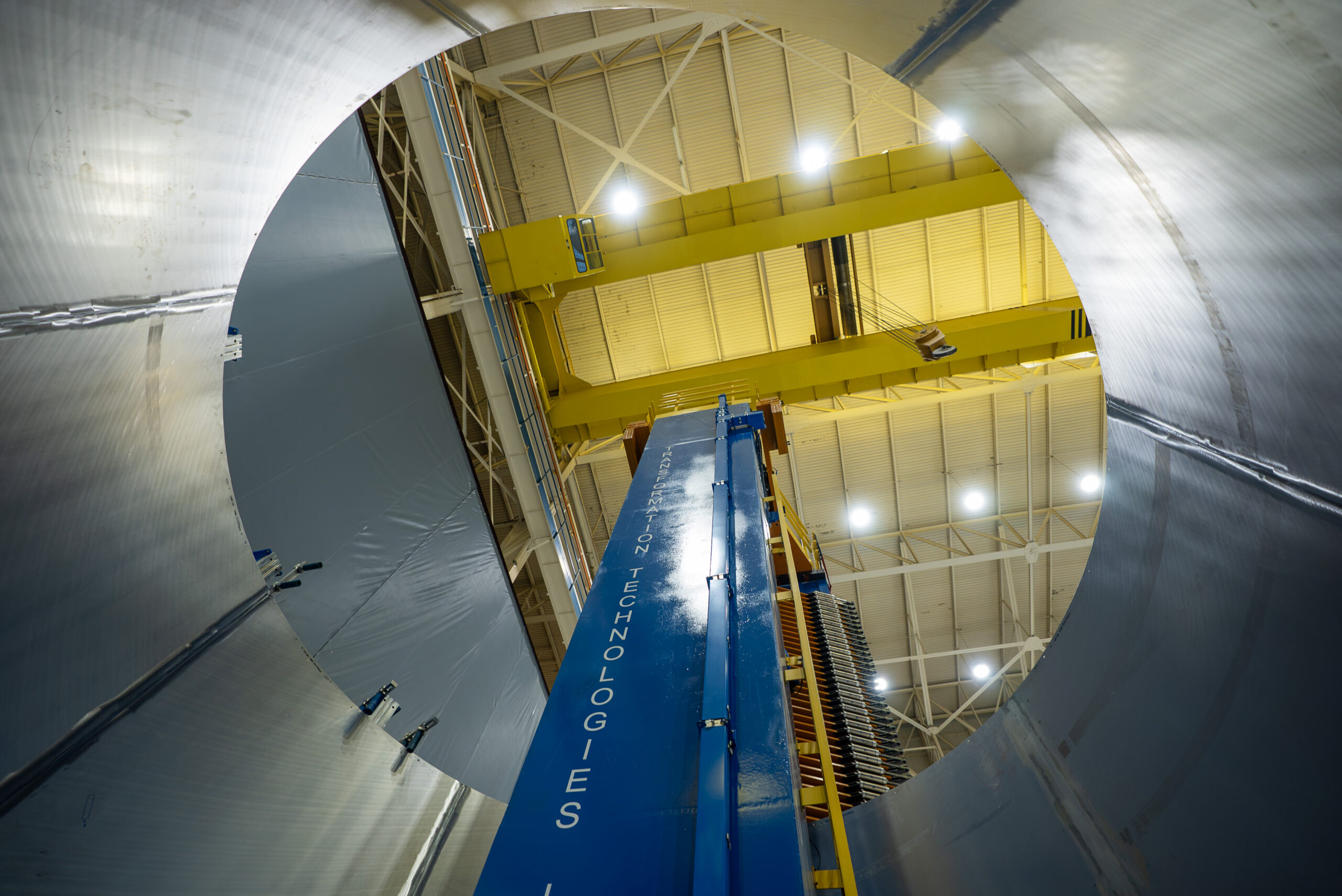
NASA MARSHALL SPACE FLIGHT CENTER, HUNTSVILLE, Ala. — Inside a multistory warehouse-like room, a large metal tube rotates on an oversized turntable. A nearby machine cuts into it, leaving a trail of silver chips and metallic smell. A few feet away, a group of engineers monitors the progress at a bank of computers: roughly 13 centimeters a minute, slower at the joins. Four rounds to complete the cut.
If all goes as planned, this spacer will ride to orbit next year as the upper stage of the Space Launch System rocket for Artemis III.
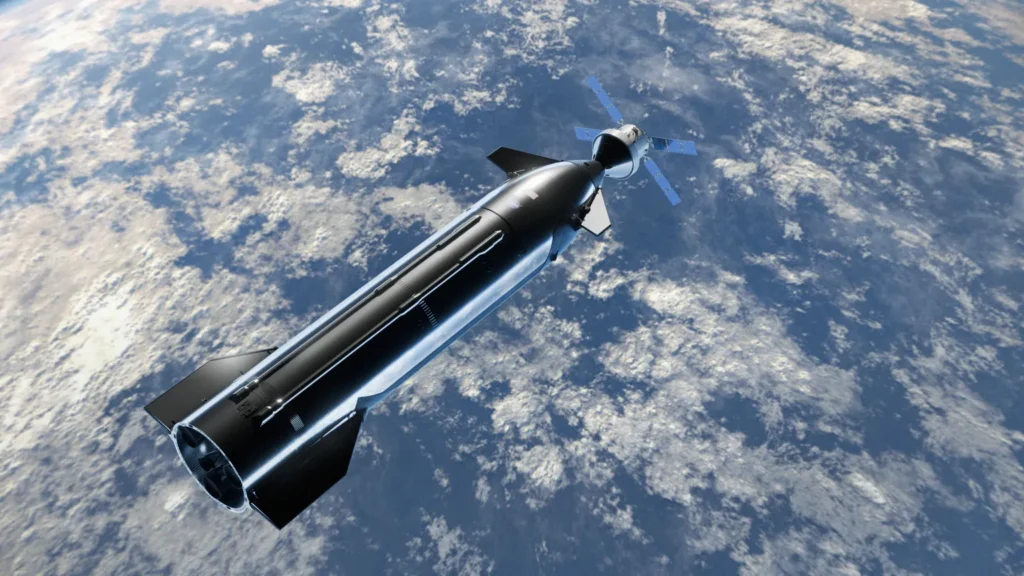
This trimming marks the latest step in development work prompted by NASA’s February decision to convert Artemis III from the program’s inaugural lunar landing to a demonstration in low-Earth orbit, in which an SLS will launch four astronauts in an Orion capsule to practice rendezvousing and docking with test articles of Blue Origin’s Blue Moon and SpaceX’s Starship landers.
The extra mission has prompted engineers to get creative.
“We’ve managed to come up with some flight hardware in a very short amount of time,” Brent Gaddes, the adapter and spacer lead at NASA Marshall, told me during an Aug. 13 visit.
The new plan for Artemis III does not require the additional thrust of the usual SLS upper stage, the Interim Cryogenic Propulsion Stage (ICPS) designed to send Orion on a trajectory to lunar orbit. So, in April, NASA decided to swap in the spacer and reserve the final ICPS for Artemis IV, to increase the odds of keeping that lunar landing on schedule for 2028. In parallel, the agency is working to standardize the SLS design, foregoing a long-planned upgrade with a bespoke upper stage in favor of adapting an existing commercial design.
With Artemis III’s 2027 launch target fast approaching, preparations for that flight and future missions are well underway at NASA Marshall, which oversees SLS and development of the Human Landing Systems.
A ‘hodgepodge’ rocket for Artemis III
Much of Marshall’s current SLS work involves repurposing old hardware and test articles to keep Artemis III on schedule. As a result, “we do have this kind of hodgepodge” rocket, said John Blevins, NASA’s chief engineer for SLS.
For the spacer, NASA chose a “barrel” shape “with two flanges to mimic the barrel of the ICPS,” said Patrick Hull, the engineering lead for the center’s Spacecraft/Payload Integration and Evolution Office. The “outer mold line” and “interfaces will remain the same.”
To avoid waiting on new materials, “we found old material — 30-year-old material — and studied it, inspected it, measured it and cleaned it up,” he said. “What we’re using is left over from ET, external tank, of shuttle. Then we went out into the boneyard, which is across the street, and found a ring forging that was left over from the Ares program.”
He added: “We started this work in April, and here we are in August. We have a barrel built. We have rings built, and we are aiming for a December completion date. This will be a total of an eight-month build for flight hardware.”
In conjunction with the upper stage change, engineers are running launch simulations in the center’s SLS Systems Integration Lab, combining mockup hardware with actual flight software. Standing next to the facility’s massive semicircular rack that’s roughly the width of the rocket’s core stage, Dustin Baker and Ariel Kramer, the facility’s testing lead and lab manager, respectively, noted how it’s equipped with representative avionics and flight computers — though the whole arrangement is technically an upside down SLS to make these systems more reachable for engineers.
“The testing that we’re going to focus on is the changes from Artemis II,” Baker said. “There are very few of those, and they’re all centered on the spacer configuration.”
“We’ve already done the development testing and the dry runs,” he added, and “formal verification testing” is slated to begin in October.
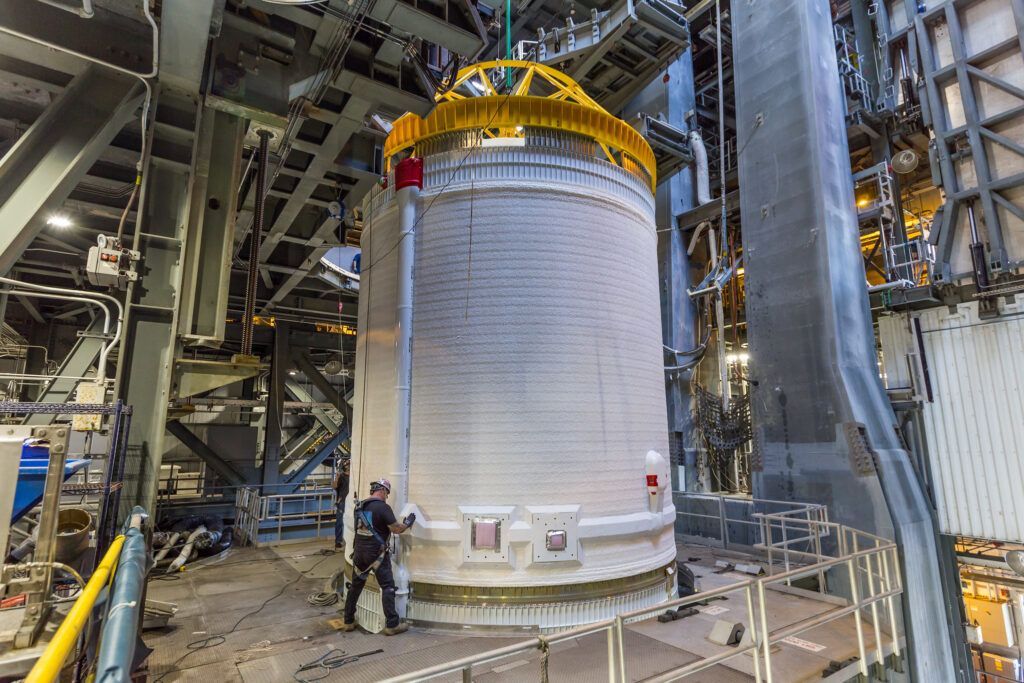
For the adapters needed to mate the spacer with the core stage below and Orion above, Marshall is repurposing structural test articles that were built and tested before Artemis I in 2022, Blevins said. This allows the already-built flight versions of the Orion Stage Adapter and Launch Vehicle Stage Adapter, which were designed to connect to ICPS, to be saved for Artemis IV.
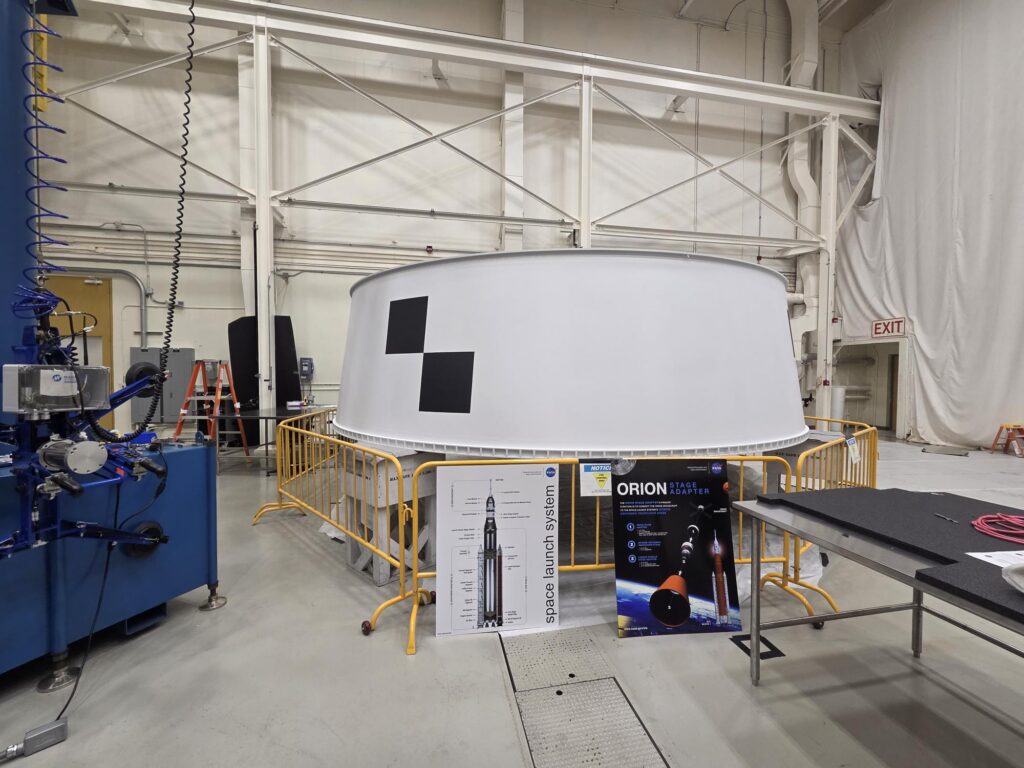
For the LVSA test article, “we never really expected to use that,” Blevins said, but “we let it earn its way in” for Artemis III and made the decision to include it “literally just weeks ago.”
Comparatively, the OSA test article was “more overbuilt,” he said, so “we were pretty confident from the get-go” on repurposing it.
On site, Gaddes showed me the cleanroom where the OSA had been “till a couple weeks ago,” he said, “but we just moved it across the street to the paint shop, where they’re getting ready to paint the outside.”
The OSA test article also includes yet another repurposed component for its diaphragm, the bowl-shaped layer that goes inside the adapter to protect Orion.
“We had materials left over from Block 1B,” Gaddes said, referring to the canceled SLS upgrade that was to include a brand-new Exploration Upper Stage. “We had all that composite material sitting in the freezer with a finite shelf life,” so Marshall engineers used it for a new diaphragm and “just finished machining all the holes into it, so it can be bolted into that structural test article.”
Despite this unique hardware mix, “if you’re a ways away, the rocket’s going to look like Artemis I and Artemis II,” Hull said.
‘Choreographed dance’ of the landers
Blue Origin and SpaceX have previously ground-tested the docking systems for their respective lunar landers, but Artemis III will be the first time the designs operate on orbit.
Over the course of the roughly two-week mission, Orion is to first dock with a Blue Moon Mark 2 test article so “up to two crew members” can enter its cabin, NASA said in June and July news releases.
Plans then call for Orion to rendezvous and dock with Starship, but the astronauts will not enter it.
Kent Criswell, the lead systems engineer for the Human Landing Systems program, said he’s confident both landers are on track.
“For Blue, [the work is] to build their lunar crew module,” he said.
A Blue Origin spokesperson said the company’s latest work with NASA Marshall has focused on testing the BT-7 thrusters for the lander.
For SpaceX, Criswell said, “they’re going to pull one of those Starships off the [production] line, then they’re going to actually modify it with the docking adapter, so they’re on track.”
SpaceX did not respond to a request for comment, but NASA Administrator Jared Isaacman said earlier this month that the company has “already started cutting hardware for that test vehicle.”
The remaining milestones include “multiple design reviews,” Criswell added. “Probably the next really big meeting is discussing how [the companies’] testing is going to verify that [they’re] building the right thing to meet our requirements.”
During a mid-August press conference at Kennedy Space Center in Florida, Isaacman was similarly optimistic about lander development and the Artemis III timeline.
“What we are going to learn from that mission, the amount of risk we’re going to be able to bring down in advance of Artemis IV, will be significant,” he said.
Standardizing SLS
Isaacman has laid out a goal of increasing the SLS launch cadence to at least once a year, starting with Artemis III. To that end, NASA in March issued a contract to replace ICPS with the Centaur V upper stage built by United Launch Alliance for its Vulcan Centaur rockets. This new configuration is slated to debut on Artemis V, which NASA is targeting for late 2028.
Centaur V will “be able to send bigger payloads deeper than ICPS,” Blevins said, “but it is not as big and not as capable as the EUS design that was on paper.”
He added that Centaur V has two RL10 engines instead of ICPS’s one, and has “slightly” larger dimensions.
“We’re in the process now of designing new adapters to accommodate a Vulcan stage,” Gaddes said.
The Block 1B upgrade had planned for the SLS flight computers to be stored within EUS, but the agency now intends to leave them in the core stage, like in the original configuration.
“ICPS was always temporary,” Blevins said. “That’s not the intent for the Centaur, and so we’ll work more closely with the software developers in United Launch Alliance, as well as NASA, in order to provide some key things that are good for crew safety.”
A ULA spokesperson said, “we look forward to working through this and continuing our support.”
Wind tunnel testing of the Centaur V is “actually well underway” at NASA’s Ames Research Center, Blevins said. “This week [they’re] doing some of the most key testing” to figure out “how do you fly that that new stage correctly?”
“You could say the design is, essentially, strategically complete,” Blevins said, but he noted NASA will likely make some modifications based on the testing results.
He added: “The core stage is standardized and very much the same. So, honestly, I think we’re a long way toward that standardization. Certainly, the Centaur will be the final piece that helps achieve the mission standardization.”