The small changes to Dragonfly’s rotors that could make a big difference


One of the many firsts in planetary exploration that NASA will attempt with its Dragonfly mission is slated to occur before the spacecraft even reaches the surface of Titan.
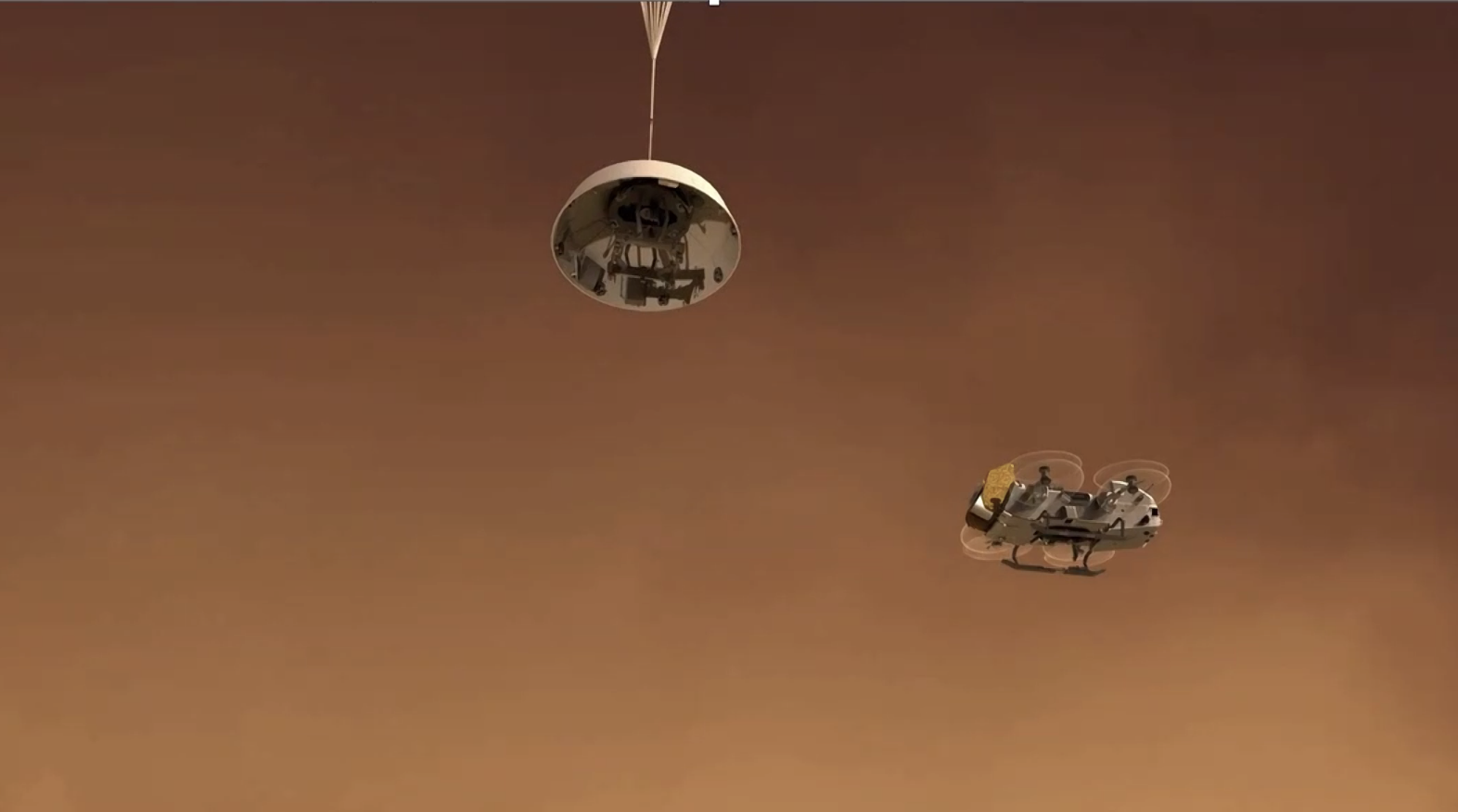
The plan for delivering the Mini Cooper-sized Dragonfly to the surface of this Saturnian moon is starkly different from most interplanetary probes. It won’t be lowered by a skycrane or have airbags cushioning the impact like a Mars rover. Instead, Dragonfly is to spin up its four dual rotors while still falling through Titan’s thick atmosphere, fly free of its protective aeroshell and touch down on the surface under its own power.
If all goes as planned, this maneuver — known as transition to powered flight, or TPF — will occur in 2034, at the end of Dragonfly’s seven-year transit to Titan. Once on the surface, the rotorcraft is to spend approximately three years flying from site to site, analyzing rocks and other features in a hunt for the potential building blocks of life.
To ensure Dragonfly survives its descent, NASA and Dragonfly’s lead contractor, Johns Hopkins Applied Physics Laboratory (APL) in Maryland, have twice redesigned the configuration of those rotors to increase the spacecraft’s stability.
Even though Titan has a relatively calm atmosphere, one of the biggest risks during descent is crosswinds, which could destabilize the flight by inducing side-to-side motion, or yaw, and spinning, said Mike Robbins, lead engineer for the Dragonfly Vertical Flight System at APL.
“If there’s a crosswind, the lander will have to be capable of adjusting to account for that wind, and hold the position steady relative to the ground,” Robbins said. “And if we haven’t built in sufficient stability, we could potentially lose control.”
NASA and APL believe they’ve redesigned the rotors to address this issue, but the reconfiguration remains in testing, said Seokkwan Yoon, NASA research scientist and acting assistant division chief of Computational Modeling & Simulation.
The design change increases “the yaw authority and helps the de-spin during the critical phase of midair release. We are still running more high-fidelity cases to increase our confidence before the 2028 launch though,” he said in an email.
After streaking through space at about 26,000 kilometers per hour, Dragonfly will reach Titan’s upper ionosphere, around 1,300 kilometers above the surface. At first, the spacecraft’s plunge through the thick orange atmosphere while encased in its aeroshell will unfold similarly to that of a spacecraft coming in for a landing on Mars or Earth. But the soupy, dense air will soon dramatically slow Dragonfly, kicking off a 100-minute drift under parachutes.
During descent under parachute, the heat shield will fall away, exposing the rotorcraft. Around a kilometer above the surface, Dragonfly will be extended on mechanical arms from beneath its backshell covering. At that point, the quadcopter’s rotors will spin up to a relatively slow speed. This rotor action is meant to cancel unwanted motion — either yawing or spinning of Dragonfly on its swivel connector, which is meant to allow the rotorcraft to remain relatively independent of the parachutes’ movements. Only then does Dragonfly detach completely on rotor power.
Because engineers can’t precisely reproduce Titan’s atmosphere and gravity on Earth, NASA has used atmospheric data from the Huygens probe that landed on Titan in 2005 — which was designed to parachute to the surface — to model and simulate how Dragonfly might function.
During early reviews of the rotorcraft’s design in 2023, APL and NASA saw a need for more lift, and therefore increased the blade count of each rotor from two to three, said Robbins and Ken Hibbard, APL mission systems engineer.
As often happens with spacecraft, this change led to a cascade of additional adjustments. The higher blade count meant the rotors could not be stowed as easily inside the aeroshell for launch and transit to Titan, so engineers made another tweak: shortening the mast on which the blades were mounted, bringing the rotors closer to Dragonfly’s body.
Modeling revealed that these changes altered the aerodynamic movement of air around the rotorcraft, Hibbard said. “Unfortunately, we were getting a suction effect between the rotor and the body wall that was adding yaw motion, so it was negatively affecting the yaw control of the vehicle.”
NASA and APL assessed tradeoffs and possible design tweaks that would counter the effect of the suction and bolster stability. They looked back on previous rotorcraft designs and methods to stabilize unwanted yaw motion.
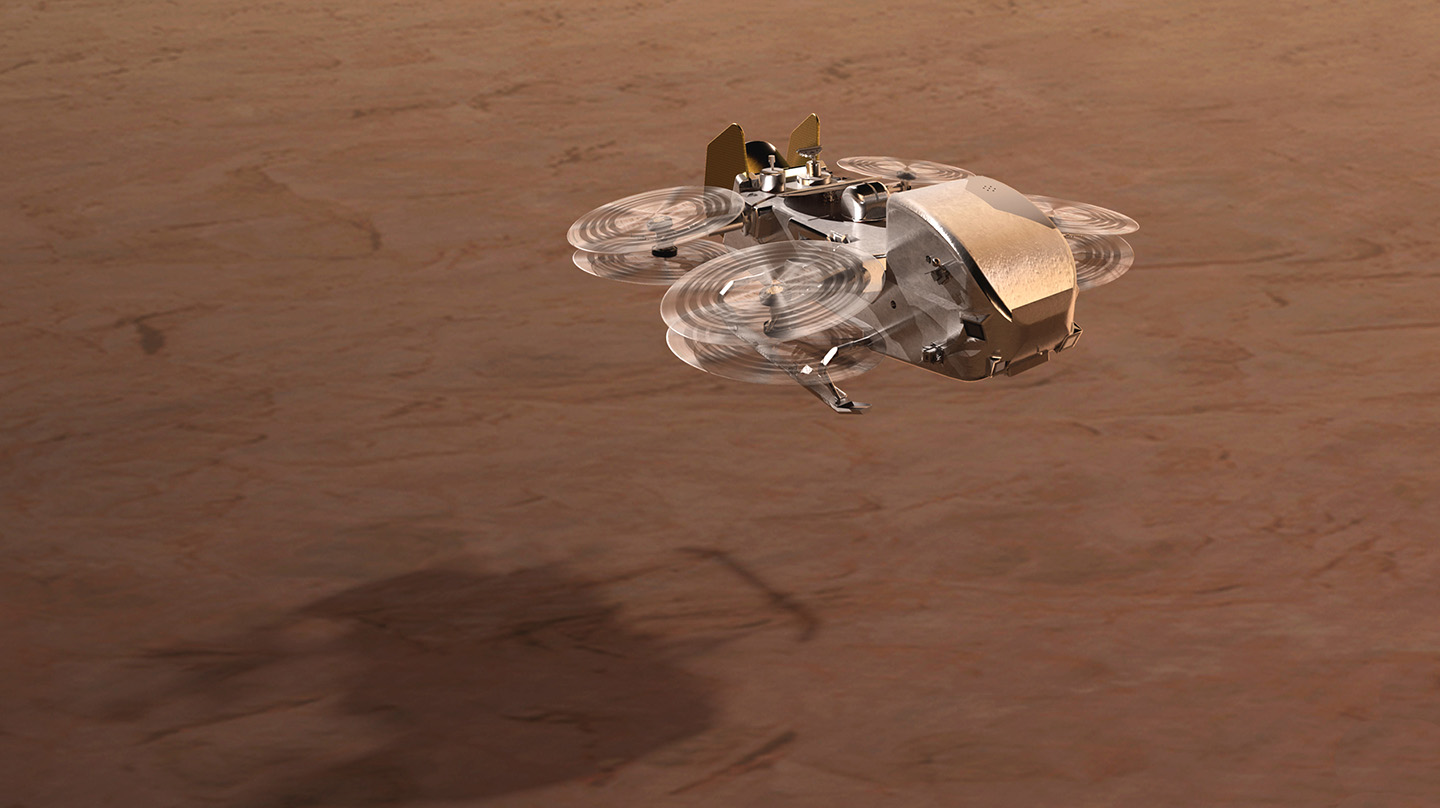
The engineers arrived at a visually striking change to Dragonfly, opting to tilt its four upper rotors away from its body.
“We knew of large racing drones where people have used oppositely canted rotors, and it gives them greater control in certain directions,” Hibbard said.
They incorporated that design change into their simulations and tested the new configuration in wind tunnels. “What we found is that by canting the upper rotor so that it’s no longer parallel, it reduced that suction wall effect,” Hibbard said, adding that the change also “gave us the necessary yaw control overall.”
APL researchers last year published a paper describing the solution: “The final configuration selected was an oppositely canted rotor orientation. While there were many factors across different attributes that went into the decision, the analysis was critical in showing that this design would improve the yaw control not only for the mission-critical Preparation for Powered Flight but throughout the flight envelope.”
The APL engineers informally refer to this change as VADR (Venturi Abating Diagonal Rotor), or simply Vader, because they thought the look of tilted rotors was reminiscent of the wings of Darth Vader’s TIE fighter spaceship.
With the rotors reconfigured, Dragonfly passed its critical design review in April 2025 and now is under construction at APL in Maryland.
The aeroshell and cruise-stage assemblies are coming together at Lockheed Martin Space in Littleton, Colorado, where system-level testing of all the flight hardware is also planned to commence next year.
The spacecraft is slated to return to APL in late 2027 for final environmental testing before heading to NASA’s Kennedy Space Center in Florida, where the full spacecraft will be stacked. If all goes as planned, Dragonfly will launch in July 2028 aboard a SpaceX Falcon Heavy.
But for now, rotor modeling and simulation continues. Based on those tests, the mechanics and aerodynamics of the transition to powered flight maneuver will have similarities to an aircraft on Earth recovering from a stall, Hibbard said. But ultimately, there’s no precedent or manual for how to fly on Titan.
“There are certain uncertainties about the environment, about the atmosphere, and how Dragonfly will behave. So, it’s been designed with the best knowledge we have, and we’ve added capability of the rotors to cancel out some of that, to account for the uncertainties when we get there,” he said.