
Roman telescope fueled in preparation for Aug. 30 launch, NASA says


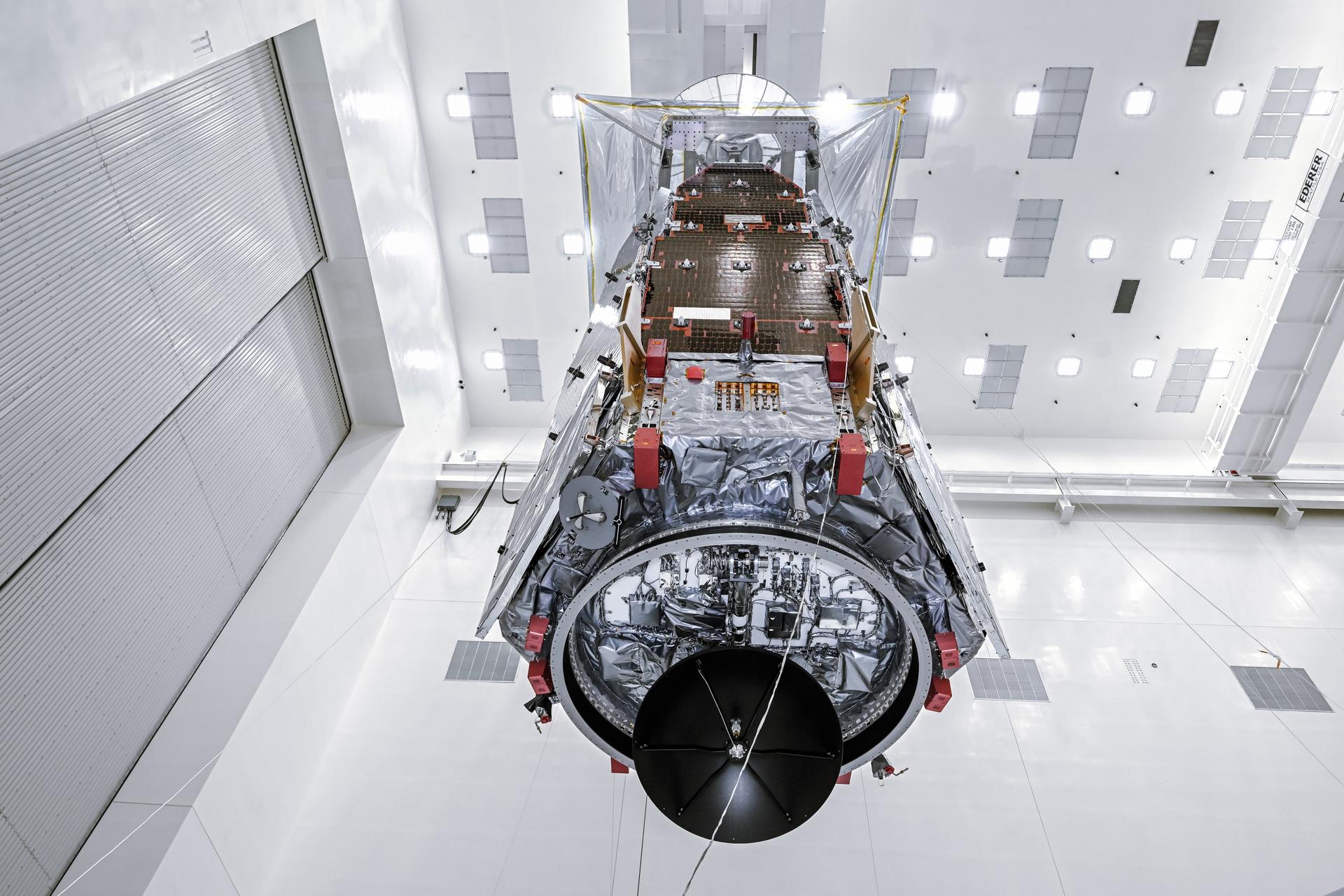
NASA’s next flagship observatory, the Nancy Grace Roman Space Telescope, is on track for launch Aug. 30 from the Kennedy Space Center in Florida, agency officials said in a press conference today.
Built at NASA’s Goddard Space Flight Center in Greenbelt, Maryland, the telescope was shipped to Florida in late June for launch preparations. NASA has set a total mission cost of $4.3 billion and estimated Roman can operate for at least 10 years depending on on-board propellant consumption.
In development since 2016, Roman was first named a top priority in the 2010 Astronomy and Astrophysics Decadal Survey. The telescope, originally known as the Wide-Field InfraRed Survey Telescope, was renamed in 2020 after NASA’s first chief of astronomy, Nancy Grace Roman.
The telescope is scheduled to lift off at 7:26 a.m. Eastern atop a SpaceX Falcon Heavy, only the 13th time the company has flown that variant since its debut in 2018.
“We’re about to get into combined operations with SpaceX, and so the focus over the next three weeks is basically getting us onto all the adapter rings and into the configuration we need to get mated to the rocket,” Jeremy Perkins, NASA’s Roman integration and test scientist, said during the press conference.
Roman is bound for an orbit around the Sun-Earth Lagrange Point 2 some 1.5 million kilometers from Earth, where it is to work in coordination with other deep space telescopes, including Hubble and James Webb. While those telescopes were designed to zero in and take high-resolution images of specific objects, Roman will have a much larger field of view: 100 times greater than Hubble and 50 times greater than Webb.
Due to that capability, Roman is expected to “conduct revolutionary surveys that will impact every area of astronomy,” said Julie McEnery, NASA’s Roman senior project scientist.
“Our universe puts on spectacular cosmic displays every second, but these events happen very quickly and often elude our telescopes,” she said. “With Romans’ panoramic vision, we will not only catch these events, but see several at once.”
In one month, McEnery said, Roman could survey “our own entire Milky Way, resulting in the detection of up to half the stars in our own galaxy.” Such a survey would take Hubble a century, she added.
In addition to these speedier surveys, Roman’s broader field is intended to allow for investigations of areas of dark energy and dark matter and possibly help answer questions about how fast the universe is expanding.
If the telescope’s measurement of dark matter significantly differs from our present understanding, “it might point towards a theory of modified gravity, or it might suggest that we need to alter our understanding of general relativity,” McEnery said. “It kind of depends on the specifics of what we actually find on whether it is staying broadly within the same family of cosmological models, and just adding a little bit more complexity, or we’re really blowing things out of the water and rethinking from the beginning.”
The telescope also carries an experimental coronagraph with which scientists plan to conduct the first direct imaging of Jupiter-sized worlds. The coronagraph combines physical masks, specialized prisms and shape-shifting deformable mirrors to block starlight from the exoplanets’ host stars.
After launch, Roman faces a 90-day setup and commissioning process, shorter than the six-month process for the much larger Webb. For example, Roman’s visor-like sunshade, the Deployable Aperture Cover, will unfold via three springing booms.
After commissioning, Roman is expected to send about a terabyte of data per day back to Earth, far more than Hubble or Webb. Along with providing answers about the universe, Perkins said, this information will likely prompt additional questions.
“The dataset that Roman is going to produce is something that will not just benefit the science that we are thinking about now, but they’re going to be a benefit to the students in five, 10 and even 20 years,” he said. “Folks are going to be looking through this data for answers that they can find with Roman data, for questions they just don’t even know about today, that we haven’t planned to use the observatory for.”