


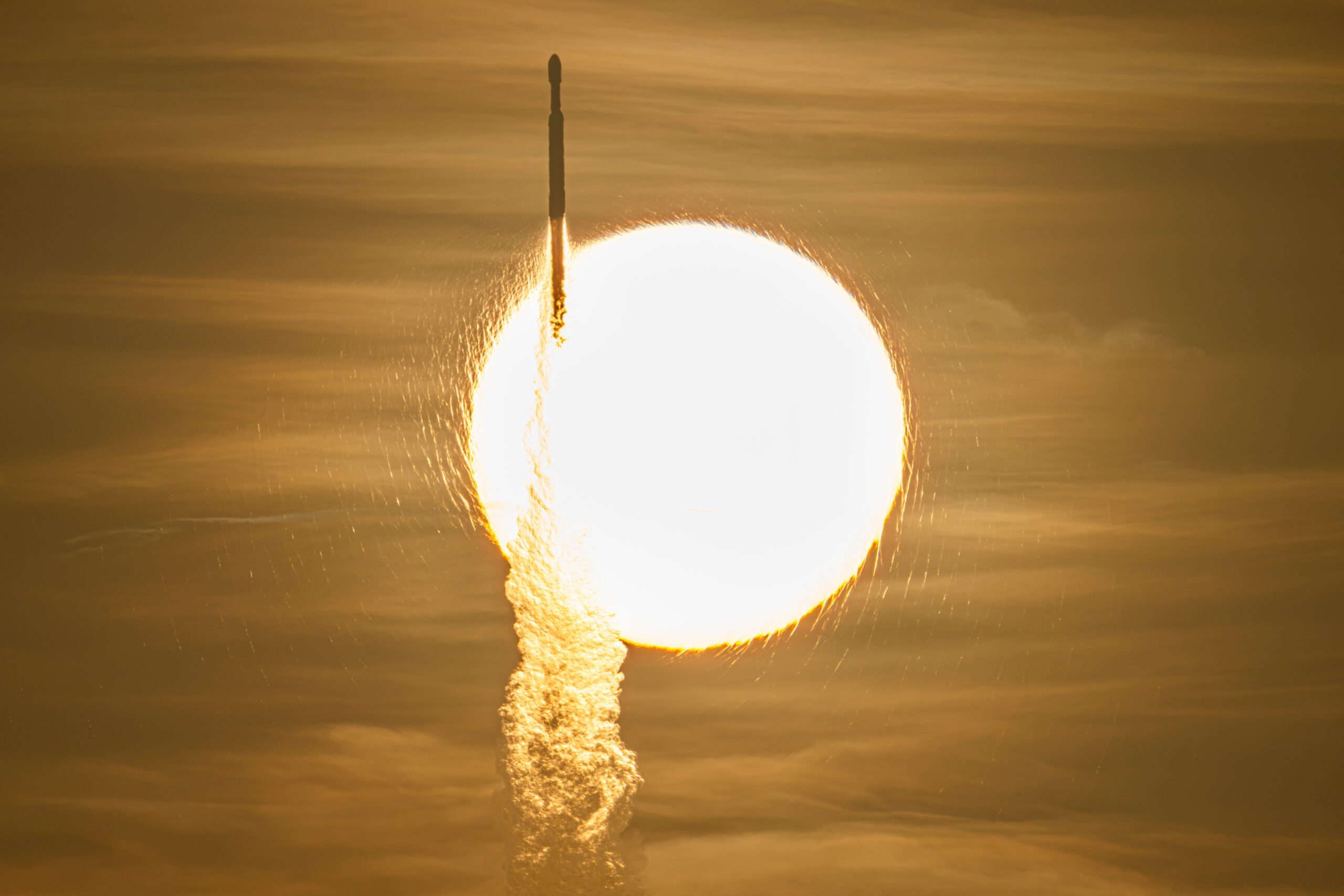
KENNEDY SPACE CENTER, Fla. — The Nancy Grace Roman Space Telescope today began its three-month journey to deep space, the next step in NASA’s plan to image scores of new exoplanets and gather fresh information on the cosmic mysteries of dark energy and dark matter.
A SpaceX Falcon Heavy rocket lifted off at 7:26 a.m. Eastern, illuminated by the rising sun over the Atlantic Ocean. About half an hour later, Roman separated from the rocket’s upper stage and began traveling toward its intended orbit around the Sun-Earth Lagrange Point 2.
During the 1.5 million-kilometer journey to L2, NASA mission controllers will command the telescope through commissioning to start up and calibrate the onboard instruments.
Roman is poised to “revolutionize our understanding of the universe,” a launch commentator said during NASA’s broadcast.
If all goes as planned, Roman is to work in coordination with NASA’s Hubble and James Webb Space Telescopes. Whereas those observatories were designed to take in-depth, high-resolution images of specific cosmic features, Roman is to quickly survey large swaths of the sky with its extremely wide field of view — 100 times more expansive than Hubble’s and 50 times greater than Webb’s.
NASA has set a total mission cost of $4.3 billion and plans to operate Roman for at least a decade, depending on on-board propellant consumption.
At a glance, the semi-trailer-sized observatory resembles Hubble, with its cylindrical trunk that houses the various mirrors that will collect and focus photons from distant stars and galaxies, and its primary instrument, the Wide Field Instrument (WFI) infrared camera. Roman’s 2.4-meter-diameter primary mirror is the same size as Hubble’s, but the distance between its primary and secondary mirrors is much shorter to achieve the wider field of view.
Photons entering the telescope will be bounced off the mirrors and directed to the Focal Plane System, which consists of multiple sensors and 18 high-resolution detectors fixed to a mosaic plate that can be repositioned during operations as needed.
The plate and motors that control it were locked into a fixed position for launch, to brace the instruments for the vibrations of the Falcon Heavy, said NASA’s Jeff Kruk, Roman’s deputy senior project scientist, in response to emailed questions.
“After launch the mechanisms are moved to their nominal in-focus position and then adjusted later as-needed” during calibration and aiming, he said.
NASA’s Goddard Space Flight Center built the WFI’s focal plane assembly and calibration system, while BAE Systems built the remainder of the instrument at its Colorado facilities, including the “element wheel which precisely articulates eight optical filters as well as a prism and grism,” meaning prism with a grate to diffract light, BAE said in response to emailed questions.
BAE also developed “the mechanical, structural, electrical and thermal systems that allow the WFI to be as stable as possible and keep the very large detector array cooled,” the company said.
“The focal plane needs to stay stable to within two microns,” BAE added in its response. “This is about the size of a bacteria and a one-third of the size of a red blood cell. Hubble’s focus can change by more than 25 microns over an orbit, making Roman at least 10 times more stable, in this one respect.”
To ensure heat doesn’t interfere with observations, BAE designed the WFI’s thermal management system to keep the hardware around the focal plane below minus 143 degrees Celsius. Webb’s instruments, by comparison, operate as low as minus 266 C.
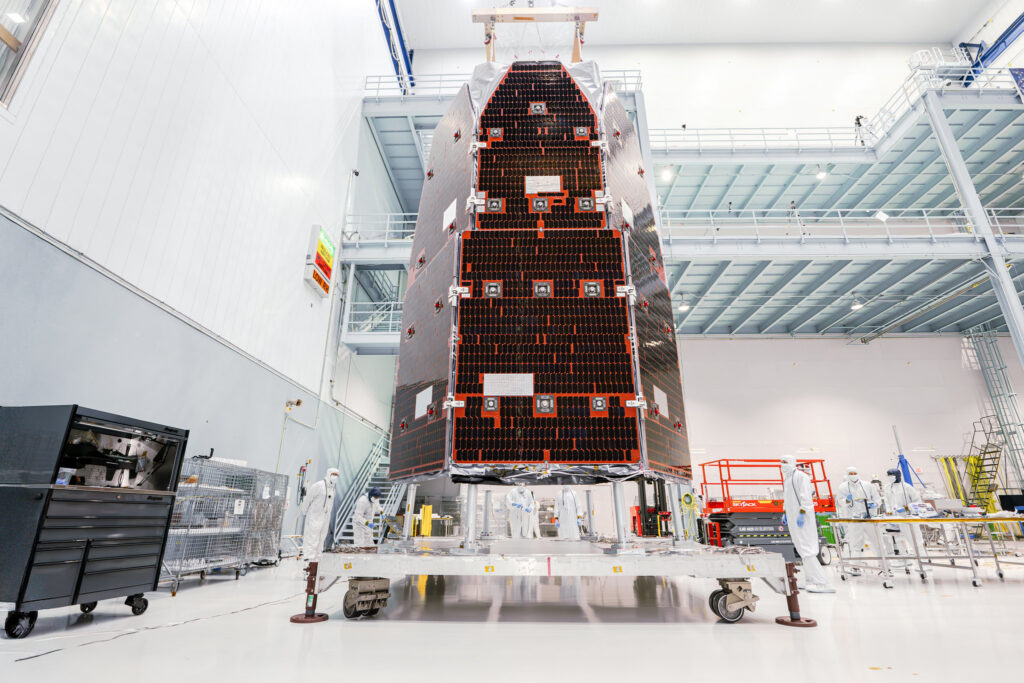
Ensuring the WFI is properly calibrated will be a priority during commissioning. To do so, NASA plans to point Roman at known star fields so its images can be compared to previous ones taken by Hubble and other telescopes. Features of interest include the Large Magellanic Cloud dwarf galaxy, “due to its density of stars in the optimal brightness range” among other attributes, and the star cluster NGC 6811 in the constellation Cygnus, according to a 2025 paper by Roman researchers.
Once operational, Roman is slated to send roughly 1.4 terabytes of compressed science data down to Earth every day, exceeding Hubble’s daily volume of about 3 gigabytes and Webb’s of 50-60 gigabytes.
“Roman’s total downlinked data volume is unprecedented for a space-based astrophysics mission,” Kruk said. “This necessitated new developments in detector readout electronics and data storage as well as in the radio-frequency system for actually transmitting the data from a million miles away.”
Chief among the telescope’s science objectives is to count or survey the number of exoplanets in the Milky Way, partly by gravitational microlensing. In this technique, the WFI would detect how the light of stars or galaxies is bent by the gravity of another object — such as a star, planet or black hole — passing in front of the background object.
It’s not necessarily the wide field of view that is valuable to that particular survey, but rather Roman’s ability to quickly scan vast areas at a high resolution, said Scott Gaudi, professor of astronomy at Ohio State University and the primary investigator of the Roman Galactic Exoplanet Survey Project Infrastructure Team.
“We can look at 100 million stars every 12 minutes, so that means what was previously considered rare phenomena become common, and that is the true power of Roman for the exoplanet survey,” Gaudi said in an interview.
He added: “I’m most interested in the microlensing events, because they do not repeat. They happen once and if you miss it, it’s gone. And so you have to characterize it when you’re seeing it. In other words, you have to get it right the first time.”