NASA targeting September to launch Nancy Grace Roman Space Telescope
 By Jon Kelvey
 By Jon Kelvey
GREENBELT, Md — Against a backdrop of windows looking down on the largest clean room at NASA’s Goddard Space Flight Center, Administrator Jared Isaacman and other NASA leaders announced on Tuesday that the agency’s next flagship mission, the Nancy Grace Roman Space Telescope, is on track to launch eight months ahead of schedule and under budget.
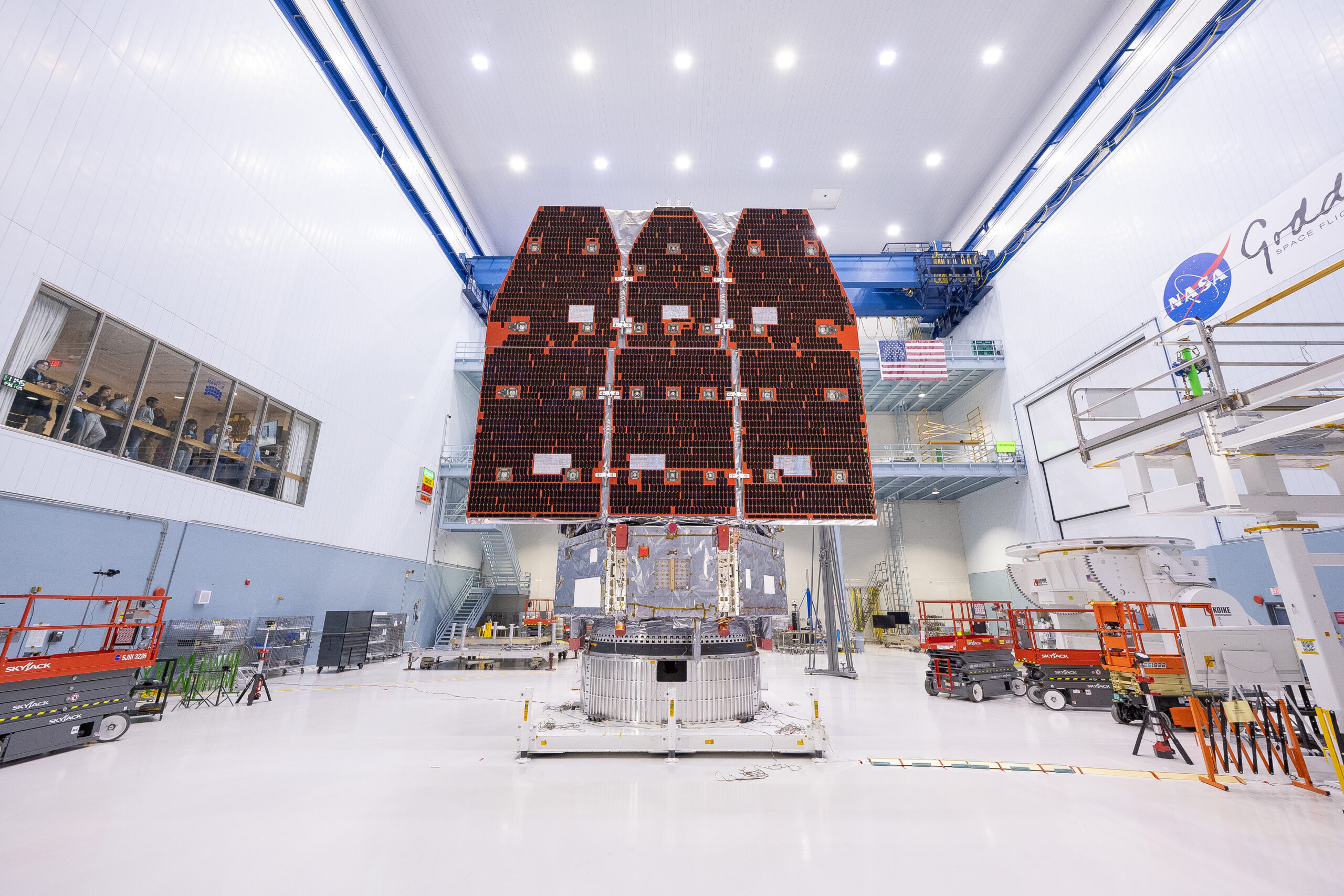
The fully integrated spacecraft — a tractor-trailer-sized obelisk standing on end and bathed in purple light in the eight-story clean room — is to be sent to NASA’s Kennedy Space Center in two months, setting up an early September launch aboard a SpaceX Falcon Heavy. NASA had been working toward a formal launch readiness date of no later than May 2027.
”Roman’s accelerated development is a true success story of what we can achieve in public investment, institutional expertise and private enterprise coming together to take on the nearimpossible missions,” Isaacman told reporters gathered here for a media event.
Roman’s science objectives include studying the large-scale structure and evolution of the cosmos, probing the nature of dark matter and dark energy, and conducting surveys of billions of new stars and thousands of exoplanets. Designed with a wide field of view, the telescope is to utilize its 2.4-meter primary mirror and Wide Field Instrument to scan the sky 1,000 times faster than the Hubble Space Telescope.
“One month of Roman observations would correspond to a century of Hubble,” said Julie McHenry, senior project scientist. She added that to display the resulting composite image of the sky from Roman’s first year would require a screen the size of El Capitan in Yosemite National Park.
Roman will also carry a coronagraph, which will rely on adaptive optics to block out the light of distant stars and, if all goes as planned, take images of orbiting exoplanets around the size of Jupiter. The first space-based instrument of its kind, the coronagraph is a technology demonstration meant to help inform the design of NASA’s next flagship telescope, the Habitable Worlds Observatory.
That telescope is currently planned to launch in the 2040s ”so it’s important to us that we get this coronagraph into space and get that first milestone towards the next mission,” said Nicola Fox, associate administrator of the Science Mission Directorate.
NASA plans to ship Roman to Florida in June for integration with a SpaceX Falcon Heavy rocket. After launch from Launch Complex 39B, the telescope is to spend a month traveling to the Sun-Earth Lagrange point two, the same stable orbit 1.5 million kilometers behind our planet relative to the sun around which the James Webb Space Telescope operates.
It will take between two weeks and two months to deploy and activate all of Roman’s systems and see the first starlight enter the telescope, according to Program Executive Lucas Paganini, followed by another month of calibrating instrumentation before operations begin.
“We’re going to have the first images by the end of this year, if everything goes as expected,” he said.
Roman has faced various budget and development challenges since the program was announced in 2016, including COVID-19-related delays that in 2021 prompted NASA to raise the program’s estimated cost from $3.9 billion to $4.3 billion. And last April, the White House’s fiscal 2026 budget recommended canceling the program, despite the telescope being largely built. Congress rejected that proposal, allocating $300 million for Roman.
On Tuesday, Isaacman praised Project Manager Jamie Dunn’s leadership in bringing Roman to the finish line without further cost overruns, and said NASA will be studying what lessons it can carry into the future.
“We talk about debriefs a lot when we get things wrong,” he said. “But when we get things right and have success stories like Nancy Grace Roman, let’s learn from some of the magic that created that outcome to try and apply it to other programs.”