House Science Committee members vow to reject NASA budget cuts


U.S. lawmakers on Wednesday criticized the Trump administration’s proposal to cut NASA spending by 23% in fiscal 2027, with one member declaring the plan “dead on arrival.”
The proposal is largely identical to the fiscal 2026 request that sought to fund NASA at $18.6 billion, which included a nearly 50% cut to the agency’s science programs. Almost none of those cuts were included in the $24.4 billion budget for NASA that Congress approved in January.
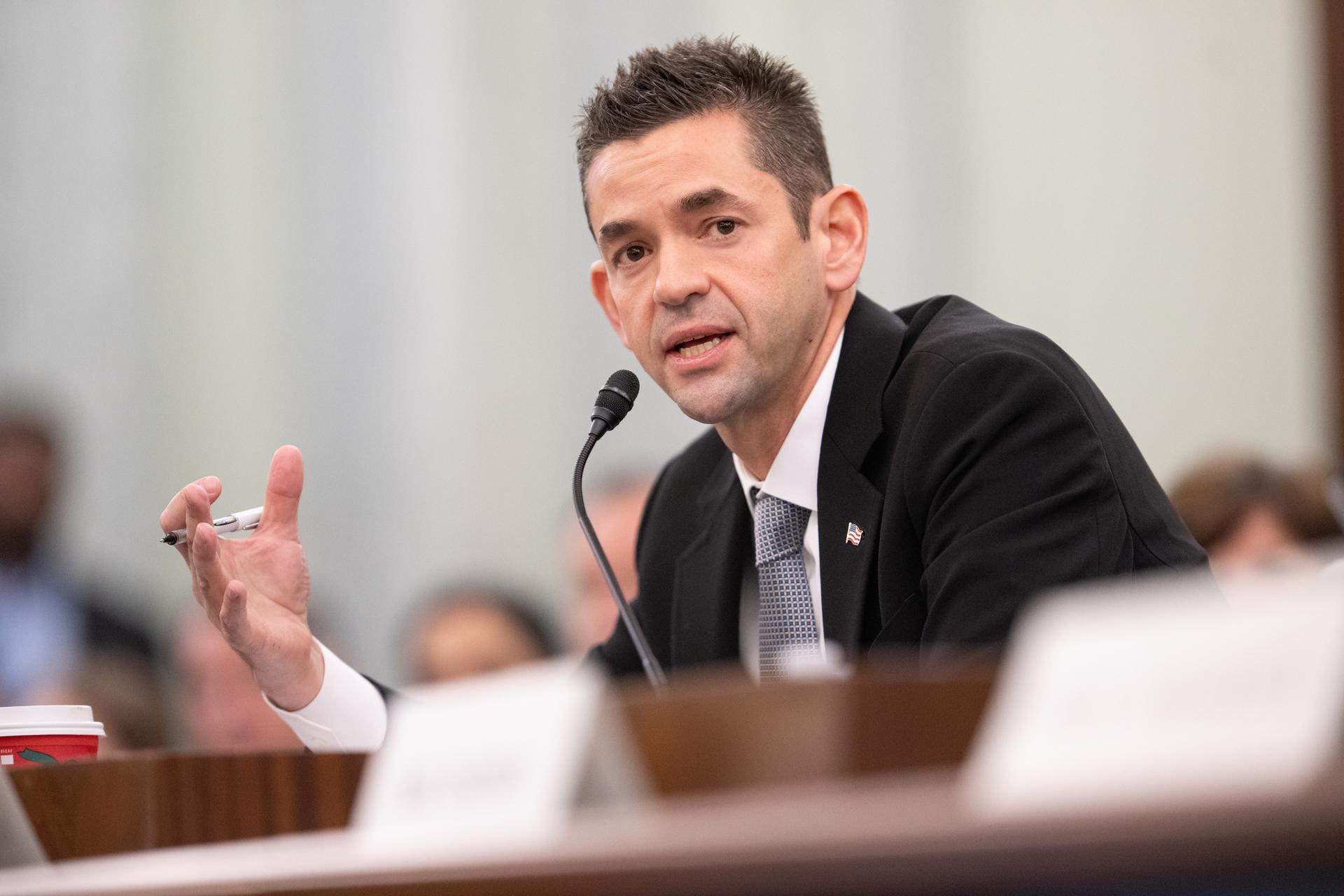
“Many of the proposed budget cuts were rejected by Congress previously, and I am confident that they’re going to be rejected again,” said Rep. Brian Babin (R-Tex.), chairman of the House Committee on Science, Space, and Technology, at a Wednesday hearing, for which NASA Administrator Jared Isaacman was the sole witness.
Babin added that it’s critical to address government deficits, but “we must be smart in how we do so, and shortchanging NASA is simply not smart.”
Rep. George Whitesides (D-Calif.) called the request “dead on arrival.”
“I have spoken to members on both sides of the aisle, and many are surprised and even offended that after Congress rejected the draconian cuts to NASA proposed for FY26, the administration would ignore clear bipartisan congressional intent and propose similar cuts again,” he said.
During the roughly four-hour hearing, Isaacman fielded wide-ranging questions about the budget request and initiatives he’s unveiled since his confirmation in mid-December. Among them was the decision to cancel the Gateway, the planned lunar orbiting outpost, and redirect those funds toward the effort to establish a lunar surface base by 2030.
Asked about the rationale for the cancelation, Isaacman pointed to long delays partially attributed to hardware issues.
“The only two habitable volumes that were delivered, both were corroded, and that’s unfortunate, because it would have delayed — probably beyond 2030 — the application of Gateway,” he said.
The agency is also assessing a shift in its future low-Earth orbit operations, specifically how it transitions its research to privately owned and operated space stations after the International Space Station is retired. The agency once intended to fund multiple stations but last month announced plans to assess the feasibility of procuring a new ISS “core module” that companies could attach their modules to.
Asked by Rep. Matt Van Epps (R-Tenn.) about the strategy to support the proliferation of future commercial stations, Isaacman said their success partly hinges on identifying customers and funding sources beyond NASA.
“I’ve pounded the table for a long time on how imperative it is for us to unlock a true orbital economy, to fund the future we all want to see in space someday, because I don’t think we’ll have dozens of commercial space stations, space hotels and outposts, if it’s perpetually funded by taxpayers,” Isaacman said. “So in that respect, I wish industry the best in that pursuit, and we will do everything we can at NASA to help with subject matter expertise on material, with test facilities across the nation, so when their satellites get up there, they stay intact.”
Several members pressed Isaacman about the White House’s proposal to eliminate STEM education programs run by NASA. He said the STEM office is still open and running in the meantime, but emphasized that NASA’s primary mission is to inspire through exploration.
“Inspiration — and as a result, STEM engagement — is inherent in really everything we do,” he said. “When Artemis II launched a human space exploration initiative, the world paused and took notice.” He said he believes there “will be more kids dressing up as astronauts for Halloween” as a result, which in his view is one way of measuring the agency’s impact.
“So I think it is NASA focusing on and achieving our near impossible mission that sends that powerful message of inspiration across the world, that does inspire that next generation of pioneers,” Isaacman said.