NASA readies mission to reverse the Swift observatory’s skyfall
 By Adam Hadhazy
 By Adam Hadhazy
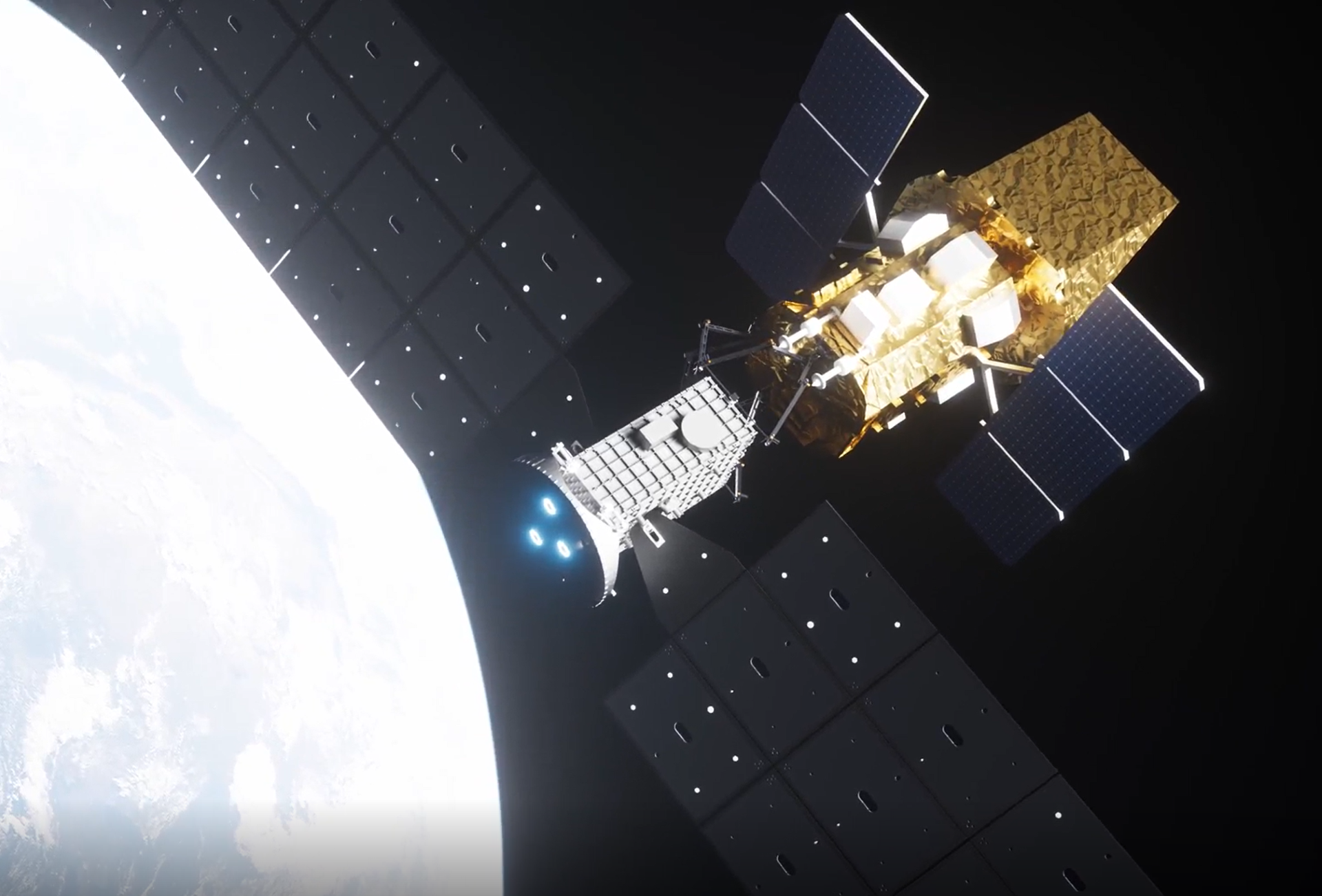
If left to its own devices, the Neil Gehrels Swift Observatory will succumb to atmospheric drag and make a fiery reentry within months. NASA is aiming to prevent that, targeting June for the launch of a robotic spacecraft that is to autonomously rendezvous, capture and then boost Swift to a safe altitude.
The mission is the first of its kind to corral an unprepared, unintended-for-service spacecraft and has come together quickly, with the $30 million contract to Arizona-based Katalyst Space Technologies awarded last September.
“We’re doing this on a time scale that’s kind of crazy by space standards,” said Brad Cenko, a research astrophysicist at NASA’s Goddard Space Flight Center and principal investigator for Swift, which was launched in 2004. “It’s a different risk posture than NASA is used to working with.”
The scientific community wants to salvage the $500 million observatory’s singular ability to detect and within minutes — hence its name — train its three telescopes on gamma-ray bursts, the universe’s most energetic electromagnetic explosions, along with other fleeting events.
“That’s the kind of capability that is unique in NASA’s astrophysics portfolio that we would like to keep going with this reboost mission,” Cenko said. “So when this opportunity came along, it was a tremendous relief.”
Initially placed about 600 kilometers up, Swift’s orbit has decayed slowly over the years, as expected. The outlook turned dire, however, in late 2024 and early 2025 when the sun became more active than predicted, blasting out high-energy ultraviolet light and particles that warmed and expanded Earth’s upper atmosphere, exerting extra drag that accelerated the observatory’s decay. Swift is now orbiting about 370 km above Earth.
To buy more time for the boost mission to come together, Swift’s team in February decided to suspend use of two of the onboard telescopes, whose pointing at targets adds to drag. And in April, the team shut down the Burst Alert Telescope, the key trigger instrument for detecting gamma-ray bursts, conserving power and enabling repositioning of Swift’s solar panels to further slash drag. Mission controllers believe these adjustments should keep Swift above 300 km — considered the lowest altitude for the boost mission to have a good chance of succeeding — until September, three months longer than the original trajectory would have allowed.
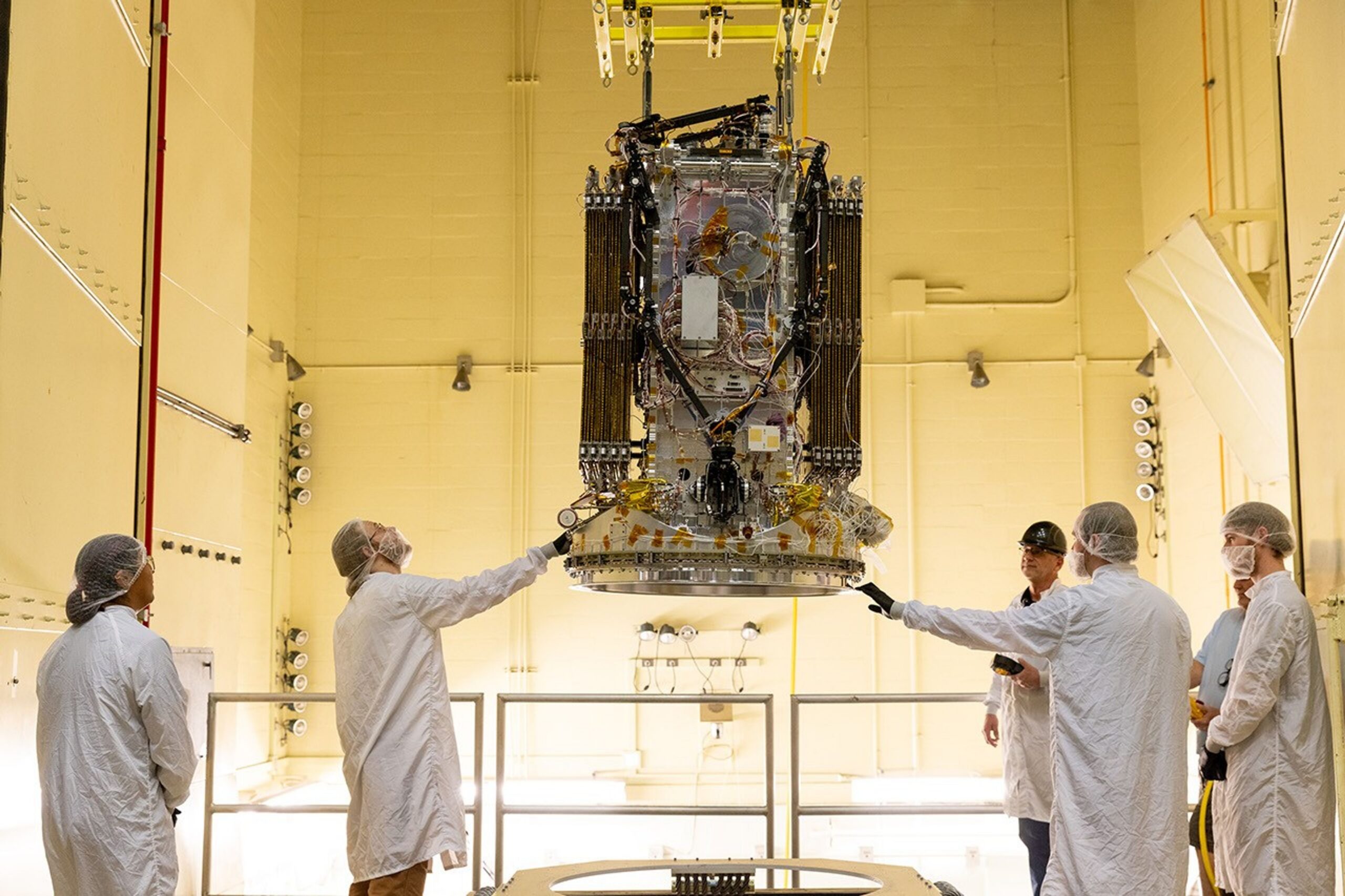
Katalyst plans to have the rescue spacecraft — nicknamed LINK, which is currently undergoing testing and integration — ready for launch as early as June 1 aboard a Pegasus, Northrop Grumman’s air-launched multistage rocket.
Built from scratch at Katalyst’s 2,300-square-meter manufacturing facility, LINK is largely based on prior architectures the company developed and tested over the past few years. LINK will be Katalyst’s first flight.
Weighing about 400 kilograms, the boxy spacecraft is about the size of a large mini-fridge, with a dual array of deployable solar panels. LINK has three robotic arms with grippers, each equipped with a small lidar for imaging to inform precision motor control.
How exactly LINK will get ahold of Swift is still to be determined. “Nobody took a picture of the backside of Swift before it launched,” said Katalyst CEO Ghonhee Lee, who founded the company in 2020. To best ascertain which structural, load-bearing flanges to grip, LINK will first do a flyby inspection, making sure there are not wiring harnesses, thermal blankets or deterioration of any sort standing in the way.
Once attached, LINK will fire its three hall thrusters to raise Swift’s altitude. When done, LINK will disconnect to avoid hampering the observatory’s delicate telescope-pointing maneuvers. At this point, LINK should have a bit of fuel left, Lee said, enabling more in-space testing or perhaps even docking with another object.
Lee said the company’s goal is to launch hundreds of robotic satellites in the coming years to service scientific, commercial and military space assets, which he described as “critical for the future of the space economy, as well as for U.S. space leadership.”
“We want to make this ‘Uber Eats’ model in space,” Lee added, “where these [servicing] spacecraft are constantly driving around,” ready to service any spacecraft in need.
If luck holds, saving Swift could be a boon to its satellite brethren.
“It’s extremely terrifying at times to think about because of how challenging and ambitious this mission is,” said Cenko, who confirms that those who work with Swift call themselves Swifties, even referring to the mission as “Boost Eras” — a nod to a certain famous pop star.
“We’re working really hard to give this the best chance to succeed,” he said.