


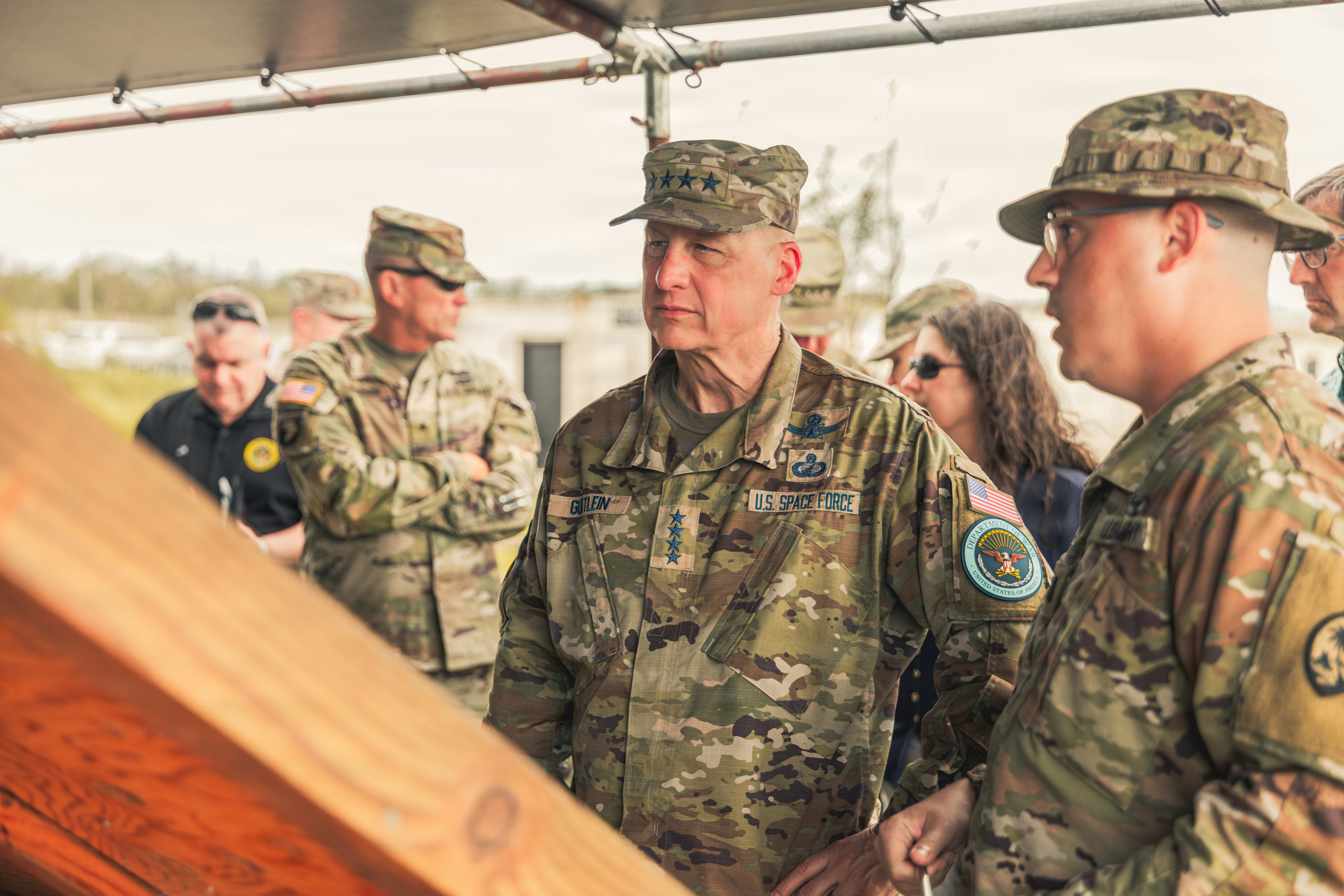
HUNTSVILLE, Ala. — The Pentagon official overseeing the Trump administration’s planned multilayered missile defense shield said today the initiative has its “first operational site” at Fort Story, Virginia.
“We are digging dirt around the homeland,” Gen. Michael Guetlein, Golden Dome’s program manager, said at the Space and Missile Defense Symposium here.
President Donald Trump has said Golden Dome will be operational before his term ends in early 2029, and Guetlein said during his keynote today the initiative is on schedule for 2028.
Speaking to reporters after, Guetlein said he “cannot comment on where the rest of the [Golden Dome] sites are nor how many of them there are.”
Program officials have held two tests, he said, noting one took place at White Sands Missile Range, New Mexico. He did not identify what specific equipment the military tested.
“In January this year, I gave a challenge to the Missile Defense Agency of what test I needed to happen in the summer of 2026,” Guetlein said. “A whole host of other agencies all came together in less than six months, starting from scratch, and delivered what I will argue is the most complex integrated missile defense test that we had pulled off as a nation.”
Both tests “demonstrated that the capabilities that we are putting together, both command and control, our sensor network and our effectors, are going to be effective against the threats as they are currently designed.”
However, he added, the White Sands test “is a fraction of what we[‘ve] got to do to deliver what they’ve asked us to do in ’28.”
Guetlein also said the space-based interceptor (SBI) layer of Golden Dome has met the first of four planned milestones, referred to as gates. Earlier this year, the U.S. Space Force selected 12 companies to mature SBI technology and compete for contracts worth up to a combined $3.2 billion.
“All of the providers that are part of the competition are progressing exceptionally well, and Gate One just came to a closure,” Guetlein told reporters.
The competition has four such gates, he continued: “Gate One is to get the design in place and do component-level testing. Gate Two is to build a capability that can go into outer space. Gate Three is to prove that that capability works in outer space. Gate Four is to prove that the capability actually works as part of the broader Golden Dome architecture.”
“Once [competitors] get through all those four gates, four tests, if you will, in a prize-based competition, then we will make a decision” on purchasing, he said.
Guetlein has previously said he will not move forward with the SBI layer if it proves to be unaffordable.
Executives from Lockheed Martin and Northrop Grumman, two of the companies the Space Force selected for SBI development, said at separate media roundtables here they are on track to demonstrate their technology on orbit by the end of 2027.
Guetlein also said his office has set up a “digital ecosystem” called ApexR to consolidate sensor data, make sense of it with artificial intelligence and use it during Golden Dome operations.