Inaugural ‘Humans to Titan Summit’ to flesh out mission challenges
 By Adam Hadhazy
 By Adam Hadhazy
For decades, NASA’s long-term goal has been to send humans to Mars. But after the red planet, what’s next?
According to some researchers, the answer to that question should be Titan, Saturn’s largest moon that NASA plans to explore via robotic rotorcraft in the 2030s.
The researchers will make their case during the inaugural Humans to Titan Summit, scheduled for June 11-12 at the Southwest Research Institute in Boulder. Organized by Explore Titan — a non-profit organization of planetary scientists and human spaceflight experts — this event will convene veteran researchers, NASA-affiliated scientists, and early-career PhD students, to discuss a range of topics germane to putting boots on Titan some decades down the road.
“It’s not too early to start talking about the next destination after Mars,” said William “Bill” O’Hara, executive director of Explore Titan and former director of lunar habitat development at Blue Origin.
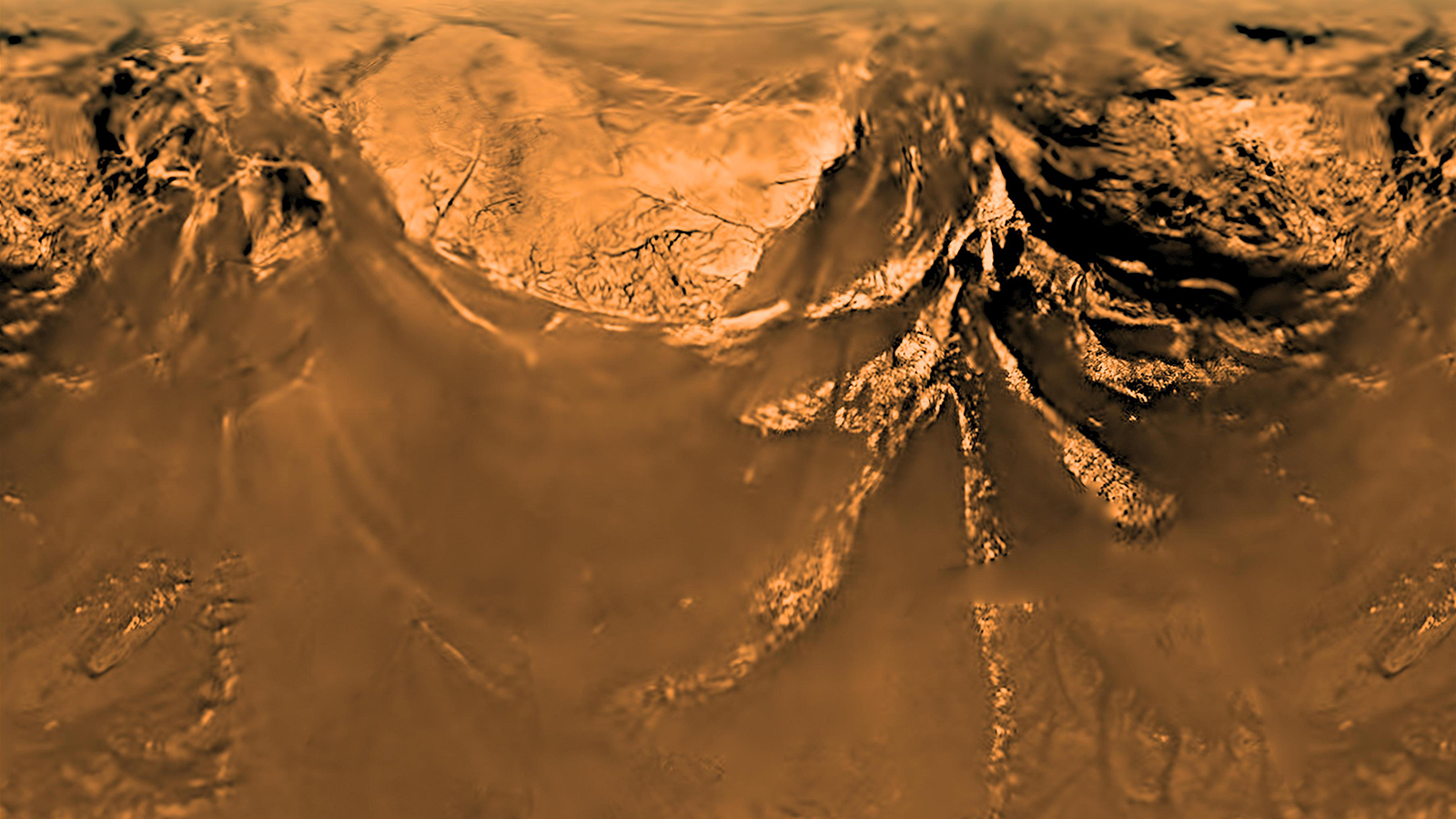
In his view, Titan beckons for a host of reasons. For starters, it is the most Earth-like body within our solar system — albeit a bizarro, frozen version. Titan is the only other body known to host permanent bodies of liquid on its surface, though given temperatures around minus 150 degrees Celsius (300 Fahrenheit), the liquid is not water, but methane and ethane. These hydrocarbons evaporate and precipitate as rain, carving Titan’s surface like our own planet’s. Adding to the Earth-like landscape, water-ice mountains loom to heights over 3,000 meters.
Most of this information comes courtesy of the Cassini-Huygens mission, a combo orbiter and lander that was launched in 1997. Cassini performed 127 close flybys of Titan during its 13-year campaign, using spectrometers to analyze Titan’s thick, hazy atmosphere and radar to peer through it to the surface. After separating from the orbiter, Huygens in early 2005 made a slow descent under parachutes through Titan’s atmosphere, snapping pictures and taking measurements for two and a half hours. The lander even provided a ground-level view after touchdown before its batteries ran out about 90 minutes later.
In the process, Cassini-Huygens discovered Titan is rich in organic (carbon-containing) materials, establishing the moon as one of the likeliest places in the solar system to plausibly host alien life. At the very least, scientists believe Titan can serve as a unique prebiotic laboratory, offering insights into the rise of life in terrestrial milieus.
“We know Titan is unique and potentially a habitable world,” said Amanda Hendrix, president of Explore Titan and a senior scientist at the Planetary Science Institute. She previously served as deputy project scientist for the Cassini-Huygens mission.
O’Hara said human crews are the best way to thoroughly investigate such biological possibilities. “We can only go so far with the robots, and in the end, humans are your ultimate exploration tool,” he said. “They can make the real-time decisions on what’s important, what’s interesting to look for, and overcome challenges that can arise when you’re there.”
The initial hurdle for a Titan expedition is, of course, the extreme distance from Earth: some 1.2 billion kilometers at its closest approach. For Cassini’s seven-year transit, NASA relied on a series of gravity assist-slingshots around Venus, Earth and Jupiter. A similarly circuitous route is being planned for Dragonfly, the eight-rotor rotorcraft the agency is preparing to launch in 2028 to investigate Titan’s prebiotic chemistry.
To deliver humans in a far more reasonable span, alternative propulsion methods are being considered. O’Hara and a colleague have done an initial study of a 500-day transit with a nuclear electric spacecraft that is a scaled-up version of the technology in development for NASA’s Space Reactor-1 Freedom mission that’s scheduled to fly to Mars in 2028. That travel time is on par with what’s been proposed for some crewed Mars architectures.
Shielding the crew from debilitating radiation exposure en route presents another major challenge, though again, one that researchers have long studied in a Martian context. Promising options include storing mission-critical water — an excellent radiation blocker — in the spacecraft hull.
On the plus side, radiation likely will become less of a concern once the crew reaches Titan. Its atmosphere is some 50% denser than Earth’s, serving as a “natural radiation shield,” Hendrix said, “which you absolutely don’t have at the moon or Mars.”
The relative soupiness of Titan’s air would also offer human explorers the opportunity to essentially fly with minimal equipment and effort. NASA hopes to exploit this with Dragonfly, which is to travel around Titan in a series of short flights that resemble leapfrog hops. A major topic at the summit, O’Hara said, will be how Dragonfly and other robotic precursor missions are crucial for preparing the eventual way for humans.
In addition, sessions will also cover spacesuit design (pressurized, no; heated, yes), planetary protection concerns so humans do not “infect” Titan, and what living and working on Titan would really be like.
O’Hara said Explore Titan plans to host these summits every couple of years to keep up the momentum and build on collaborations this first conference will forge.
“We see the summit as a point of inspiration,” he said. “The more we start thinking about going to Titan, the more possible it becomes.”