NASA tweaks X-59 software, flight control systems ahead of first supersonic attempt in ‘early June’


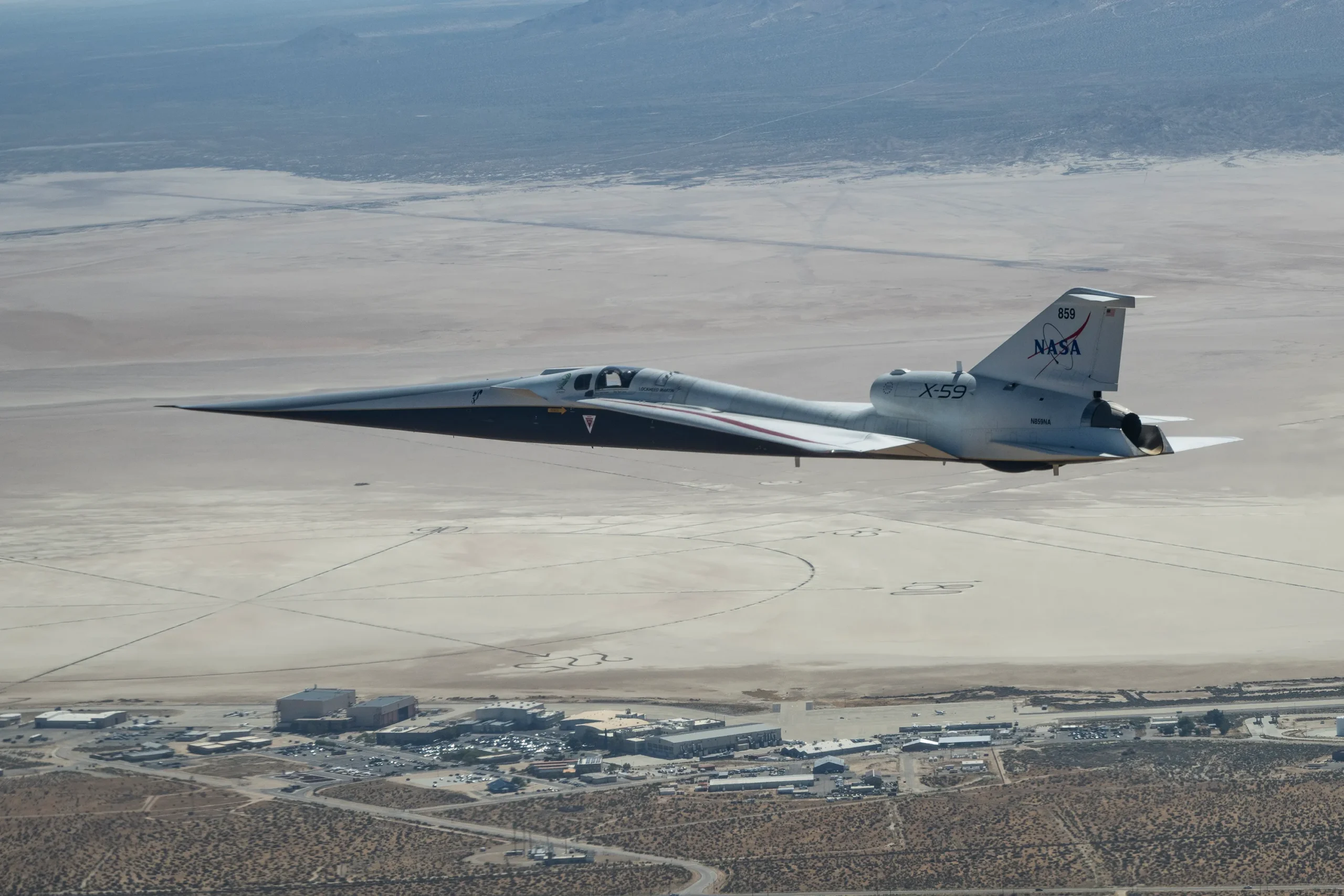
During the past two months, NASA’s needle-nose X-59 demonstrator has taken to the skies over the Mojave Desert in Southern California, rolling, dipping, and performing other maneuvers at subsonic speeds and ever-increasing altitudes.
These Block One flights, meant to verify the aircraft’s handling and other aspects of its performance, are now concluded, NASA confirmed by email on Tuesday. The next phase, supersonic flight, is targeted to begin in “early June,” the agency told me.
But first, NASA and its prime contractor Lockheed Martin Skunk Works have identified small adjustments that need to be made to the demonstrator, which has completed 16 flights since its debut in October.
An Instagram video NASA posted on May 1 captures the reason for one such change. As X-59 prepared for a wing level push maneuver, an alarm faintly sounded in the cockpit. The source? ICAWS, or the Integrated Caution Advisory Warning System, a suite of avionics sensors commonly found in highly automated jets.
This particular alarm was triggered by a change in pressure as X-59 executed a push maneuver. Flight controllers on the ground deemed it acceptable in this case, but it’s among the tweaks to the aircraft’s software and flight control systems that will be made before a pilot attempts to break the sound barrier.
“In flight testing, we’ve discovered that there are a couple of trip levels on some of those warnings that could tend toward a nuisance,” said Mike Buonanno, a Lockheed Martin fellow and the company’s lead engineer on X-59 development. “Maybe the parameter just needs to be set a little bit higher or lower. So there’s a few things like that. None were critical, none jeopardized continued safety of flight, but they’re the type of things that we want to get cleaned up so that the airplane performs as it should.”
X-59 has now flown up to 43,000 feet and at “transonic” speeds very close to Mach 1, Buonanno said.
“Subsonically, we had a lot of data collected, including fuel burn predictions we had made about the performance of the plane. So far, everything we see is in great agreement with our preflight predictions,” he said.
The supersonic flights are also to follow a steady progression, starting with short, simple flight patterns over the Mojave Desert and gradually moving to longer flights, according to NASA’s mission description. The goal is to demonstrate that X-59 can avoid producing the ear-splitting sonic booms that other aircraft produce when exceeding Mach 1, because they generate multiple shock waves that merge. The demonstrator’s slender airframe was designed to break up the shock waves, instead producing a quieter “thump” comparable to the sound of a car door closing 6 meters (20 feet) away.
For the flights, an F-15B aircraft with a shock-sensing probe attached to its nose will fly with X-59, and additional microphones on the ground will capture acoustic data. Based on the initial results, NASA plans to adjust the trim and attitude of the aircraft with its control surfaces and also reposition the stored fuel on board, Buonanno said.
Such adjustments will “allow us to kind of continually improve the boom characteristics as we gather the flight test data from both on the ground and from the near field probing with the F-15s,” he said, “and then we will run that through our computer models and determine if there’s a slightly more optimal setting on the control surface that would allow us to get the sonic boom noise levels even lower.”
If these flights go as planned, they’ll pave the way for X-59 to fly over various communities across the U.S. to measure the public response to the noise. All of that data is to be submitted to FAA and the International Civil Aviation Organization “in the hopes of changing regulations prohibiting commercial, supersonic flight over land,” according to NASA.