NASA’s Roman telescope could help solve this cosmic mystery
 By Jon Kelvey
 By Jon Kelvey
In the coming months, the Nancy Grace Roman Space Telescope will be launched 1.5 million kilometers from Earth to investigate dark energy and dark matter. But in building the observatory to tackle these cosmological enigmas, NASA is also poised to help solve another mystery that has emerged since Roman was first conceived more than a decade ago: conflicting calculations of how fast the universe is expanding.
“The discrepancy is not marginal,” says Charles Bennett, an experimental cosmologist at Johns Hopkins University and its Applied Physics Laboratory.
Researchers using the standardized brightness of objects like supernovae to establish the current cosmic expansion rate, called the Hubble Constant, get a rate of about 73 kilometers per second per megaparsec, plus or minus one. But researchers extrapolating the Hubble Constant from measurements of the Cosmic Microwave Background, the faint radiation after-image of the universe shortly after the Big Bang, get a figure of around 68 kilometers per second per megaparsec, plus or minus one, Bennett says.
“It’s been over 10 years now since we’ve known there was a conflict, and it gets more and more significant every year,” he adds.
Cosmologists call this discrepancy the Hubble Tension, and the experts I spoke with described two possible solutions: Either there’s some subtle, as-yet-undiscovered flaw in the different methods used to measure the expansion rate, or “our standard model of the universe is incorrect” and there’s new physics to discover, says Julie McEnery, Roman’s senior project scientist at NASA’s Goddard Space Flight Center.
Solving this puzzle requires “a mission or an experiment that can probe the universe to about a factor of 10 better than we did before,” she says, and Roman is slated to do just that.
Either solution to the Hubble Tension will move science forward, says Roman Program Scientist Dominic Benford, who oversees the science mission from NASA Headquarters. Discovering the measurement methodologies are subtly flawed would lead to more accurate astronomy, and “if it turns out that there is something fundamentally wrong in our understanding of the universe, we really ought to find out what that is,” Benford says, “because its ramifications could be enormous” — and not just for astrophysicists.
Consider, for example, how astronomers once puzzled over small deviations in Mercury’s orbit from what Newtonian physics predicted. Once Einstein published his Theory of General Relativity explaining how massive objects warp both space and time around them, scientists were able to match their math with observations of Mercury. This in turn required engineers to apply the principle to Earth-orbiting satellites. Without those corrections, Benford says, GPS navigation would never work because coordinates for locations would drift out of alignment over time.
Roman’s mission stems from a recommendation in the 2010 Astronomy and Astrophysics Decadal Survey that NASA build a telescope to investigate dark energy, the mysterious, repulsive force believed to be driving the accelerating expansion of the universe. Also among this telescope’s objectives would be to study the equally enigmatic phenomena of dark matter, which is observable only by its gravitational effects and may play a role in the structure of galaxies and galaxy clusters.
For these observations, Roman needs more precise optics and instruments than its predecessors. Like the James Webb Space Telescope, it must fly in deep space to avoid atmospheric perturbations and the glare of the sun. Roman will observe in the near infrared to capture the light of the most distant galaxies, which has been stretched into longer, redder wavelengths by the expansion of space over billions of years.
The telescope also requires a wide field of view to survey large sections of sky and measure subtle differences in the structure of galaxies and galaxy clusters. All of these attributes are equally important for the observations necessary to solve the Hubble Tension.
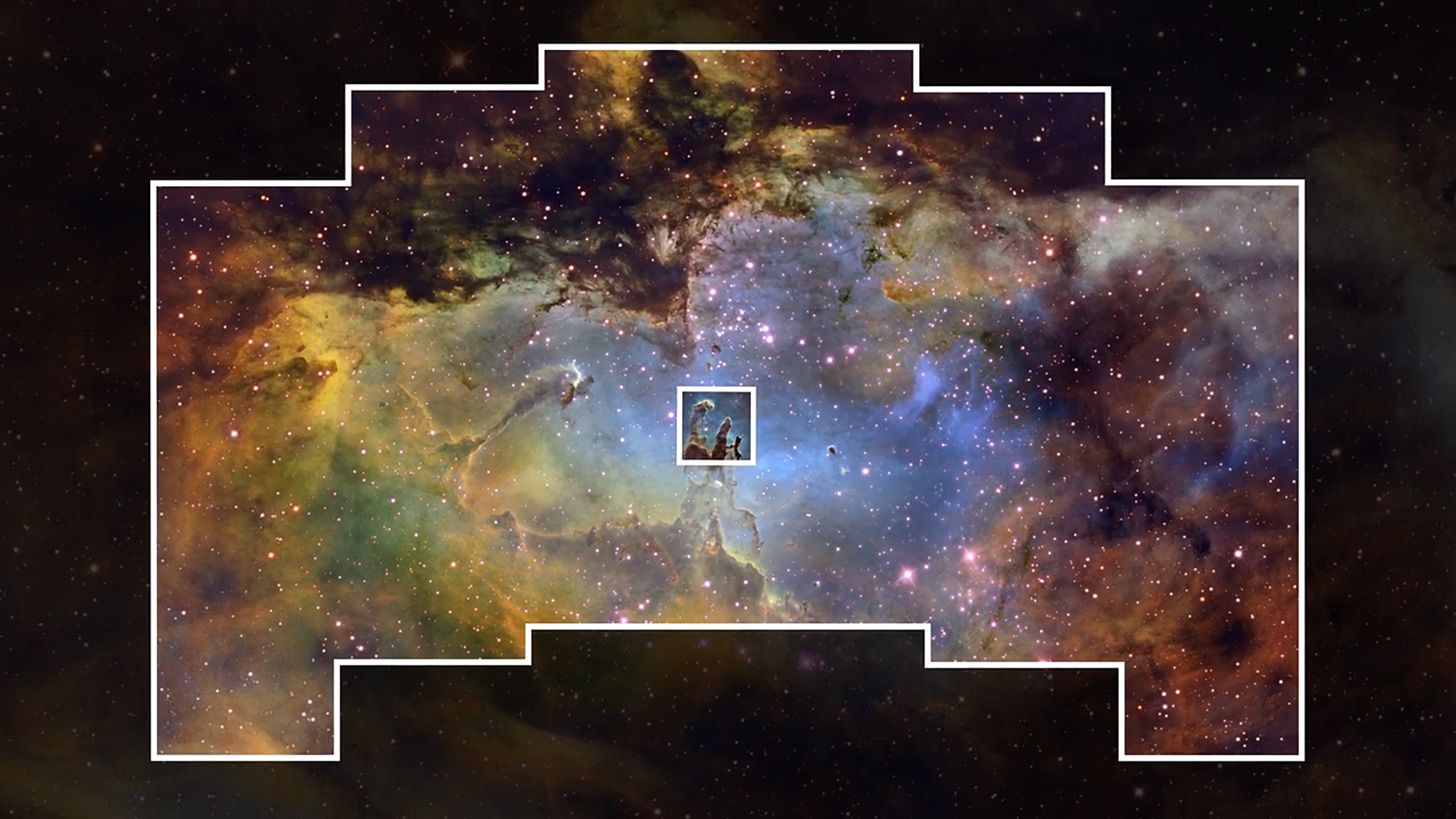
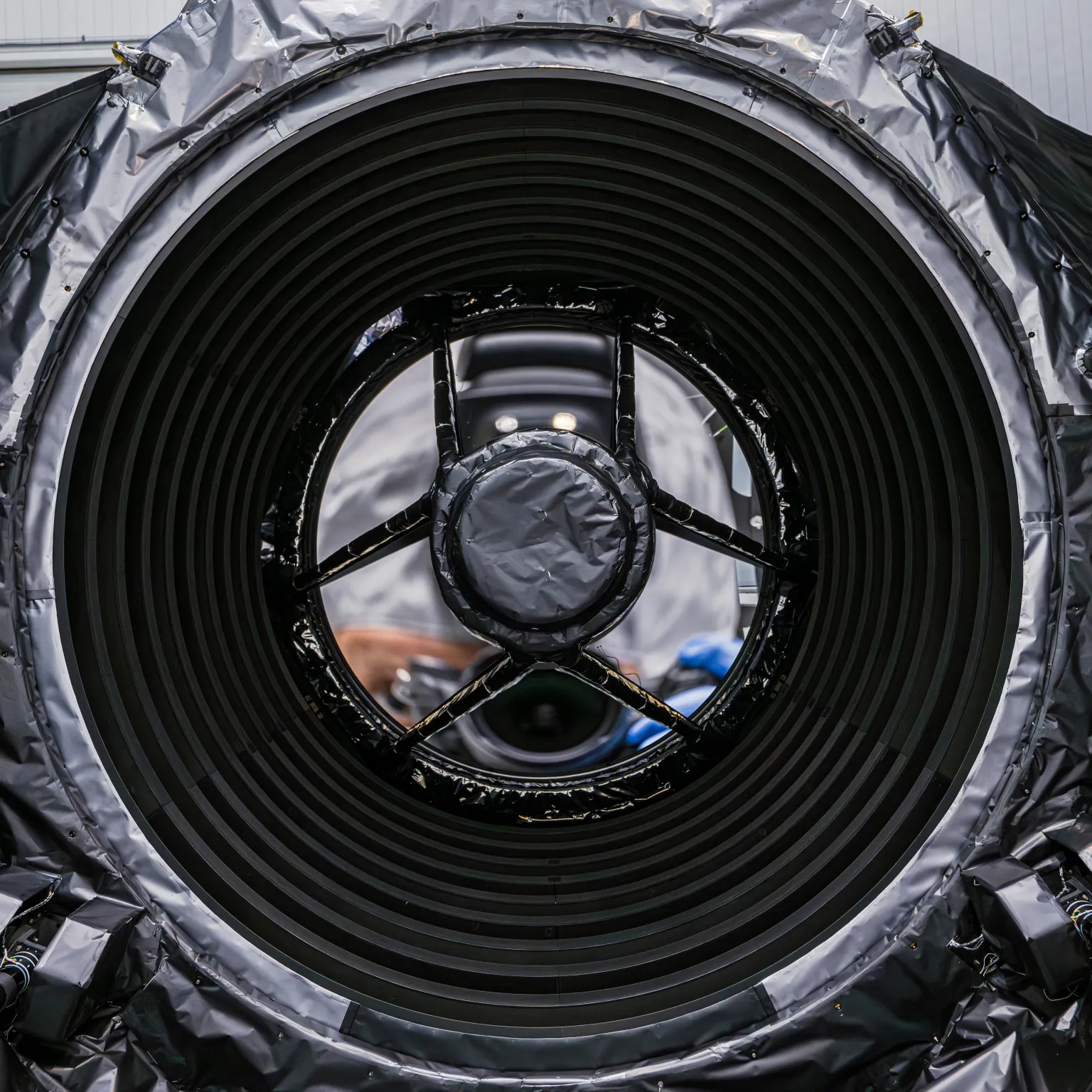
Though its 2.4-meter diameter primary mirror is the same size as Hubble’s, Roman is also equipped with a Wide Field Instrument that can see at least 100 times as much sky at a glance and reorient on new target patches of sky 1,000 times faster than Hubble, McEnery says.
Plans call for completing a High-Latitude Time-Domain Survey, in which the telescope will hunt for supernovae by repeatedly observing 18 square degrees of the sky to discover an estimated 27,000 type 1a supernovae — about 10 times more than are currently known. Because astronomers already know the intrinsic brightness of type 1as, they can calculate their distance based on the supernovaes’ relative faintness, Benford says.
And measuring their red shift — how much their light has been stretched by traversing expanding space over time — tells scientists how fast the supernovae are moving away from Earth, yielding the Hubble Constant out to that distance.
Roman will not measure the Cosmic Microwave Background directly, but it will use two primary methods to map the expansion history of the universe from the time of the Cosmic Microwave Background to the present.
First, Roman will study Baryon Acoustic Oscillations (BAO), says Ami Choi, deputy scientist for the telescope’s Wide Field Instrument. If the Cosmic Microwave Background is the afterglow of the Big Bang, BAO are the echoes: sound waves that reverberated through the infant universe, creating rings of slightly higher densities of early matter. Galaxies would later form along those rings, which have been stretched farther apart as space itself has expanded, providing a sort of cosmic ruler for the growth of the universe to be read in the large-scale pattern of galaxies.
With Roman’s spectrographic instrument equipped with a “grism,” a hybrid prism and diffraction grating, scientists can obtain the spectra of the light of the thousands of objects Roman views in one frame. Measuring the red shift of those spectra to obtain distances will allow them to construct a three-dimensional map of the distribution of galaxies and calculate the Hubble Constant.
Roman is also to conduct a weak gravitational lensing survey, studying the minute distortions in the observed shapes of background galaxies as the gravity of foreground matter, including dark matter, warps the galaxies’ light. By building a 3D mapping of the distribution of matter over time, scientists can arrive at another calculation of the Hubble Constant, according to McEnery.
Other ground- and space-based observatories have or will make similar measurements, but Roman will peer deeper into the cosmos, Choi says, and is unique in its ability to make so many of the measurements of the Hubble Constant from the same instrument. Earth’s atmosphere limits the ability of ground-based telescopes like the Vera C. Rubin Observatory, for instance, to see the most distant supernovae with the same resolution as Roman. Rubin can discover type 1a supernovae up to about 5 billion years in the past, but Roman will capture supernovae 11 billion years in the past.
Most weak lensing surveys to date have also been conducted from the ground, and in optical wavelengths. The space-based and near-infrared-focused Roman will see more distant galaxies with greater clarity.
The European Space Agency’s Euclid space telescope studies BAO, and with a wider field of view than even Roman, but will not see as deep into the sky as Roman. Its grism is also lower resolution than Roman’s, says Choi, who is also a member of the Euclid science team.
“Roman is unique in this combination of being space-based, near infrared, with very well-controlled instrumental systematics and resolution,” she says, and its results will be combined with other observations to provide the best measurements to date of how fast the universe is expanding and how that expansion has changed over cosmic time.
But it’s not guaranteed Roman will solve the Hubble Tension. If its observations also generate the same
conflicting measurements with greater precision, “the mystery could get deeper,” Bennett notes.
Still, McEnery remains optimistic. “I think there’s a very good chance that Roman is going to confirm that our standard cosmological model doesn’t work,” she says, “and put us on a path to understanding how the universe is actually working.”