


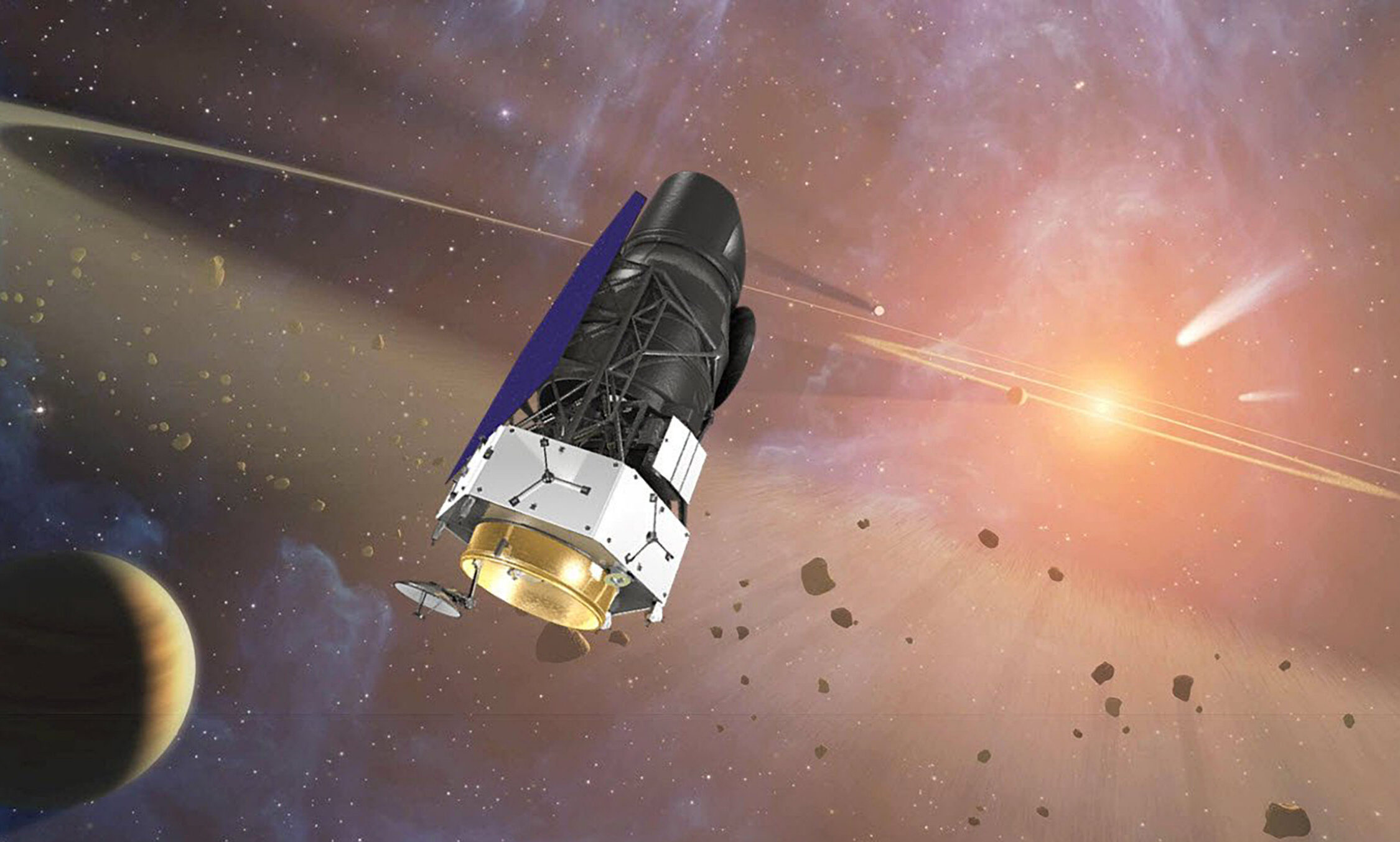
KENNEDY SPACE CENTER, Fla. — Now that the Nancy Grace Roman Space Telescope is on its way to its intended orbit in deep space, NASA scientists are looking to early 2027 when the first science imagery is expected. And they’re anticipating more than just fresh views of the cosmos.
With its wide field of view, Roman is designed to survey expanses of the sky many times more vast than any previous space telescope, revealing new information about dark matter and dark energy, among other phenomena. The telescope also carries an experimental coronagraph, whose observations will help shape the design and operations of the one slated to be aboard NASA’s next flagship telescope: the Habitable Worlds Observatory (HWO), planned for launch in the mid-2040s.
At its most basic level, a coronagraph is a masking device that partially blocks the blinding light from host stars so that a telescope can detect the fainter glow emitted by nearby planets. Previous telescopes have had such instruments, but none as sophisticated as Roman’s coronagraph, which was designed to directly image Jupiter-sized exoplanets for the first time. The instrument is to serve as a pathfinder for the one aboard HWO that will attempt to directly image Earth-sized planets, which scientists consider the best chance of identifying life beyond our solar system.
To that end, Roman’s coronagraph will test a new star-dimming technique: deformable mirrors for what NASA describes as “adaptive optics,” to correct imperfections or interference imparted by the telescope’s own vibration or heat.
“Every mission that we fly sort of stands on the shoulders of the mission that came before it,” Nicola “Nicky” Fox, associate administrator for NASA’s Science Mission Directorate, told me in an interview before Roman’s launch on Aug. 30. “Habitable Worlds will have a coronagraph based on the one that is flying on Roman. We now have this unbelievable deformable mirror technology, and Roman is a demonstration of that technique.”
Based on the performance of the mirrors, which were developed at NASA’s Jet Propulsion Laboratory in California, NASA will refine the technology for HWO, said Vanessa Bailey, JPL Roman coronagraph scientist.
The specific mirrors for HWO “may not be exactly the same as what we’re doing” for Roman, she said, “but the big picture concept has a lot of similarities.”
Roman’s coronagraph contains two deformable mirrors about 5 centimeters in diameter, each equipped with more than 2,000 tiny pistons, or piezoelectric actuators. These devices can mold and shape the mirrors’ surfaces to correct for imperfections created by the telescope’s own lenses, or by vibrations generated by Roman’s motors and reaction wheels as the telescope repositions itself.
Roman doesn’t have the onboard computing power to calculate precisely how the mirrors must be deformed for each image; instead, operators on Earth will make those calculations.
First, the telescope will take a picture of a reference star that is near the intended target. That image will be sent to Earth, where operators will run it through software. The computed instructions will then be sent back to Roman so it can image the target.
Just as eyeglasses can be shaped to correct for vision problems, the coronagraph’s mirrors can be adjusted to make an image sharper, said Bailey. For instance, the mirrors might be shaped into something resembling a Pringles chip or parabola.
She’s anticipating at least one update for the coronagraph that will fly aboard HWO: “Almost certainly, Habitable Worlds will need more actuators than we have. They’ll need finer control than we have,” Bailey said.
NASA has compared Roman’s task of imaging Jupiter-sized exoplanets to attempting to view a firefly next to a flood lamp from across the entire United States. HWO’s coronagraph will need even more clarity and precision to image the smaller Earth-like planets, said Joshua Schlieder, a research astrophysicist in the Exoplanets and Stellar Astrophysics Laboratory at NASA’s Goddard Space Flight Center.
“What we learn in the process will be critical for a next-generation coronagraph instrument that’s designed to be even more sensitive and more precise, which is where we have to go for this ultimate goal of directly imaging a small planet like the Earth around a nearby star,” Schlieder said. “The Roman coronagraph will be a huge leap in that direction.”