NASA’s habitable planet seeker comes into view
 By Adam Hadhazy
 By Adam Hadhazy
Some two decades from now, if all goes as planned, NASA will have a new telescope stationed around Lagrange Point 2. From this gravitationally stable orbit some 1.5 million kilometers from Earth, the Habitable Worlds Observatory will hold watch for several hours at a time, collecting thousands of photons reflected by gases in the atmospheres of far-off exoplanets.
What is it seeking? An answer to one of the biggest questions about what’s beyond our solar system.
“‘Are we alone?’ is the most ambitious question that has really ever been addressed by any mission, and an observatory capable of addressing this question must also be ambitious and powerful,” says Breann Sitarski, deputy principal architect for HWO at NASA’s Goddard Space Flight Center in Maryland.
HWO (pronounced “who” and called Hab Worlds for short) is NASA’s first-ever mission dedicated to searching for signs of life on planets beyond the solar system. Slated for launch in the 2040s, the telescope represents an enormous technological leap forward in multiple ways — which has also prompted NASA to reimagine its approach for developing flagship missions.
Configuration-wise, HWO is to be the most stable spacecraft ever constructed — about 100 times stabler than the James Webb Space Telescope, with the instrumentation portion of the spacecraft wobbling no more than the width of a hydrogen atom during observations. To see Earth-like worlds against the glare of their host stars, HWO needs a coronagraph that suppresses starlight by a factor of 10 billion, another double-order-of-magnitude jump from the current state-of-the-art. Finally, mission planners also want to build in the capability for robotic craft to service the telescope all the way out at L2 — a far cry from the basic servicing possible today in the geostationary-geosynchronous realm 35,000 km above Earth.
To further develop and mature today’s limited versions of these technologies to meet HWO’s stringent requirements, NASA in January awarded three-year, fixed-price contracts to seven companies. The agency did not disclose individual contract amounts, but Congress approved $150 million for HWO development for fiscal year 2026.
Although much work remains, those involved with HWO say they’re optimistic about the mission’s prospects.
“This is our first chance to directly search for life because we live in a time where technologically we think we know how,” says Evgenya Shkolnik, a professor of astrophysics at Arizona State University and co-chair of the HWO Community Science and Instrument Team (CSIT) that is contributing scientific expertise to the fledgling mission. “It’s an amazing opportunity that humanity has never had before.”
Astronomers identified HWO as their community’s top-priority large mission in the 2020 Decadal Survey on Astronomy and Astrophysics, with a budget estimate of $11 billion. That report also called for a more cautious development trajectory compared to Webb, which ran roughly 10 times over its initial $1 billion cost estimate and was launched a decade behind schedule.
NASA is accordingly taking a more proactive programmatic approach with HWO, setting aside extra time and budget up front before locking in the design and proceeding to fabrication.
“A lot of it is making sure that the technology is ready to go, so before you actually start sprinting with a mission, you’ve actually assured that you can do the mission,” Nicola Fox, head of NASA’s Science Mission Directorate, told reporters at an April press event. “So with Habitable Worlds, we’re putting a lot of focus right now on maturing the technology.”
Sitarski says NASA is also relying on exploratory analytic cases during HWO’s ongoing preformulation phase, mapping science goals to engineering parameters to better inform “virtual telescope” simulation, modeling and architecture assessment.
“This is a new paradigm that we haven’t really looked at in previous flagship missions,” she says.
The agency’s contractors have noticed and embraced the shift.
“We’re learning from Webb: Don’t start a program and expect miracles to happen,” says Alison Nordt, director for space science and instrumentation at Lockheed Martin, which received one of the development contracts.
Among the factors contributing to Webb’s delays, says Nordt — who for 16 years served as the principal engineer for the telescope’s near-infrared camera — was the longer-than-anticipated time required to develop the 10 critical technologies needed to fulfill its mission. These included a deployable, layered sunshield; lightweight beryllium mirrors; and cryogenic detectors. The project moved into design and manufacturing before these technologies had fully gestated, resulting in forced redesigns and workmanship issues along the way.
Instead, the strategy for HWO is “spend a decade developing technology first and fund it well before you have the marching army of developing a flight observatory,” Nordt says.
The agency awarded the first study contracts in 2024, so the pivot to manufacturing is not likely to begin until the mid-2030s.
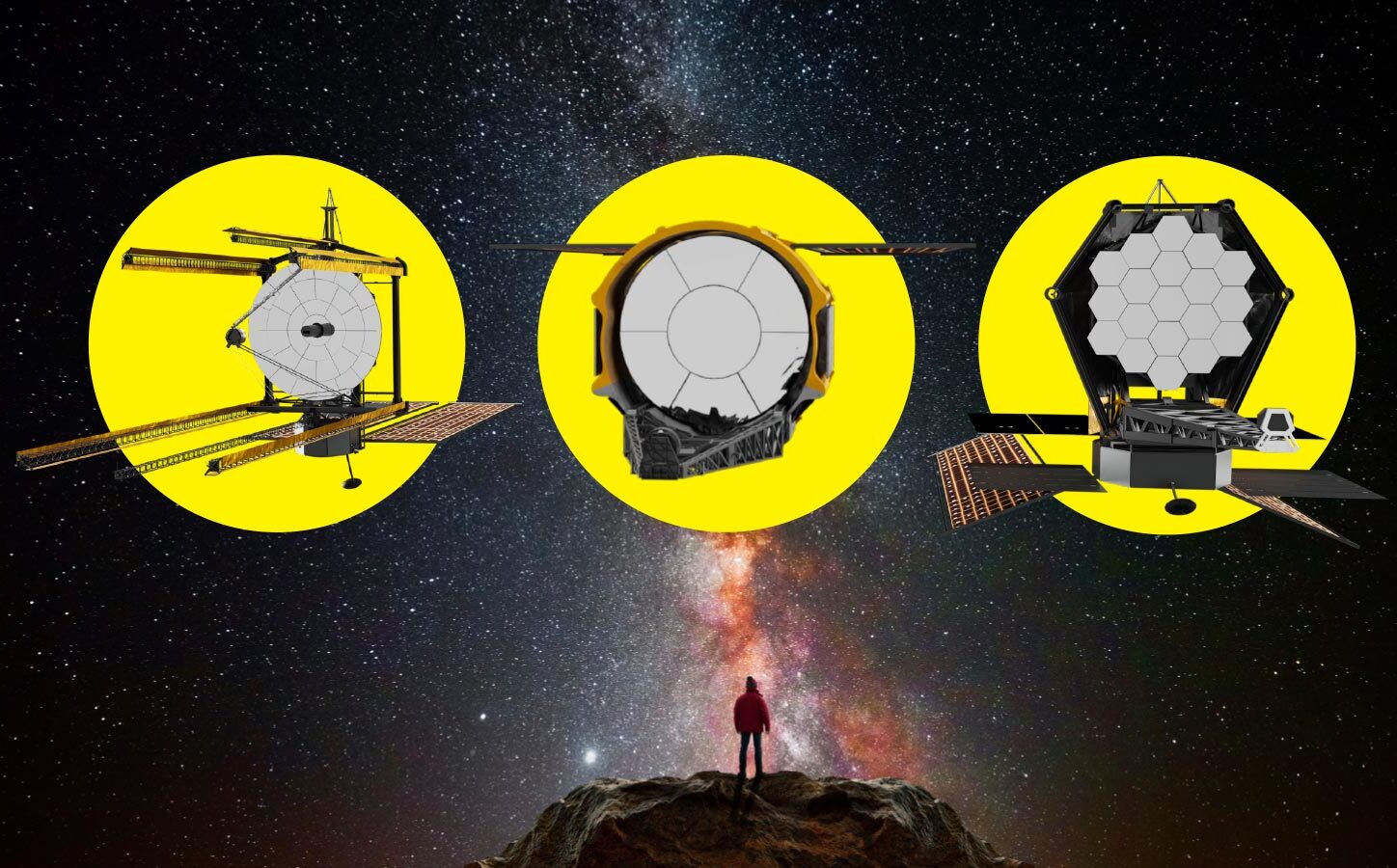
Another difference is fewer launch vehicle constraints. HWO is expected to be at least the size of Webb, with a folding primary mirror that will expand to at least 6 meters in diameter — perhaps up to 8 meters. Webb’s design was constrained by the 5-m fairing of what were then the latest heavy-lift rockets. Since then, new designs have been introduced, including SpaceX’s Starship and Blue Origin’s New Glenn, that offer wider fairings and greater mass launch capabilities.
With Webb, “they had limited margins and limited capability to respond to challenges,” says Matt Bolcar, HWO chief technologist at NASA Goddard. With HWO, “we can carve out more margin for mass and volume and make sure that we have more flexibility in the future.”
Rather than appointing a single prime contractor, as has often been the case for Webb and other big
missions, Nordt hopes NASA will pursue a more integrated, multi-contractor approach for HWO beyond the current development phase, fostering competition as well as teamwork. “It’s a different paradigm than I think any observatory or NASA mission has ever been in, trying to make this kind of a collaboration together,” she says.
HWO’s chief science goal is to find and observe up to 25 Earth-like planets orbiting sun-like stars located roughly 15–30 light-years from Earth. In addition, the telescope will also serve as a general-purpose observatory —
continuing the legacy of the Hubble Space Telescope, Webb and the Nancy Grace Roman Space Telescope slated to launch later this year — deepening knowledge across astrophysics, cosmology and planetary sciences.
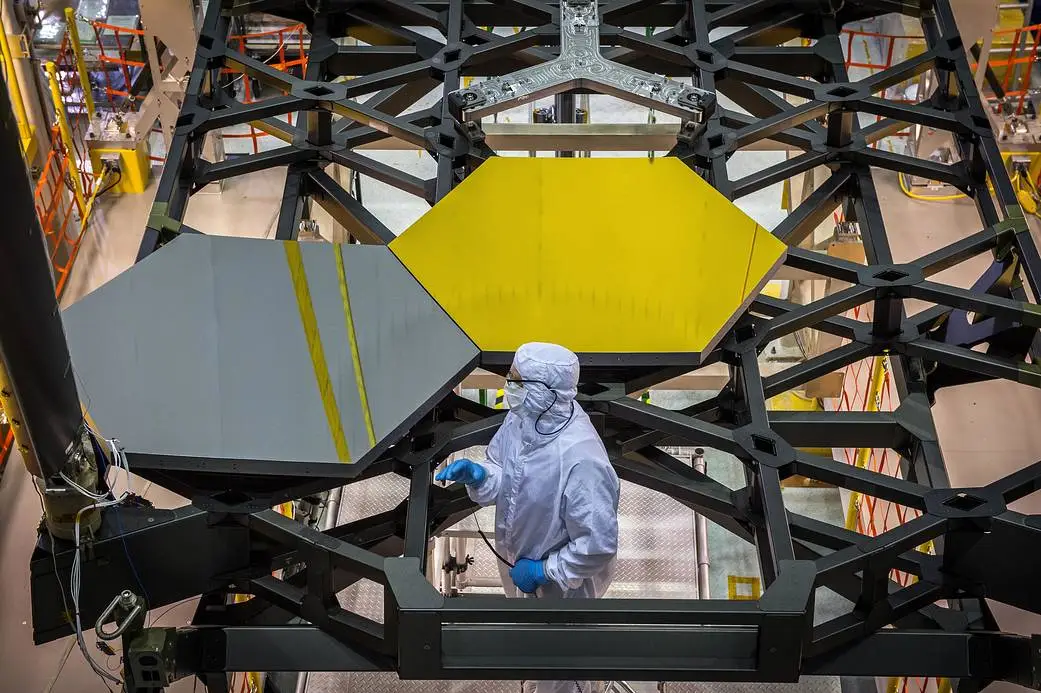
For its exoplanet-hunting mission, HWO must maintain precise optical alignment, focus and pointing while withstanding inevitable heat and mechanical perturbances from itself. The primary mirror — which, like Webb’s, will be segmented — secondary mirror, support structures and coronagraph all require active control systems and sensors that must perform at a newfound level of picometer (trillionths of a meter) precision. That’s 1,000 times greater than Webb’s nanometer control.
As Nordt put it, “the No. 1 requirement for Hab Worlds is we’ve got to be stable, stable, stable.”
Lockheed Martin is one of the contractors studying how to achieve this. For the mirror, Nordt says the company is leveraging its prior work on the Space Interferometry Mission, a NASA project that was canceled in 2010. For that spacecraft, Lockheed engineers developed laser-based metrology using photonic integrated circuits for measuring mirror segments, which still remain in the vanguard and they believe can now help HWO reach its requirements.
Partnering with Lockheed is L3Harris Technologies, who through its predecessors and subsidiaries has been a long-time NASA collaborator on mirrors and optics for Hubble, Webb and Roman.
“We build the eyes for these NASA systems,” says Charles Clarkson, vice president and general manager of space superiority and imaging at L3Harris. The company plans to construct a testbed at NASA Goddard to analyze the thermal stability of potential HWO mirrors, experiment with gauge placement for precisely
measuring where the mirrors are and configure actuators to move them as needed.
As for mirror coatings, NASA has contracted Illinois-based ZeCoat to develop durable, large-scale thin films that maximally reflect light with wavelengths from 100-2,500 nanometers, from near-ultraviolet wavelengths through visible into the near-infrared. (ZeCoat did not reply to multiple requests for comment.)
For extremely stable pointing, NASA is evaluating microthruster technology. The agency has contracted Busek, a Massachusetts-based spacecraft propulsion company that contributed microthrusters to the 2015 LISA Pathfinder mission and demonstrated technologies for future space-based detection of sublimely subtle
gravitational waves. The colloid micronewton thrusters that flew for the first time on that spacecraft had a maximum thrust of 30 micronewtons, equivalent to the weight of a mosquito, necessary for counteracting forces such as the incessant pressure of sunlight.
The thrusters use an electrospray technique, in which electric charge is applied to droplets of an ionic liquid. The droplets are then accelerated by an electric field and expelled
to produce precise, low-force thrust. That technique controls the position of the satellite to within “the width of a strand of DNA,” which is “directly applicable to HWO,” says Peter Hruby, vice president of business and strategy at Busek.
For its HWO contract, Busek is advancing its microthruster tech for longer lifetimes and greater redundancy and serviceability, Hruby says.
Regarding spacecraft architecture more broadly, the plan is to isolate the instrument payload side as much as possible from the rest of the observatory, where solar panels, communications, propulsion and other heat- and mechanical-disturbance-producing components reside.
To that end, Lockheed Martin has developed what it calls “disturbance-free payload.” This noncontact method relies on components known as voice coil actuators — essentially a coil of wire that goes inside a high-strength magnet cylinder. The two elements do not actually touch and are mounted opposite each other. As a current goes through the coil of wire in the presence of a magnetic field, a force is created, allowing control of one degree of freedom. Placing six coils in a hexapod configuration enables full pitch, yaw and roll control, and thus active control, keeping the instrument side locked in during observing runs.
“The spacecraft could vibrate all at once, and the telescope’s rock solid above it,” says Nordt. “‘You go ahead and dance away, spacecraft, but I’m going to do what I want to do and point directly at that star.’”
The only elements connecting the spacecraft and instruments would be cables across the interface, “but we’ll make those as flexible and as compliant as possible so that they don’t transmit a lot of the disturbances across,” adds Nordt.
Meanwhile, BAE Systems’ Space and Mission Systems division, based in Boulder, Colorado, is working on picometer-level control specifically for HWO’s mirror segments. Ball Aerospace, which BAE acquired in 2024, made Webb’s actuators and primary mirror segments.
In a statement, BAE described how Webb’s nanometer-level stability only required occasional segment fine-positioning via those actuators, whereas HWO necessitates constant active control. The company says it has developed patented ultrafine actuators with pico- meter-level resolution that are “strong enough to hold the weight of the primary mirror through ground testing and survive the forces of launch.”
BAE also has a patent-pending capacitive sensor in the works for measuring mirror motion across all six rigid body degrees of freedom. A control loop would connect the actuators to the sensors, enabling continuous correction of unwanted changes in mirror position.
Northrop Grumman, another HWO contractor, did not respond to requests for an interview about its technology. Conference proceedings and general summaries of HWO contractor focus areas supplied by Lockheed Martin, however, describe that Northrop Grumman is working on stiff, ultra-stable telescope structures. These include latches for deployment of elements — such as solar panels after launch — but with avoidance of structural micro-lurching, where unpredictable shifts in position occur when deployed structures “jerk” into lower-energy states.
The company is also leading development of a shield to protect HWO’s mirrors from micrometeoroids, which came into play following a strike to one of Webb’s mirror segments in May 2022. That impact left a dimple and required actuator adjustment of the segment to compensate. While mission engineers had planned for sand-grain-sized micrometeoroids at L2, the velocity of the offending grain exceeded expectations. HWO’s team accordingly wants a barrel-like baffle, given the extreme sensitivity of the instrumentation.
Finally, at the heart of HWO will be its coronagraph. This instrument is entrusted with creating a 10-billion-to-1 contrast ratio, letting dim worlds emerge into view with their stellar host’s light squashed.
Lockheed’s Nordt offers an illustrative analogy: “It’s like seeing a firefly next to stadium floodlights in San Francisco from Colorado Springs,” about 1,500 km distant.
Much groundwork has already been done, courtesy of Roman’s Coronagraph Instrument (CGI), set to launch with the telescope as soon as late August. Built at NASA’s Jet Propulsion Laboratory as a technology demonstration, CGI is expected to see down to Jupiter-sized planets around sun-like stars. The instrument also doubles as a spectrograph for atmospheric characterization.
“We can take what was done on CGI and apply it directly to the coronagraph that we need for Hab Worlds, with a few additional advances,” says NASA’s Bolcar, who also is the optical systems lead for Roman.
Basically, all CGI’s relevant components and technologies to actively suppress starlight — including masks, detectors and deformable mirrors — will have to be honed further for HWO, Bolcar says. “One of the main design principles is to evolve from what we know how to do versus trying to do something brand new,” he adds.
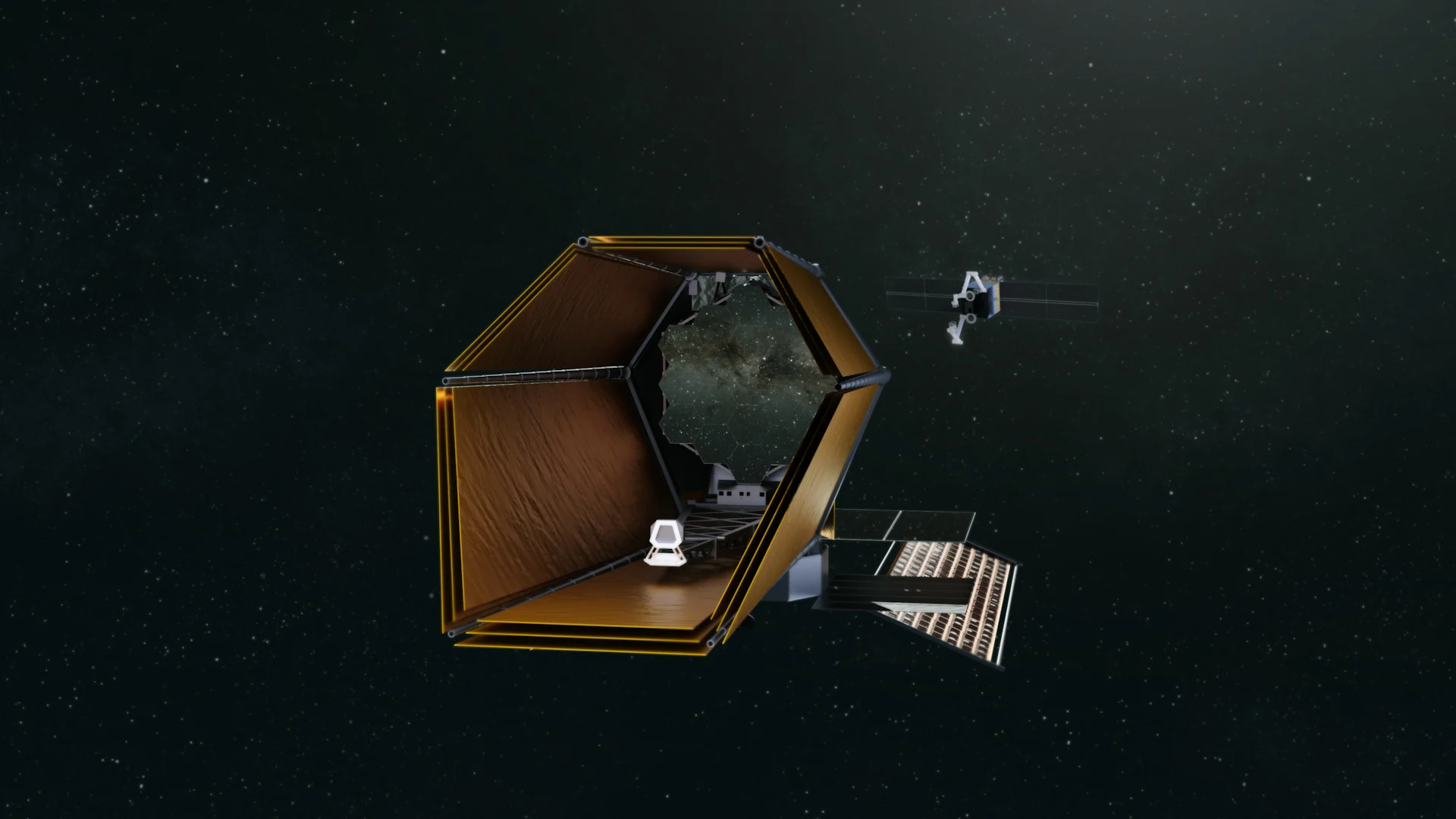
Where HWO will be breaking entirely new ground is its baked-in serviceability. The idea is to ensure the observatory can be repaired, should a malfunction occur, and upgraded as sharper instrumentation emerges. Robotic service missions could thus significantly extend HWO’s useful scientific life beyond a baseline of five to 10 years, akin to the five astronaut-led missions to Hubble that have allowed that workhorse to deliver science 36 years and counting.
To study the feasibility of L2 servicing, NASA has contracted Astroscale U.S., a Denver-based on-orbit servicing company currently developing servicing vehicles for low-Earth and geostationary orbit. Although upfront costs and complexity increase with designing HWO to be serviceable, the gains can help ensure mission success and longevity.
“Serviceability offers a level of risk reduction for the net science program that you can’t offer when you have just a singular monolithic telescope that can’t be serviced,” says Jeff Schloemer, the company’s senior director of engineering.
Among the challenges Astroscale is examining is how to deal with the roughly 10-second communications latency between L2 and Earth. So far, the basic plan is for robotic servicers to semi-autonomously handle a task, then check with the human mission controllers before proceeding to the next step, Schloemer says.
Another issue is how to avoid potential contamination of mirror surfaces from the fuel used by the servicing craft for rendezvous maneuvers. Astroscale’s proposed solution is for any residue-generating chemical burning — for instance, hydrazine — to be conducted at a determined safe distance, with substantially lower residue-generating cold gas (such as nitrogen) thrusters a good candidate for close-in maneuvering, says Schloemer.
It’s also key to ensure servicing does not jeopardize HWO’s exquisite stability. Any science observations would be paused during service, but part swap-outs and maintenance must be performed carefully to avoid introducing errors.
As far as potential upgrades, says NASA’s Sitarski, a prime example is a next-next-generation ultraviolet coronagraph-spectrograph, sensitive down to about 200 nanometers. Such short wavelengths pose similar, though even more daunting, technical challenges than HWO’s intended instrument, including unprecedented stability and mirror smoothness.
But developing such an instrument by, say, the 2050s could be worth the wait. “The key feature that we would get out of [such an instrument] is this very deep ozone feature in the near-ultraviolet,” says Sitarski. In concert with other, easier, longer-wavelength gas detections, “that would be a very good indicator of potentially life on that planet.”
Because ozone decays rapidly, it requires a replenishing source of highly reactive oxygen that, in Earth-like planetary regimes, would most reasonably come from biology. Should HWO indeed produce such a finding of probable life, the exo-world in question would likely become one of the most studied objects in science, prompting NASA and other organizations to devote considerable future resources to revealing a potential alien biosphere.
But before any of that comes years of grind to endow a host of technologies with never-before-obtained powers.
“It’s an audaciously difficult observatory,” says Lockheed’s Nordt. “But I think if we put the best of everybody together, it can be accomplished.”