Reflect Orbital readies for first on-orbit demo of shining sunlight at night


What if solar panels could generate power all night? What if search and rescue crews had better lighting for nighttime operations? These are among the questions startup Reflect Orbital is hoping to answer by putting mirror satellites in low-Earth orbit to deliver sunshine on demand.
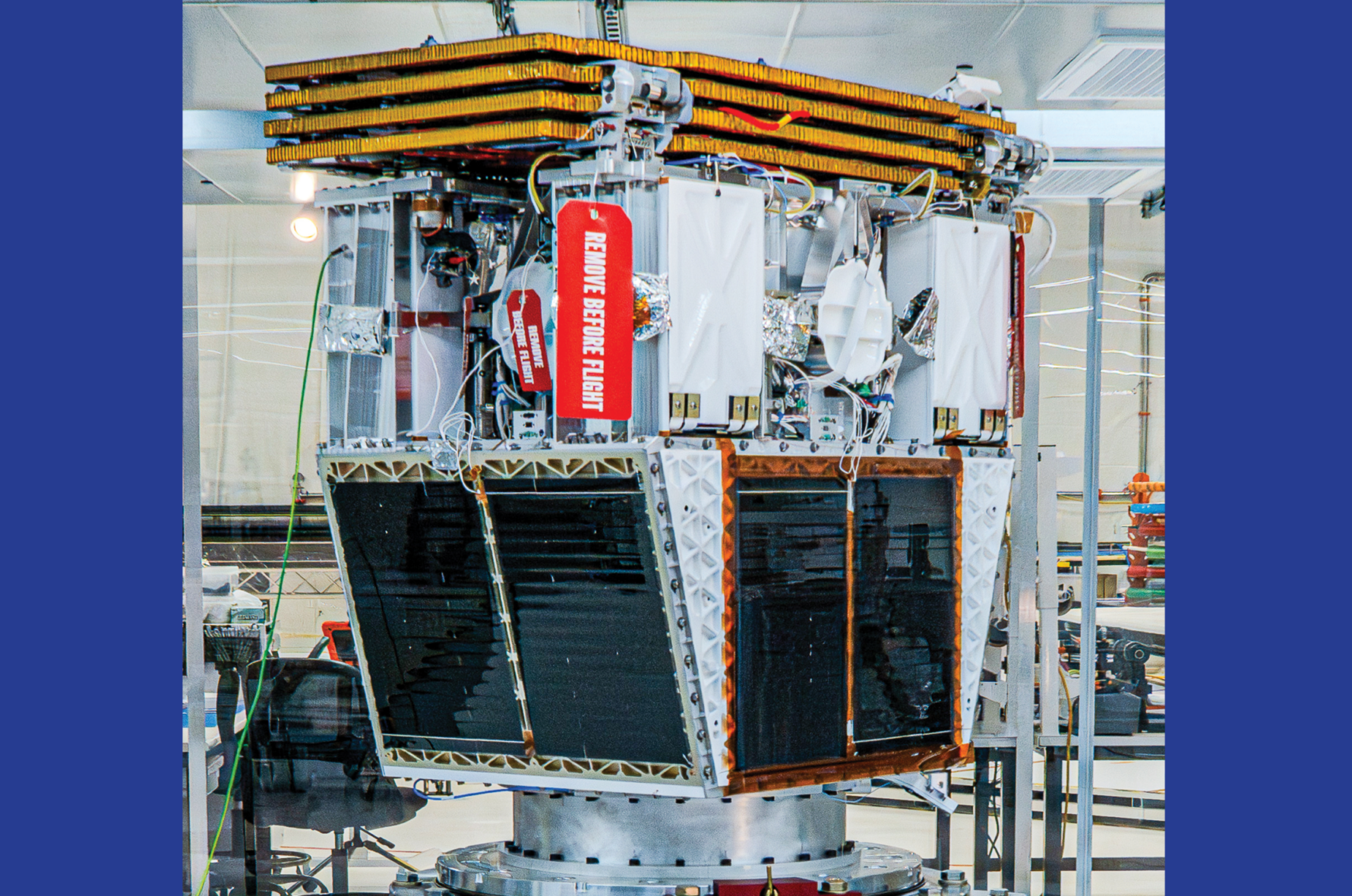
The first in-space test of this technology is to commence later this year, when a SpaceX Falcon 9 launches a satellite roughly twice the size of a microwave containing extremely thin and shiny reflectors.
Reflect Orbital, which is based in Los Angeles, declined to name the rideshare mission or target launch date. The Federal Communications Commission granted the company a license for its first mirror satellite, dubbed Eärendil-1, on July 9, per a news release.
Eärendil-1 is bound for an altitude of around 500 kilometers. Once there, the 134-kilogram satellite is to unfurl its solar array of four triangular reflector panels to create an 18-meter square.
“Sun is the most powerful resource in the solar system,” said CEO Ben Nowack, “and we currently have no control over where and when it shines, so we’re trying to do that.”
After the satellite is fully deployed and checked out, “we’ll boost up to 650 km altitude [and] do some demonstrations up there,” he said.
For these demonstrations, ground operators will position the satellite so its mirror panels reflect sunlight at a target location on Earth for about 5 minutes. The illumination is expected to be “about the brightness of a full moon” and cover a 24-square-km area, Nowack said.
He declined to list the planned illumination locations because the demonstrations will be done in coordination with “dozens” of entities considering purchasing the company’s sunshine services. So far, he said, potential customers include solar farms — which Reflect Orbital views as its likely anchor clients — as well as emergency response crews and event-type organizers. Nowack said some of these entities, like solar farms, might use the nighttime sunshine to increase production, while others might use it to help in a crisis or fuel public excitement.
The technology also has potential military applications, including as a helicopter searchlight or an artillery flare, he noted.
For the upcoming demo, which Nowack said Reflect Orbital is primarily self-funding, the company received a $1.25 million award from the U.S. Air Force in 2025. Nowack said the prototype satellite cost around $2 million to build, though similar production units are estimated to cost around $300,000 each. He declined to disclose the full cost of the mission.
The success of the illumination trials hinges on Eärendil-1’s mirrors and operational controls.
Designed by Reflect Orbital, the reflector panels have an aluminum front and a space-grade plastic backing. Each panel weighs about 500 grams and is only 15,000 atoms thick — significantly thinner than a human hair.
“[It’s] just like a bathroom mirror,” Nowack said. “Actually, our mirror is a little bit more efficient than a bathroom mirror” and “slightly shinier.”
“It’s not new physics, but it’s new engineering,” he added.
To control the reflection off these panels, the prototype satellite is equipped with “massively oversized” reaction wheels — the size “usually used in a 650-kg-class spacecraft,” Nowack said.
Reaction wheels allow spacecraft to change pointing direction without burning fuel. Eärendil-1 will have three such wheels, according to the company’s FCC filings.
Reflect Orbital has also developed software meant to stabilize reflections and ensure the light is kept away from certain areas, such as dark sky parks or observatories.
Still, the American Astronomical Society filed an FCC petition in March, arguing the technology would interfere with professional and amateur stargazers, pose a nuisance to the public and disrupt natural environmental cycles.
“While the AAS supports U.S. commercial space innovation, the potential for catastrophic interference with federally funded astronomical research, in addition to potentially serious impacts to human health and the Earth’s environment, outweigh the limited experimental utility of this” satellite, the petitioners wrote.
Nowack told me the company has “implemented a lot of design changes based on the feedback that we’ve been getting over the years.”
“We really feel that that responsibility and that weight on us,” he added.
Reflect Orbital hopes to launch a second prototype satellite by the end of the year, with a long-term vision of launching enough mirror satellites to make sunlight-after-dark a commercially viable service.
Eärendil-1 has a design life of one year and is slated for deorbit post-demonstration rather than becoming part of the future constellation.
With more satellites, Nowack said, “we can increase the amount of time that we’re able to serve a particular location,” direct sunlight to “any location around the world” and “increase the brightness” by pointing multiple satellites at the same location.
He added in a written statement: “What we learn from the demonstration mission will shape everything that comes next.”