

In 2022, NASA and the U.S. Energy Department announced a handful of study contracts for nuclear reactors that could generate power for at least a decade on the lunar surface. It was a clear indication of the role nuclear power could play in the agencies’ broader ambitions, including the Moon Base plans NASA unveiled earlier this year.
By that time, Vanderbilt University students Tyler Bernstein and Jonathan Segal had founded their company, Zeno Power, and were working on harnessing nuclear power as a sustainable solution for powering deep sea vessels and deep space probes.
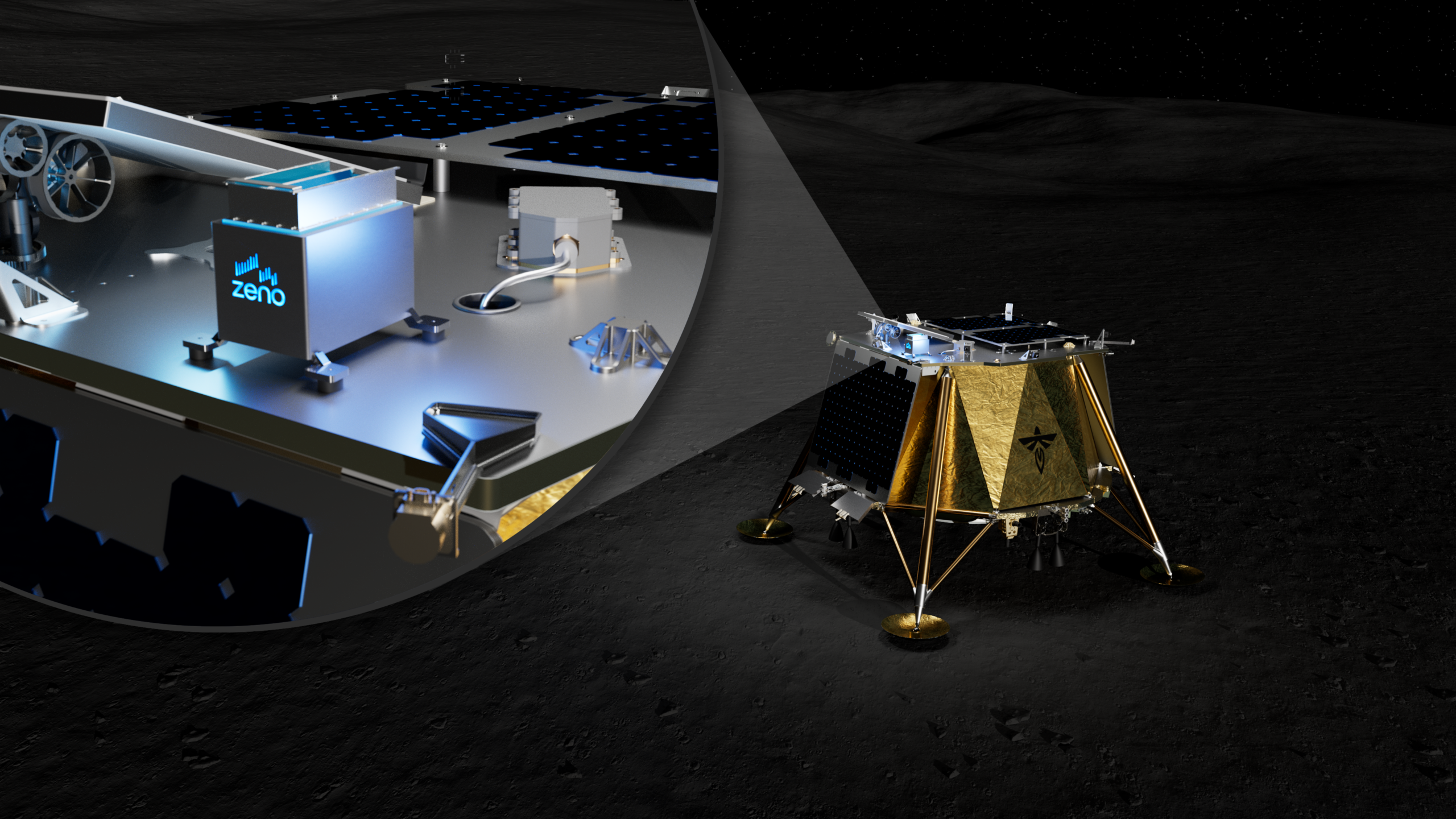
The Seattle-area company in 2023 received a $15 million NASA Tipping Point contract to develop a radioisotope Stirling electric generator to power lunar landers and surface systems. Separately, Zeno last month announced plans to demonstrate a radioisotope heater unit — a “survive the night” package that provides essential heat rather than electricity — aboard a Firefly Aerospace lander that’s slated to land on the moon “no earlier than 2028.”
Bernstein spoke with me about his company’s strategy, the existing regulations and what’s driving renewed interest in space nuclear power. Selected excerpts of our conversation follow, edited for length and clarity.
Q: How does Zeno’s generator work, and why have you developed this method? Why is this method suited to lunar exploration?
A: The company was founded with this core belief that we’re seeing increased competition with China in areas like the Arctic seabed and deep space, where energy supply is a massive challenge.
On the seabed, solar power doesn’t work. Batteries die quickly. On the moon, we don’t have infrastructure. You’re in sunlight for two weeks and darkness for two weeks, making solar power and batteries challenging by themselves, which is why recent landings quit after the two-week-long lunar day. And we started seeing how compact nuclear power sources could be foundational for space exploration.
We are not building nuclear reactors, so no fission, no uranium. We are building nuclear batteries, boxes the size of a microwave oven or smaller, where we take radioisotopes — material that decays and produces heat for decades — and we convert that heat into electricity.
It’s not new. NASA has used it for all our deep space spacecraft. Now, we can take this proven technology but industrialize the production and build this at mass scale using available abundant fuel forms.
Q: Is there renewed interest in nuclear power as a fuel source?
A: Interest in nuclear power waned after Apollo and the Cold War. Today, we’re once again entering this extremely exciting era of nuclear energy, where we’re seeing investments, from microreactors in military bases to small modular reactors for data centers.
So you’re seeing nuclear come back at full thrust right now, and I think there’s a friendlier political environment for it and multiple tailwinds from energy resiliency to decarbonization.
It comes back to [NASA] Administrator [Jared] Isaacman and the centralized plan for the Moon Base, but also his personal belief that nuclear power is instrumental to space exploration and to power a large infrastructure on the moon.
Q: What products do you have for what types of missions?
A: To address the cold, we have a radioisotope heater unit. The other is the radioisotope Stirling generator. The heater is what we announced that we’re flying to the moon in 2028. Our radioisotope Stirling generator is currently under development with a NASA Tipping Point award, and that is the second product that we’ll bring to the lunar surface, to have power that enables 24/7, year-round operations.
NASA says its Tipping Point awards are meant to “foster the development of commercial space capabilities,” in cases where an investment from the agency will “significantly mature the technology” and “bring the technology to market.” — PB
For decades, NASA had a program that was funding Stirling generators. They’ve always used plutonium 238, which is a rare, expensive isotope. So they were investing in the Stirling engine to look at how to increase the efficiency. So there was a ton of investment from NASA, focused at NASA Glenn Research Center. And in our NASA Tipping Point award, we’re also working with NASA Glenn and industry partners that have been developing this for years to get to a test flight very soon, hopefully.
Q: Tell me about the nuclear material you’re using and how difficult it is to obtain.
A: We are using an isotope called Americium 241 as the fuel for our space systems, which has a lot of characteristics that are like what makes plutonium 238 attractive. It’s an alpha emitter, so the fuel requirements are relatively minimal. It has a long half-life, over 430 years.
Alpha emitters are radioactive materials that shed alpha particles, composed of two protons and two neutrons. These particles travel short distances of up to about 5 centimeters, making them thermally efficient and relatively safe in confined spaces. — PB
Americium 241 has a supply chain that can be more available than plutonium 238. It can be separated or recovered from nuclear waste streams. So we’re recycling nuclear waste material to power the Moon Base.
The supply chain is still relatively immature, but it’s one that we’re investing heavily in to ensure that we can meet the demand to build hundreds of these generators for the Moon Base. Americium means we can scale up in a way that we couldn’t with plutonium 238.
Q: How are you tackling regulatory barriers?
A: We’re now engaged with the FAA, NASA and the correct regulators to ensure that we get the approval to launch safely. I’d say we’re very engaged on the Hill with Congress members and also with different White House stakeholders to help kickstart the industry through funding opportunities or streamlining regulation or language that encourages NASA to use nuclear power by certain dates.
There really is bipartisan support for this. The NASA Reauthorization Act has entire sections that were focused on space nuclear.
The House version of the latest NASA Reauthorization Act includes an amendment that states “space nuclear systems are a key enabling technology for deep space human and robotic missions.” — PB