


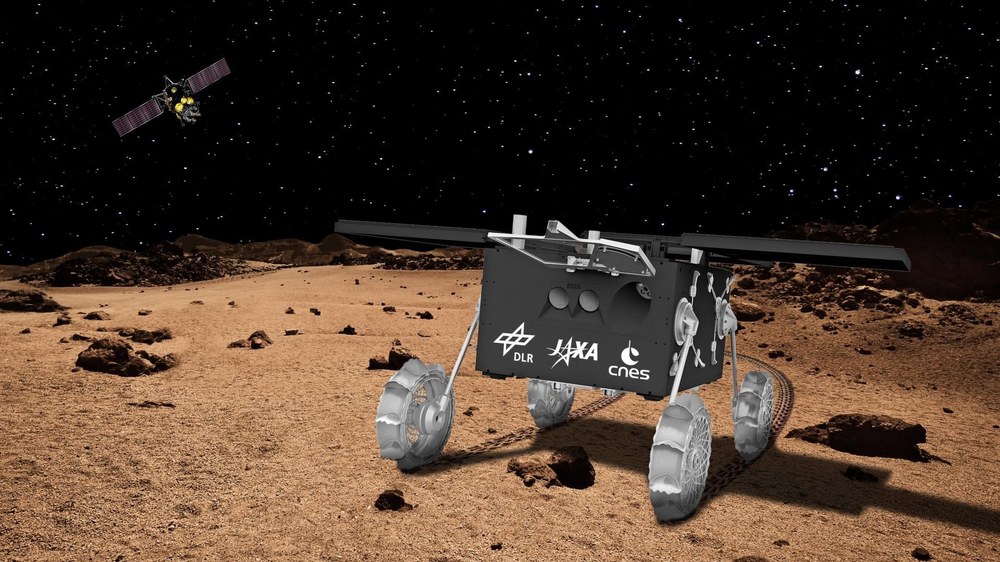
The first surface rover to attempt wheeled locomotion on an ultra-low-gravity celestial body is slated to begin its voyage across the solar system next week, when the Japan Aerospace Exploration Agency launches its Martian Moons eXploration (MMX) probe.
The 4,200-kilogram spacecraft is scheduled to lift off at 4:41 a.m. Japan Standard Time on Oct. 20 (3:41 p.m. Eastern on Oct. 19), beginning a yearlong journey to the Martian system. If all goes as planned, MMX will arrive in late 2027 and use remote-sensing instruments to help determine whether the moons Phobos and Deimos are chunks of ejecta from an ancient collision with Mars, or if they are captured asteroids.
One of MMX’s main objectives is to acquire 10 grams of regolith from the surface of Phobos for return to Earth in 2031. This would be the first sample ever returned from the Mars system — unless China’s Tianwen-3 Mars sample return, also due back in 2031, arrives first.
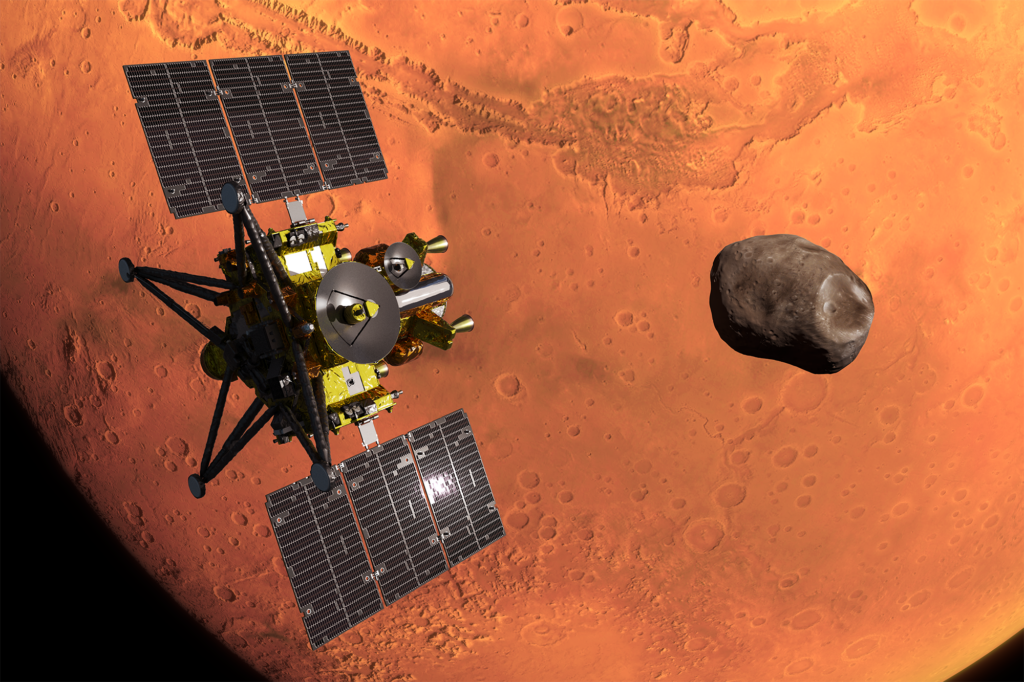
In addition to identifying the best sampling site, the MMX probe is to scout out a landing site for Idefix, a 25-kilogram wheeled rover that is to traverse Phobos for 100 days, characterizing the surface granularity, chemistry and geology with its ground sensors. The rover would be the first to conduct wheeled driving on an ultra-low gravity body. Previously, only small hopping landers — like the MINERVA probes JAXA deployed on a 2018 sampling mission — have provided mobility on low-g bodies like asteroids. The rover’s findings are to help answer the question about Phobos and Deimos’ origins, as well as provide info for future lander missions.
Gravity on the potato-shaped, 27-km-long Phobos is around 2,000 times lower than on Earth, raising many engineering challenges, said Bastian Deutschmann and Fabian Buse. They’re the chief mission engineers at the German Aerospace Center (DLR) in Munich, which built Idefix alongside French space agency CNES.
“Idefix has a mass of 25 kilos, but its effective weight on Phobos” will be 12 grams — “the same as a grape or a medium-sized envelope,” Deutschmann said. This has ramifications for how the rover is deployed and gets upright, as well as how fast it drives.
DLR wants to avoid the fate of ESA’s Philae lander, on which it also worked with CNES and others. That lander attempted to reach the surface of comet 67P/Churyumov-Gerasimenko in late 2014, only for its anchoring harpoons and hold-down thruster to fail. Philae bounced for hours, finally lodging in a crevasse, where the lack of solar power limited its mission to 60 hours.
To avoid this with Idefix, “the MMX spacecraft will map the surface of Phobos to help us pick a suitable landing site” said Deutschmann, meaning one that is as flat and crater-free as possible.
MMX is slated to release Idefix from an altitude of 40 meters, so the rover will impact the surface at 1 meter per second (2.2 mph) — below Phobos’ 10 m/s (22.3 mph) escape velocity, so Idefix does not bounce back into space. DLR expects the rover to bounce for around 15 minutes, traveling a few tens of meters before coming to rest.
In case Idefix does not settle upright, the CNES team, led by rover engineer Brysbaert Clement, has developed a universal uprighting mechanism. By installing the wheels at the end of extendable arms, each fitted to 360-degree electrically-rotatable “shoulders” that can swing the legs to either side of the rover chassis, it’s always possible for the rover to reorient itself.
Once the box-like rover is upright, three solar panels will fold out sequentially from its top, deploying to the rear, left and right of the chassis. If the sun angle is not quite right for a flat deployment to suck up maximum energy, the individually rotatable legs can be moved to angle the rover into the sun. This is critical to mission success, said Buse, because without power to warm its electronic systems, night temperatures of around minus 150 degrees Celsius would freeze, embrittle and destroy Idefix’s circuits.
Assuming uprighting works, Idefix will have to keep to a glacial speed of just 1 mm/s, said Deutschmann. “In an emergency stop, we must not fall over forwards, so that puts a hard limit on our upper velocity.”
That limit is 5 cm/s, he said, but Idefix is to go much slower so it cannot trundle into risky terrain during periods when it’s out of touch with mission control.
Locomotion is not the only role for Idefix’s wheels: The rover also has a pair of WheelCams aimed where the front and rear left wheels meet the soil. “These allow scientists to understand how the regolith behaves and flows in microgravity,” said Deutschmann.
By observing how the regolith tumbles off the “grousers” — the grip-providing lugs stationed all the way around the wheel’s diameter —scientists can estimate grain size, shape and cohesion, as well as how compacted the moon’s soil is.
That’s priceless data for future lander missions to Phobos, said Dan Negrut, a surface rover specialist at the University of Wisconsin-Madison.
“The WheelCams should provide a rich record of the soil’s mechanical behavior,” he said.