

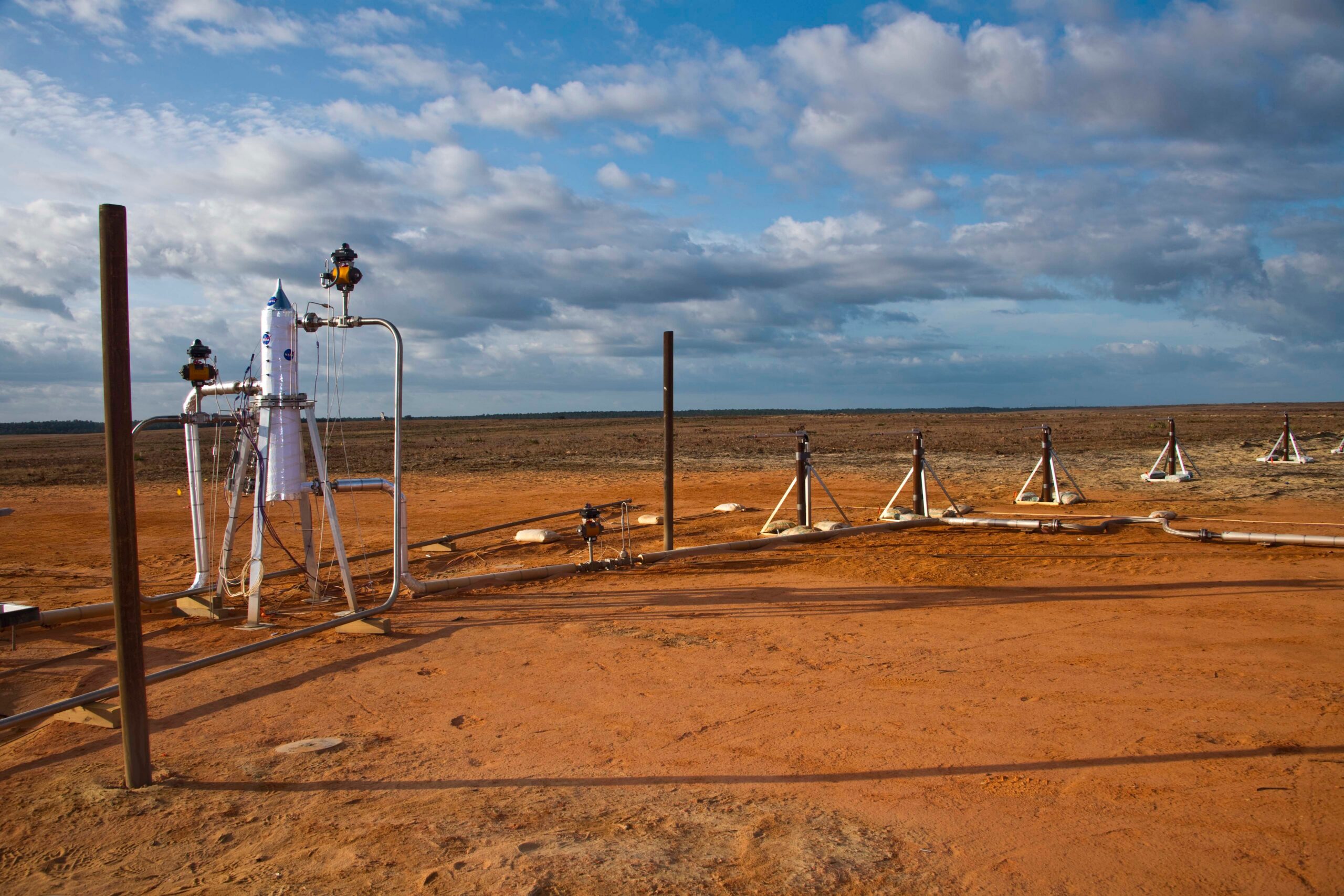
NASA is targeting the middle of this month to wrap up a test campaign that is simulating explosions of rockets fueled by liquid methane, a common propellant for the new generation of launch vehicles. The goal is to inform efforts to update launch safety protocols and launch pad keep-out zones, the agency said.
Tests began in January at Eglin Air Force Base in Florida, NASA said in an emailed statement attributed to Jason Hopper, deputy project manager of the Liquid Oxygen Methane Assessment.
As of Aug. 26, engineers had conducted 16 detonations of test articles filled with pressurized liquid natural gas — which is mostly methane — and liquid oxygen, Hopper said. The largest detonation used 9,000 kilograms of propellant, and three more explosions at that size are planned.
The tests are scheduled to conclude Sept. 16, he added.
In a March article, NASA described the tests as part of its responsibility to understand the “safety profile” of liquid oxygen and methane-propelled rockets and spacecraft, given the increasing popularity of the combination, particularly for larger designs. SpaceX’s Starship and Blue Origin’s New Glenn, for instance, require hundreds of thousands of kilograms of methane per launch, according to each company’s published rocket details.
NASA’s existing models and protocols for ground explosions were crafted for rockets that use liquid hydrogen and liquid oxygen, such as SLS, or liquid oxygen and kerosene, such as SpaceX’s Falcon, Hopper said, but for liquid methane designs, new models are needed.
The remote detonation tests at Eglin are being conducted in cooperation with FAA and the U.S. Space Force, according to the March article.
Hopper said NASA’s testing includes two failure scenarios. One is a “bulkhead failure,” in which there is some breakdown of the barrier between the liquid oxygen and liquid natural gas tanks in the test article. Another configuration is failure of the “transfer tube” that feeds one of the propellants through the tank containing the other propellant.
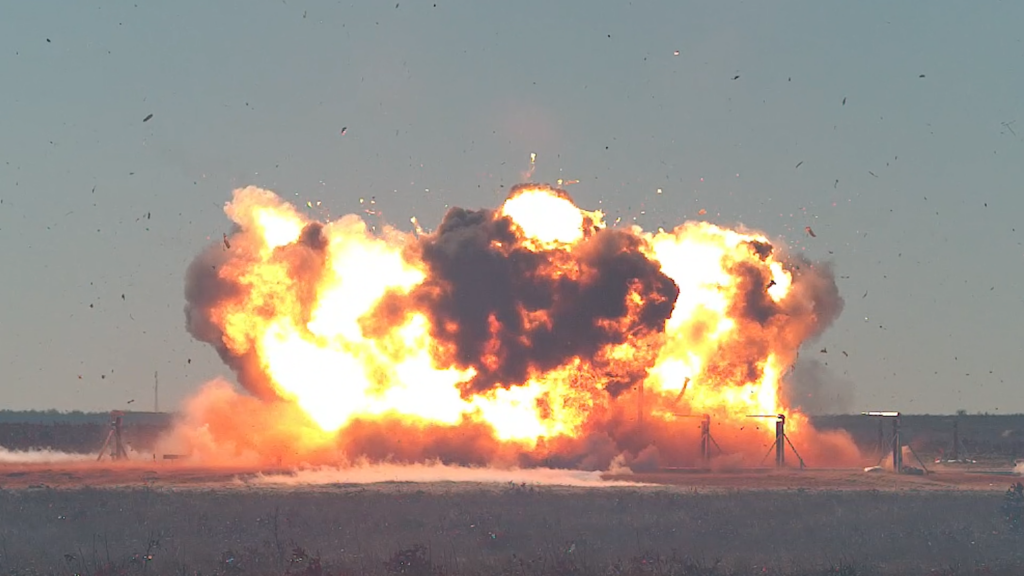
To measure the resulting explosions, NASA placed instruments on the test articles themselves and out to roughly 240 meters, including optical cameras designed to capture high-speed movement of debris and acoustic microphones and sensors to measure heat and pressure, according to the agency and contractor Amentum.
Hopper said “the main safety issues involved are blast overpressure [blast wave] and fragmentation. These issues affect four main domains: ground siting, range safety, crew safety, and nuclear payload safety.”
Ground siting is the “development of hazard areas for protection of personnel and infrastructure during ground operations such as fueling a rocket on a launch pad,” Hopper added, while range safety refers to keep-out zones for people, vehicles, boats and aircraft during a launch.
When it comes to crew safety, he said, NASA must assess how a methane explosion affects “risks to a rocket capsule in an abort scenario, which is used to determine abort rules such as separation time.” Nuclear safety requires the agency to predict and safeguard against the dispersion of nuclear material from a payload in the event of an explosion.
Amentum said by email the tests have “provided valuable experimental data on the explosive behavior” of the methane-oxygen combination. Amentum and NASA will “validate and refine analytical models and predictive methods, helping improve the industry’s understanding” of why and how such explosions occur, the company added.
There are a few real-world examples of liquid methane-fueled rocket explosions. A Starship upper stage exploded during a June 2025 static fire at SpaceX’s Starbase facility near South Padre Island, Texas. And in May, a New Glenn exploded during a hot-fire test on its Florida launch pad, damaging nearby structures and creating a massive mushroom cloud.
Also as part of the Florida tests, Kent Gee, a physics professor at Brigham Young University in Utah, had teams of his students place microphones in three directions from the test articles, out to 30 kilometers, to measure how the acoustic sound waves from the explosions travel farther out.
Gee, who Amentum hired as a subcontractor, told me the testing done thus far shows that the direction the wind is blowing, the temperature and humidity and the presence of any hills can affect the strength of the pressure waves.
“We know weather affects sound, but when it comes to measuring the impact weather has on a blast like this, we need the data from multiple tests to build a model that we can use to gauge even larger explosions,” he said in an early August interview.
The surrounding greenery is another big factor in how far the sound waves travel, he added.
“Foliage is actually scattering the sound, and that sound absorption through the trees and ground cover is actually turning out to be more than I would have expected.”