


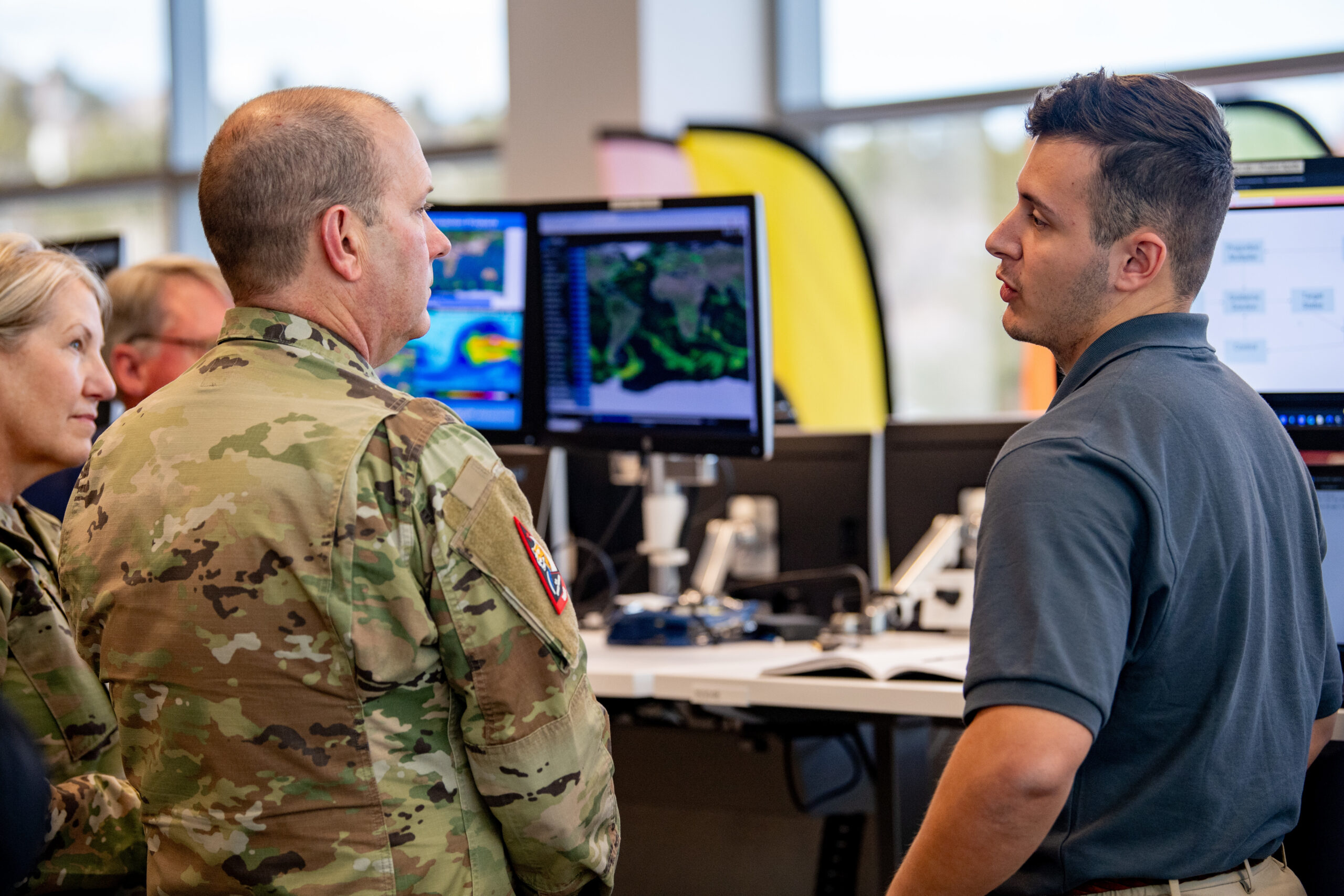
The U.S. Space Force’s commercial software laboratory is preparing to host its first participants since undergoing an extensive overhaul. The changes — which include a new name, longer program timelines and rotating focus areas — are intended to create a more effective pipeline for bringing participants’ software into operational use.
“Where the SDA TAP Lab wasn’t quite as effective is transitioning the technology to programs of record,” said Lt. Col. Collin Greiser, a System Delta 85 program leader, referring to the facility’s previous name. It had “some success” at this, “but it very much was, I think, an exception rather than a norm.”
“We’re trying to solve all that with how the BMC3I TAP Lab was rearchitected,” he added.
Under the old model, the SDA TAP Lab — short for Space Domain Awareness Tools, Applications and Processing Lab — ran three-month programs, during which companies developed products, ideas and research to address specific Space Force software challenges. The last cohort concluded its work in March.
Under the new model, first announced in July, the BMC3I TAP Lab has a broader focus on finding innovative software for battle management, command, control, communications and space intelligence capabilities. It sits within the Space Force’s Kronos program, which focuses on these same topics and is also led by Greiser.
Participants will now move through the BMC3I TAP Lab in a “staged approach” expected to last about a year, Greiser said, adding “we’re going to try to run as many as three cohorts a year.”
First, participants will apply as teams and pitch technology for one of the lab’s current focus areas, which are slated to change over time, he said. Once selected, they’ll “get integrated with the [lab] environment” and “demonstrate to us you can do code development,” a process he said takes about six weeks.
“The subsequent two stages after that are essentially what I would call SBIR phases,” Greiser said, referencing Small Business Innovative Research contracts, “where they have the opportunity to win work.”
The BMC3I TAP Lab will not directly fund participants, he said. Instead, plans call for the funding to come from SpaceWERX, the Space Force’s innovation arm. “We integrate our process with their calls for awarding SBIR contracts. Essentially, when I let a focus area, I’ve already precoordinated with SpaceWERX.”
As teams move through the lab, “they are essentially refining [their software], applying more cybersecurity controls, passing more tests,” Greiser said, “and then getting ready to go to the proving ground as kind of the exit of the lab.”
“When you ‘graduate’ that model and that proving ground, you have a high chance of getting a contract with the government,” he said.
“That’s when my program’s funding kicks in,” Greiser said. Kronos has a commercial solutions opening which lab participants can “apply to and have the opportunity to win more serious contracts,” although these are not guaranteed.
The BMC3I TAP Lab has two focus areas for its first cohort: Battle Damage Indications/Assessment, which will look for innovative ways to fuse data, and Crimson Forge, which is to build on an earlier space domain awareness effort.
Greiser said these topics were selected based on feedback from Space Force operators.
“We’re almost ready to announce the first cohort,” he told me in mid-September.
He added: “We’re trying to make it [the BMC3I TAP Lab] deliberate and structured, so that at the end we have the highest chance of transition and integration.”