Researchers design crash-resistant locator beacons for nuclear spacecraft
 By Paul Marks
 By Paul Marks
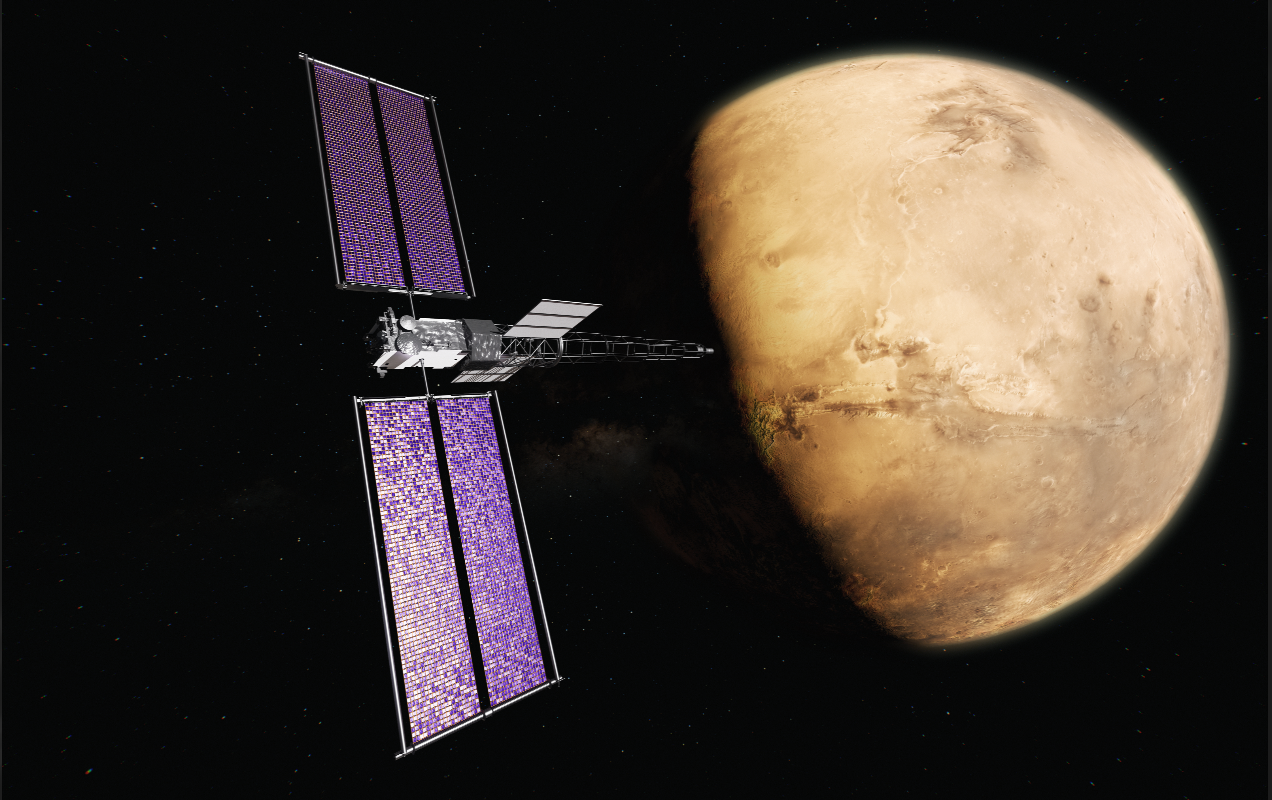
Nuclear fission has emerged as an attractive option for propelling deep space missions to Mars and beyond. However, launching such spacecraft from Earth poses a potential safety risk — and a group of Chinese researchers believes it may have a solution.
In the event a launch vehicle explodes or suffers another destructive anomaly on ascent, hazardous materials responders must be able to quickly find and secure any fissile reactor materials in the wreckage. But how can those materials be found if a spacecraft’s locator electronics are destroyed in the breakup?
One answer could be the impact-resistant device proposed by a team of aerospace engineers led by Wang Chen at the Nanjing University of Aeronautics and Astronautics in China. In a paper published in late June in the journal Acta Astronautica, the researchers described their concept for a “Micro Black Box,” or MBB, that combines a satellite locator beacon and a flight data recorder.
This 4.5-kilogram device, they wrote, would allow space agencies to quickly track down nuclear materials lost in such incidents before the substances leak into the wider environment or harm people. And they are confident of its impact resistance because they have been firing prototypes into dirt and water using a piece of recoil-less weaponry called a Davis gun.
To create the MBB, the Nanjing team placed a Beidou (China’s GPS system) transponder and a flight data recorder on an electrical module. That module was then installed at the center of a hardened aluminum alloy cylinder measuring 16 centimeters in diameter and 16 cm long — about the size of a small can of paint.
To protect the electronics from the force of a spacecraft explosion or impact, they filled the cylinder with shock-absorbing materials the paper described as “multilayer buffering structures.”
“After a launch failure of a nuclear-propelled spacecraft, all of the gravitational potential energy and flight kinetic energy will convert into impact energy. The crash velocity may reach hundreds of meters per second, and acceleration may reach hundreds of thousands of meters per second squared,” the authors wrote. “This will destroy everything in the spacecraft and cause a nuclear leak.”
The buffer structures are designed to absorb up to 26 kilojoules of impact energy, and in simulations were shown to “absorb 90.26% impact energy,” the authors wrote.
These structures are layered in a series of shells, starting on the outside with an aluminum alloy casing. Beneath that is an aluminum honeycomb layer, followed by a magnesium alloy section, then a hyper-elastic foam sealant that can be heavily deformed to absorb a lot of energy. All of these sit atop an aerogel layer, which provides heat protection to the locator module.
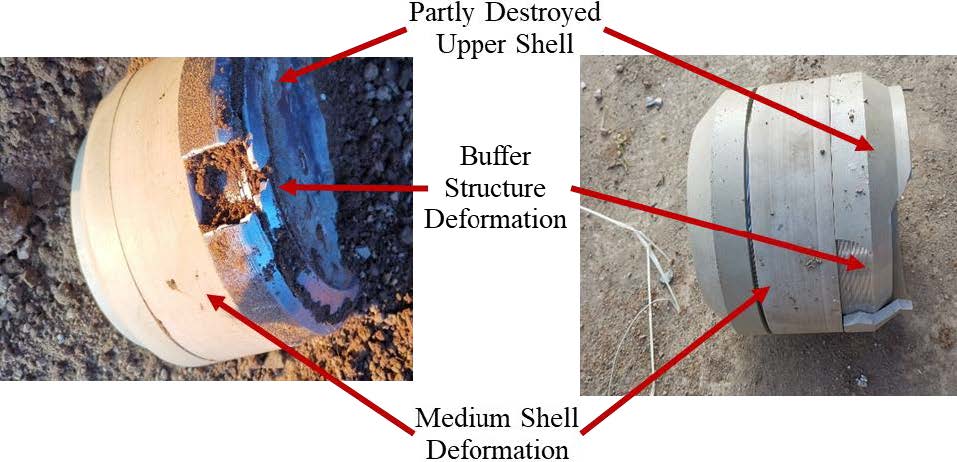
The MBB design was first simulated and perfected on a hyperfast 1400-teraflop supercomputer before facing ballistic tests. For these trials, the Davis gun — which cancels lab-damaging recoil by firing an equal mass in the opposite direction to the main round — propelled the MBB into an earthen bank.
The researchers found the core locator and data module were unharmed, suffering no impact deformation after impact. “It still operated well and would help to find the crash location,” the team reported. However, the exterior suffered some damage — and fixing that is the subject of ongoing work at Nanjing.
At least two space agencies are planning deep space missions that would rely on nuclear-electric propulsion, which uses the heat from nuclear fission to generate electricity to drive ion engines. In March, NASA announced it will develop the Space Reactor-1 Freedom spacecraft, slated to launch toward Mars in 2028 carrying a payload of no fewer than three Ingenuity-derived Mars helicopters. And in 2022, the China National Space Administration revealed it is targeting 2030 to launch a nuclear orbiter to the ice giant Neptune.
The Nanjing team’s work is important to these and future missions involving nuclear spacecraft, said Javid Bayandor, founder and director of the Crashworthiness for Aerospace Structures and Hybrids Laboratory at the University at Buffalo in New York. Known as the CRASH Lab for short, the facility has simulated spacecraft impacts for various NASA missions and concepts.
“The risk of radioactive materials polluting the atmosphere due to a leak or failure cannot be overstated,” Bayandor told me by email. “It is therefore imperative for any relevant space programs to resort to an array of preventative solutions, with extremely high reliability, to drastically reduce the risk and plan to avoid/contain any leakages as may be caused by potential launch or system failure.”