

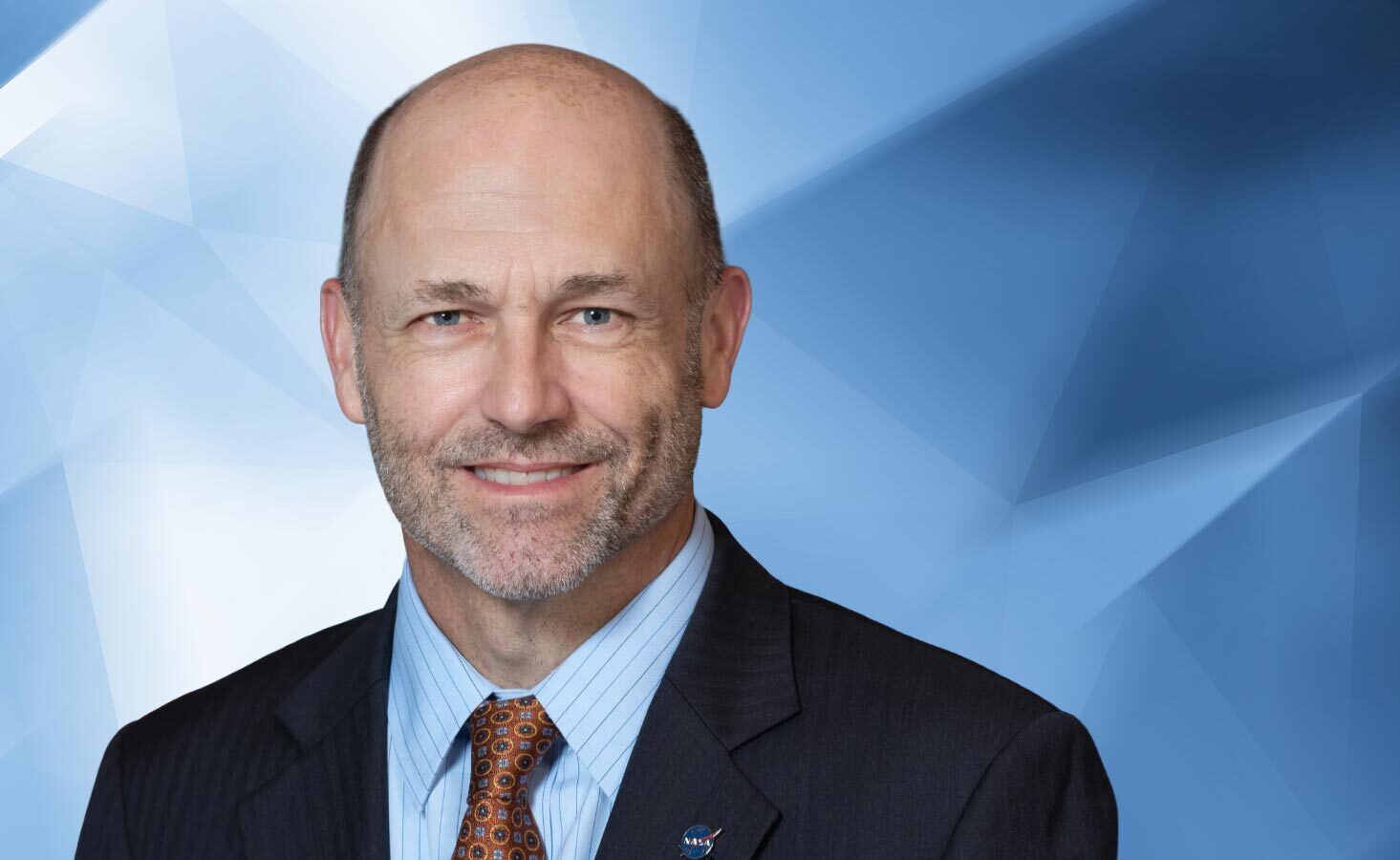
Pick one of NASA’s high-profile research initiatives or missions, and there is a very good chance it falls under Jimmy Kenyon’s purview. The consolidation of the agency’s aeronautics and space technology directorates into a new Research and Mission Technology Directorate was one of the largest changes under the reorganization Administrator Jared Isaacman announced in May.
RMTD’s $2.6 billion portfolio ranges from X-planes to nuclear power and propulsion, and includes many of the technologies required for the consistent lunar surface operations the agency envisions for its Moon Base. At the same time, Kenyon says he’s balancing these and other short-term priorities against the long-term research investments required for innovations decades in the future.
Our wide-ranging conversation has been lightly edited for clarity and length.
Q: What are the benefits of bringing everything from aeronautics to space mission technology under the same directorate?
A: The idea overall was to create a single, fast-moving organization that’s going to drive and deliver the technologies that our missions need, and that our space and aerospace industry need, including our aviation markets and industry. We find that in many cases, what we’re doing in space and what we’re doing in aviation and aeronautics are very much synergistic. We’ve already identified a number of areas where we can bring those investments together in one place, so it’s a more holistic investment, a single view of where the technology is going, what the needs and the gaps are.
I can give you a few tangible examples. One is high-temperature materials. When I was the Glenn center director, we were working on a new metal alloy, and we were getting funding from both Space Technology and Aeronautics Research [mission directorates]. It was complementary, but by having it all in one place, now we know what we’re investing, and we can make sure that investment stays whole and gets us the outcome and the product that we need.
Another area is communications. When we were working on optical communications, we were doing some testing on a research aircraft and seeing that we could go from a moving aircraft and beaming to the space station. But then we also were working [on that] in Space Operations [Mission Directorate], which eventually transitioned and was demonstrated on Artemis II. Being able to bring that technology across actually allows us to leverage both. Everything we’re going to learn on the moon about lunar relay is something that we can use as we expand our airspace.
I’ll share just one more example: workforce. It gives us an opportunity to more easily move people between, say, aeronautics and space applications. It gives them a little bit of an advancement and an opportunity to grow their careers in different ways as well.
Q: How do you balance the portfolio to support near-term priorities like Artemis as well as the long-term investments for missions that are decades away?
A: This is a natural tension that always happens in a research and technology organization. You spend some time working on a very fundamental technology, and you’ll invest at a certain level. But then you have a breakthrough, and you need to push it to the finish line. Well, pushing it to the finish line can take some [extra] investment. So you have to look at it holistically: What is the mission? What are the priorities? Where do we impact those priorities?
By bringing together the organization the way we have, we actually have an opportunity now to really deliver these technologies to the agency’s missions and priorities, be they Artemis, a lot of focus on Moon Base and where that’s going to go, the SR-1 Freedom, additional X-planes.
By the same token, we also know that there won’t be priorities beyond that if we don’t have some investment in what that future is going to look like, which could be different. You always have to think about how you’re going to disrupt yourself. There’s not an equation or an algorithm that gets you there, but it’s a mindfulness of where you are in the mission, where you’re driving the mission and where that gives you flexibility to invest in newer things.
Q: The administrator has talked a lot about addressing the “X-plane deficit.” What can you share about the plan to do that and when we can expect some announcements?
A: The administrator has clearly expressed to us that we want to fly more. Period. We’re looking at our priorities, going through the budget process now, looking at where we want to go with — we loosely call it X-planes, but that actually has a very specific moniker — large-scale flight demonstrators.
We have some things that we want to take to flight, but we’re not going to be able to make any real announcements until we go through that budget process. In the meantime, we’re also working on a way to accelerate flight at different scales.
One is a project called the Aeronautics Flight Accelerator. We have a number of flight test assets now that we use as chase airplanes. We can board sensors on them. We can board payloads on them. We completed a couple flights this past year where we did natural laminar flow on a high-speed jet by putting a fin on it that had laminar flow control. We just bolted it on a jet and flew it. So we’re doing more of that, and we’re working on some internal projects, and hopefully soon we’ll be doing something externally where we allow others to come in and flight test with us as well.
If it’s something that can be bolted onto another asset, then we’d want to do that, because it’s about how do you get to flight and what’s the right environment to demonstrate the technology. But there are things that hey, the aircraft configuration is what drives the technology. Take X-59. The outer mold line is designed to mitigate the shock structure. I can’t bolt that onto something — I’ve got to fly that.
Q: When the administrator said “more X-planes,” my mind went to X-66A. Any chance of reviving that flight demonstrator?
A: We have to look at, again, what we’re trying to do and the timescale and the complexity and if that makes sense for the technology that we’re trying to demonstrate. We’re working with Boeing on what that would look like,
whether that’s the right vehicle — and so we’ll have to see how that pans out.
NASA and Boeing originally planned to fly this demonstrator in 2028 to demonstrate the truss-braced wing design, but indefinitely paused aircraft development in 2025. Ground testing of the wing and other components has continued. — CH
I think we’re going to get to a good answer on that because there are clearly some really good technologies: the high-aspect ratio, short cord, so-called thin-wing technology has a lot of promise and a lot of benefits. But we need to make sure we’re using the right asset to get that to flight.
Q: Shifting gears to Moon Base, paint us a picture of 2030. What does the base look like and what kinds of operations are happening there?
A: The initial Moon Base is largely going to be robotic in nature, and right now we’re looking at our Commercial Lunar Payload Services program as a way to take many of those assets up there and put them in place. There’s technology demonstration there, but what you’re really talking about is placing really mature technology in the operating environment. Figuring out how to operate the robotics in the austere environment that is the moon — the dust, the sand, the illumination, the power constraints, those sorts of things.
A big part of our directorate’s focus is Phase Two and Phrase Three: a more enduring, more integrated Moon Base. Much of what’s going up in Phase One has to take its own power. In Phase Two, I’m going to need a power infrastructure, and so this is where we start getting into radioisotope power systems that we would be sending up. We’re going to need to figure out how to do those more rapidly, more efficiently. Eventually, putting a fission power system on the surface of the moon to drive larger-scale power. If we’re going to do any sort of industrialization, any sort of regolith mining or regolith processing, we’re going to need power to do that. We know from our experience here on our own rock that power is a real constraint to some of the industrial things that we want to do.
We’re going to need comms. If I’ve got robotic systems working together on the surface of the moon, they’ve got to talk to each other. I need wireless technology, some sort of a technology that’s going to allow this system here to talk to that system there and say, “Hey, I’ve got to meet you here to power up, or I’ve got to meet you here to get astronauts from here to here.” Now I can do scientific experiments, whether it’s observations or understanding or excavation and sampling. I can have people interacting with robotic parts of it. This is the exciting part of what we want to get to.
Q: On nuclear power and propulsion, what gives you the confidence that this is the right time for this technology after decades of starts and stops?
A: The difference this time is we’re going to stay on the moon, and that means you’ve got to have power that can survive the lunar night. Solar is great, but when you enter the lunar night or less illuminated parts of the moon — which is where some of the more interesting things are — solar’s not going to cut it for you. Nuclear is a great answer to that. So we have a pull for it, we have a purpose for it, and that gives me a lot of confidence that we’re going to develop it.
We also see our sights going out beyond Earth, eventually taking people to Mars. Science going interplanetary with larger and larger missions. We need next-generation radioisotope capability, but we also need something larger. Fission power provides some real opportunities there. Clearly, the administrator sees that, the [Trump] administration sees that and so seizing this opportunity with their support where the mission is driving us there, that’s what I think is going to get us there ultimately with nuclear power and propulsion in space.
Q: Long term, how widely do you see nuclear propulsion being adopted compared to chemical propulsion?
A: Again, that’s going to be driven by the mission. With chemical propulsion, I’ve got to carry my stuff with me. Getting stuff off of this planet — between the drag going through the atmosphere and the weight getting off with the gravity — it takes a lot to launch a little. With nuclear, the propellant load is not nearly as big. My reactor will operate for years and produce the power I need. The electric propulsion propellant feed is less mass that I have to carry to be able to operate for a much longer period of time. And so where we see that going is as we expand and we want to stay in space longer, that’s the opportunity that going to drive that.
We’re going to learn a lot between now and then. We’re going to learn that trade space between nuclear-electric and nuclear-thermal. There are going to be hybrid systems between nuclear-electric and chem, between nuclear-thermal and chem. That means I can add a little chem when I need it, but I don’t need to carry so much propellant with me. Those are the engineering trades that all of this opens up so that you really can do a robust mission space.
Q: Can you give some tangible examples of how the Moon Base is going to prepare us to send humans to Mars?
A: One of the things for sure is learning how to live and work farther away from our home planet. You don’t have all the resources of Earth, and learning how to do that is going to be really instructive. The second thing is how we operate the equipment, whether it’s communications, fission power, the robotics, the automation — how we use the resources that are there on the surface.
What we do at the moon isn’t necessarily going to tell us what we’re going to find at the surface [of Mars], but the techniques that we’re going to learn, the tools that we’re going to have, we’ll be able to work with those and learn how to use those at the surface of the moon. So it provides a great basis for that longer journey.
Q: What’s the latest thinking on how soon we can send humans to Mars? Are the 2040s feasible?
A: I hear various people talk about various dates. I think a lot of that’s going to be driven ultimately by what we end up finding at the moon, and I think we’re going to find a lot on the moon that’s going to keep us pretty busy for a little while.
But again, we’re going to learn, and that’s going to allow us to go on to Mars when it makes sense. We definitely want, as soon as we can, to get people to Mars, but the moon is going to be an important first step. So the focus is on that and getting that done.
Q: A lot of the topics we discussed overlap with NASA Glenn’s portfolio. Are there any lessons you’re carrying forward from your time as center director?
A: The magic of NASA is our people. Most of our workforce and all of our mission happens at the centers, and so my job as a mission directorate associate administrator is to make sure that the centers and the people there have the resources they need to execute the mission — period and full stop. That means appreciating the challenges of having a center, whether it’s an 80-year-old wind tunnel that’s a little finicky, power outages, weather. That’s what they are dealing with every day, and yet, they come in and they get the mission done. How do I make that job easier? That’s where my focus is.