

The Pentagon’s push to incorporate artificial intelligence is presenting both opportunities and challenges in defense training, according to retired Vice Adm. Sean Buck.
“We move every day to more autonomy,” Buck told me. “Right now, autonomy is mainly seen in the actual operation of a vehicle, but we’re seeing more and more AI being used in decision-making.”
As president of the National Training & Simulation Association, a subsidiary of the National Defense Industrial Association, Buck seeks to bring together industry, academia and government to discuss those challenges and improve the national security training ecosystem. “I’m a convener, a collaborator and a coordinator,” he said.
Before assuming this role in 2024, Buck spent 40 years in the U.S. Navy, including as a naval flight officer and as superintendent of the U.S. Naval Academy.
I interviewed Buck in August on the sidelines of MODSIM World, an NTSA event focusing on modeling and simulation, about the future of simulated training for aerospace and defense.
Below are selected excerpts of the conversation, condensed and lightly edited for clarity.
Q: Tell me about NSTA’s current approach to training.
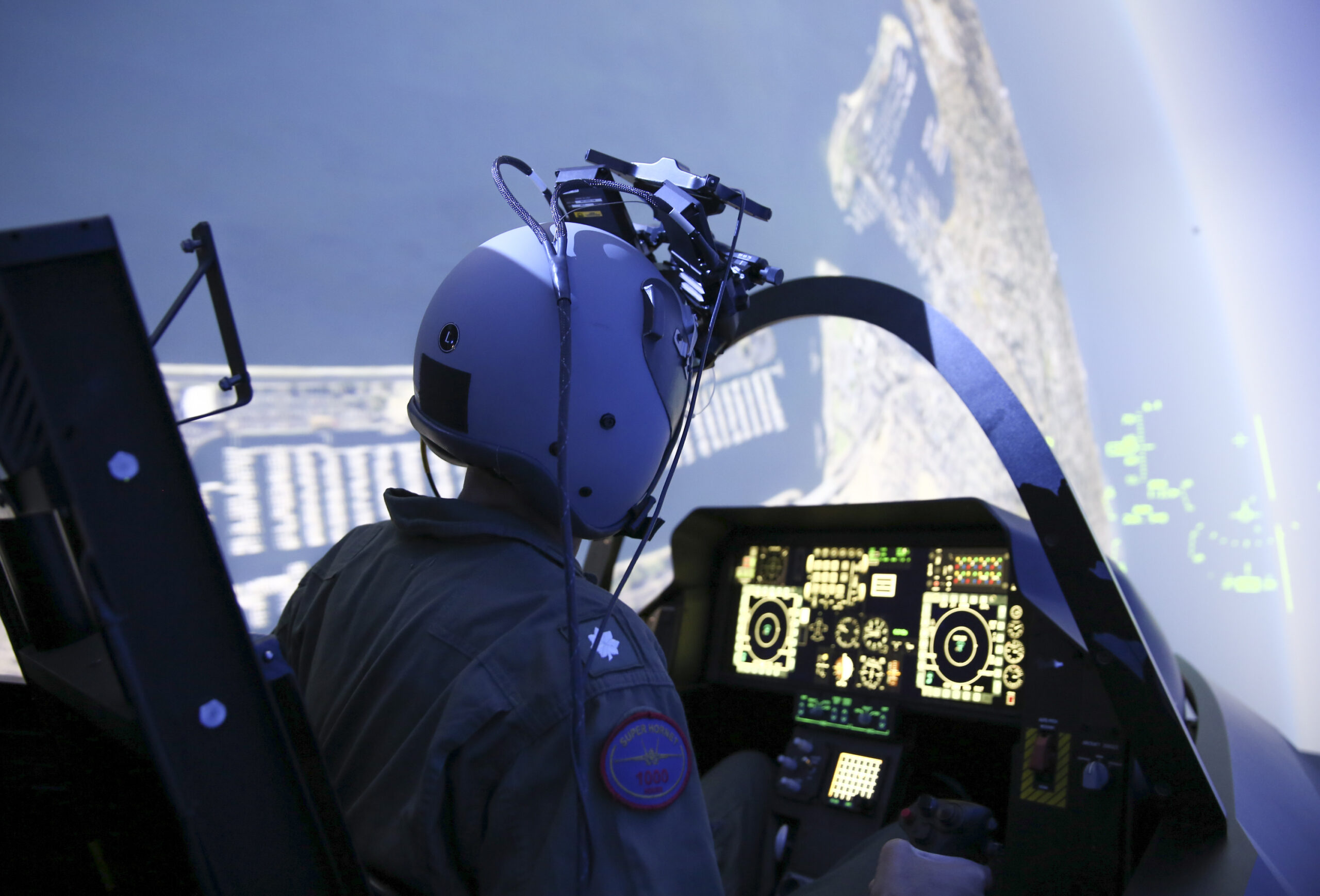
A: Anybody that’s doing a particular task can be [trained] through simulation and high-fidelity synthetic environments now. It’s more efficient, and — I would suggest and argue — it’s more effective.
In the military, you want every member of your team thoroughly trained and prepared. You can do that so much easier and better through synthetic, simulated training. We knew this 60 or 70 years ago, but what we didn’t have then was the [necessary] compute power. Now, we’re in the day and age of massive compute power, and that’s why we can create such high-fidelity, realistic synthetic environments. It’s getting better and better right in front of our eyes. The more powerful the compute power, the better training environment that we’ll have [and] the better human being that we’ll have.
Q: What emerging technologies do you see shaping modeling, simulation and training in the next five to 10 years?
A: The first technology was what we already talked about: compute power and all that goes with computing power, like the ability to process data and the speed [of it].
Now, what I see is the introduction of artificial intelligence into existing modeling and simulation. That is a game changer and where we’re really intensely focused [on] at NTSA: helping the modeling, simulation and training industry introduce and complement their simulation with AI, [which] makes for a better and more realistic training environment.
Q: Can you expand on that?
A: When I first got into the job, I thought about training a human to do a physical endeavor: Fly an airplane, shoot a gun, use a telescope. Now, what I see is we’re using simulation and AI to help with decision-making. The cognitive aspect of training a decision-maker is a very, very powerful aspect of training.
Q: Do you see any risks in adopting AI? And how do you mitigate those risks?
A: I see a lot of risk. All of us that choose to put AI on our networks need to keep it compliant, to govern use [of it] and light off a warning signal when the bias is getting out of bounds. We also need to do an assessment after the fact that the use of it truly was beneficial.
Q: Let’s talk aviation specifically. How do you see the future of pilot training amid the push for autonomous aircraft?
A: For the foreseeable future, I want and hope that we keep a human in the loop of the decision-making cycle as we move every day to more autonomy. Right now, autonomy is mainly seen in the actual operation of a vehicle, but we’re seeing more and more AI being used in decision-making — and I’m a little bit skeptical on that.
Today, a drone is not unmanned. There is a tremendous amount of infrastructure, of human beings that are flying that drone, building the drone, maintaining the drone and actually employing that drone.
Technology is taking us to the point where the drone, once it launches, is becoming more truly autonomous. We’re moving further and further and further into that world as we use remotely piloted undersea vehicles, surface vehicles, air vehicles and space vehicles. We have humans that are operating those right now, and we need to listen to them to see how they’re doing emotionally, psychologically as they employ weapon systems against an adversary they don’t physically see. That’s a heck of a dilemma.
Q: It sounds like your answer is that training for autonomous platforms has to change to encompass different psychological and ethical dilemmas?
A: Yes, that is exactly my answer. A human is subject to psychological and emotional factors. It’s also about the psychological aspects of using automation and autonomy. Where are we heading with that? Because that’s a component of training and preparation.