Adding AI to aircraft design


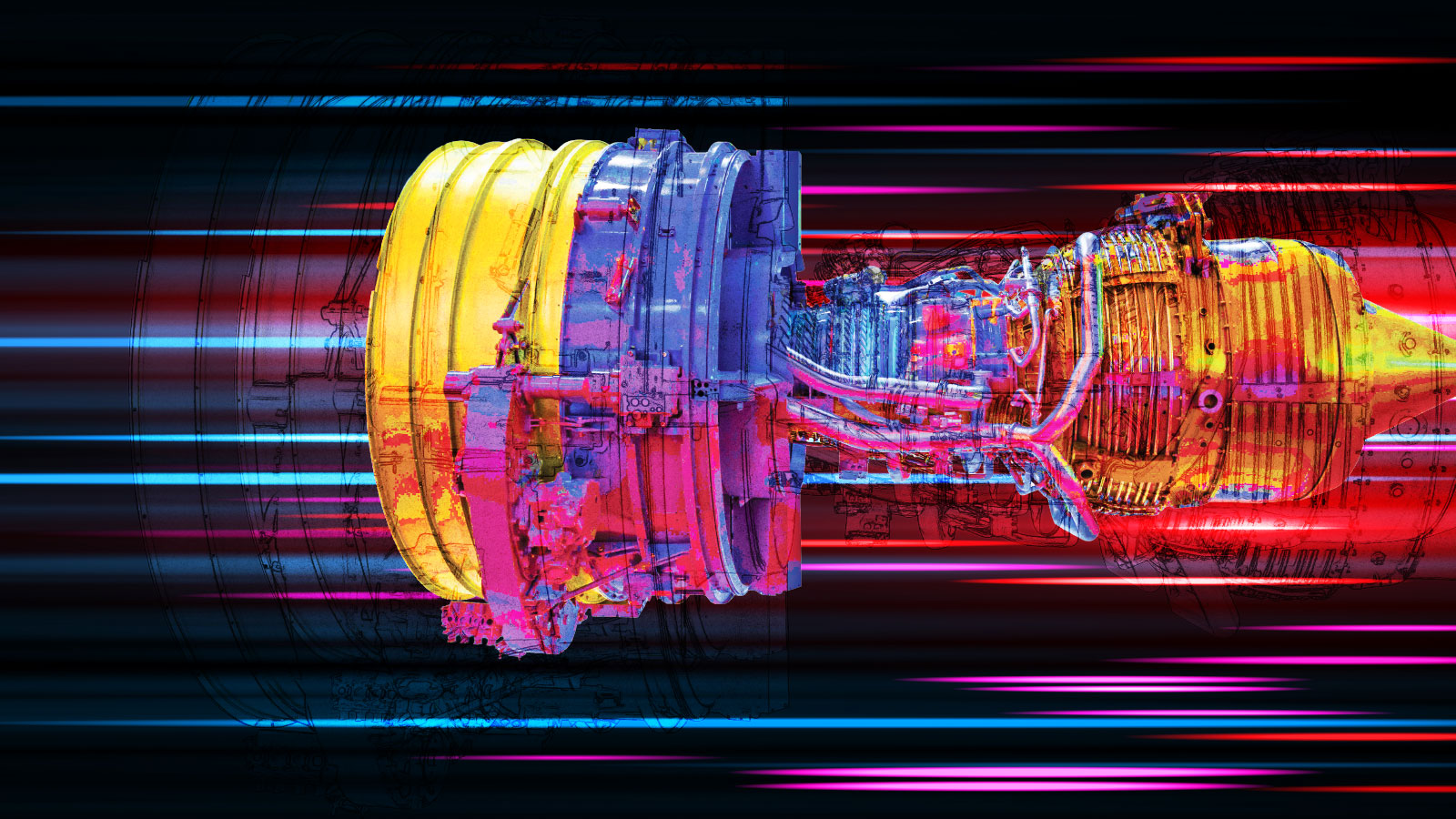
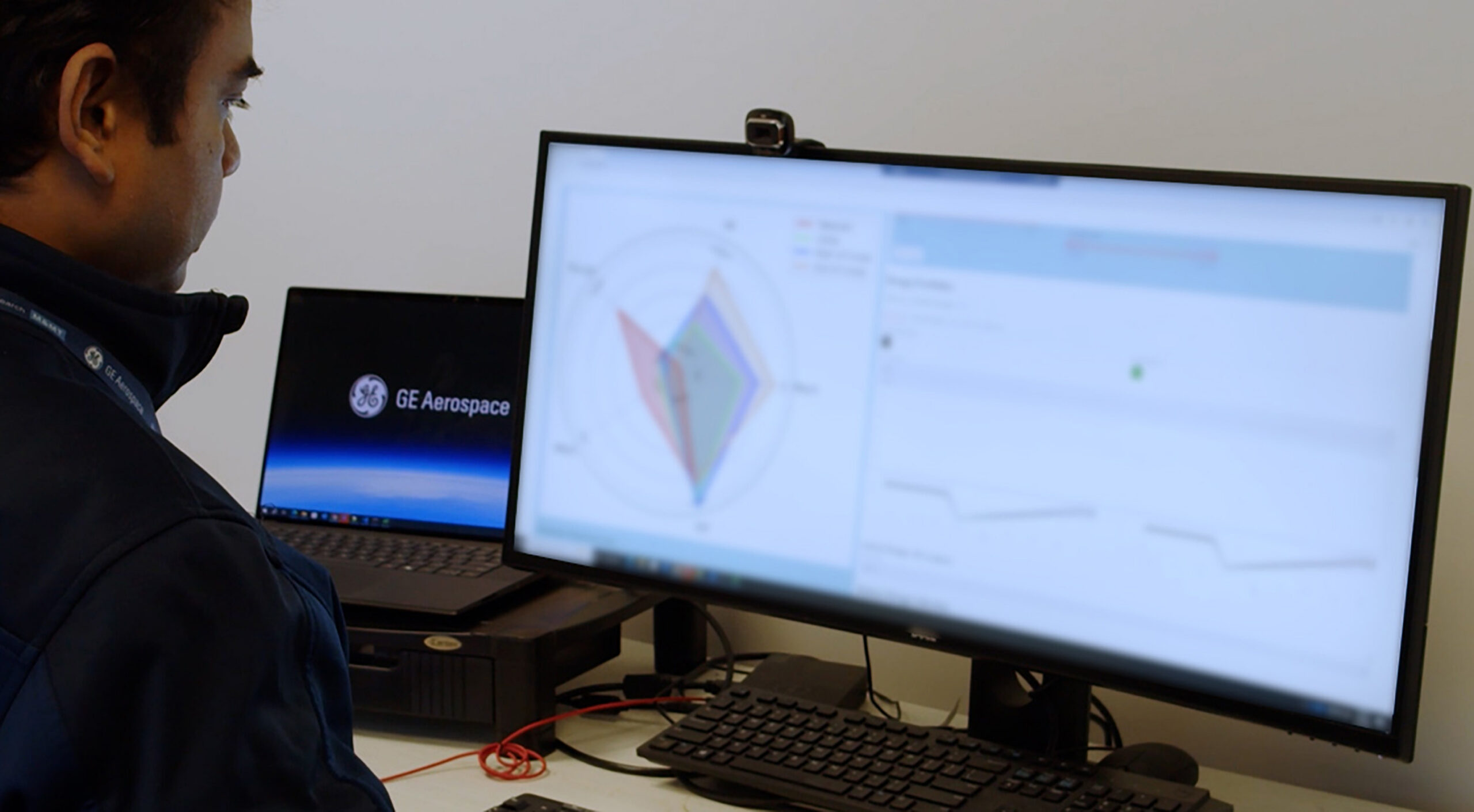
Inside GE Aerospace’s research center in Niskayuna, New York, a computer terminal started a simulation. The result, produced within seconds, was a preliminary design for a hypersonic ramjet engine.
Such concepts have traditionally been the result of months of design work by a team of engineers. This time, however, the lead developer fed the desired flight conditions and criteria, including thermal performance and the engine’s structure, into a generative AI dashboard, which returned a design almost immediately.
The demonstration, announced by GE in May and recounted to me by Joe Vinciquerra, general manager and senior executive director of GE Aerospace Research, illustrates the kind of computational speeds the company says could significantly accelerate the development of next-generation commercial aircraft engines, including RISE. The company is developing this open-fan concept with French partner Safran Aircraft Engines through their joint venture, CFM International.
“When we think about the practical use of that tool, it is poised to just dramatically shorten the design cycles of our products,” Vinciquerra told me in an interview. “We can shrink the amount of digital iterations that we do and get to those physical tests faster, to have even more robust, durable and safe products on the other end.”
The commercial aviation industry has historically operated on lengthy and expensive development cycles, with brand new engines and clean-sheet airframes each taking several years to develop. The cost is typically $5 billion to $7 billion for an engine and $10 billion to $20 billion for an aircraft, according to the consultancy Leeham.
The process is extensive, even as the industry has begun to rely more heavily on computer modeling, digital twins and other tools. First, engineers create 3D models based on the requirements received from the customer. Next, the most promising designs are fleshed out in a preliminary design phase, where engineers conduct simulations with techniques like computational fluid dynamics to predict gas and liquid flows, and optimize the structure.
This is followed by materials selection and extensive physical testing — including pushing and pulling on components to simulate the stress they will undergo in flight, and wind tunnel testing for parts like engines, flaps and rudders.
Almost every stage of the process could be improved by increased adoption of AI, according to Jonas Zinn, an analyst and AI expert at consultancy Roland Berger. For instance, large language models could narrow down the part specifications provided by manufacturers. Then, instead of constructing 3D models, designers could prompt an AI algorithm to generate “100, 200 designs” that match the requirements, he says. Finally, AI could be used during the simulation stage to speed up testing.
Rather than having to wait up to three days between physical test cycles, engineers could use AI models to instantly evaluate design tweaks, reserving costly full-scale simulations for when they are confident the new part will work. This would help to reduce costs overall, Zinn says.
Airbus’ Fast Track Lead for Artificial Intelligence Pooja Narayan, who is responsible for leading AI strategy and integration across the company, sees the technology as a game changer.
“If I go into design today, the most promising application is saving the time on cost,” she says. “We run these kinds of simulations, and they are quite time expensive, meaning if it is for the whole engine or for the whole aircraft, they take a long time to run. It could be days to weeks sometimes.”
Multiple companies — from Rolls-Royce to Airbus to RTX’s Collins Aerospace — told me they are incorporating AI into their work. However, some executives say there remains a gap between future applications they are considering for AI and what the existing regulations permit.
FAA and other regulators typically require engineers to “show their working,” as a Rolls-Royce executive describes it, and explain exactly how every part is designed — a level of transparency today’s AI tools cannot provide.
The aerospace standards that exist today don’t account for the use of artificial intelligence, according to Narayan. “Industry and regulators acknowledge that gap today, and the industry is working together to close that gap,” she says.
Although GE’s AI-generated ramjet design demonstrated the potential of AI, Vinciquerra notes the company is only using the technology in early-stage design.
“It’s really more like a quicker pace to the starting line,” he says. “By shrinking that early development time, it allows us to do things like detailed design, engine test and whatnot, where you really begin to build the regulatory record in earnest.”
FAA and the European Union Aviation Safety Agency (EASA) have so far embraced different approaches to AI.
EASA has taken what industry executives describe as a more prescriptive, structured approach, grounded in its AI Roadmap that is in the process of being updated and the overarching framework of the EU AI Act enacted in 2024. The agency’s core principle is human oversight of AI systems, according to Guillaume Soudain, EASA’s AI project manager.
In other words, it can’t be two machines talking to each other. “We are saying if a tool is preparing, for instance, a preliminary design, we want a human or an independent process that is not AI-based to verify this output,” he told me. “If it’s a double verification, like a development plus verification, AI-driven, for now we say no.”
EASA has published specific technical standards companies must meet and categorizes AI applications into three different levels of human-machine collaboration: assistance, teaming where the machine is more like a coworker, and AI working autonomously and potentially without human ability to override it.
In contrast, FAA has crafted a more flexible framework. As outlined in its Roadmap for Artificial Intelligence Safety Assurance, the agency provides principles and allows companies to propose their own means of compliance, provided they can prove safety equivalence.
FAA declined to make an official available for an interview, but outlined this strategy in emailed comments, noting the agency’s approach is to implement AI incrementally while learning from real-world applications.
“Applicants in this innovative area can propose a compliance method that is most appropriate for their product,” spokeswoman Crystal Essiaw said.
This could be an existing standard from the standards organization SAE International, “or another method that the company proposes or adapts from other industries. The FAA must accept the proposed means of compliance.”
Essiaw added that FAA also aims to adopt consensus standards with other regulators to promote global harmonization — an approach supported by the International Civil Aviation Organization, which has been working since 2023 on a framework to guide national authorities in shaping compliance.
FAA’s core principles, as laid out in its roadmap, include to “avoid personification,” meaning users should “treat AI as a tool, not a human.”
In other words, the ultimate responsibility lies with the human who designs or maintains the AI, not the software itself. The document also states AI should be integrated within the existing aviation safety framework, rather than overhauling the framework.
Both regulators have acknowledged the challenges of implementing AI in aircraft design, testing and manufacturing. As FAA’s roadmap puts it: “The application of AI faces the challenge of determining how to assure the safe operation of an AI system which was not traditionally designed, but instead learned how to perform its task. Conventional aviation safety assurance techniques assume that a designer can explain every aspect of the system design, but such explanations are not readily extendable to AI.”
To navigate the transition, both regulators envision a phased, step-by-step timeline. They advocate starting with non-safety-critical ground applications —predictive maintenance analytics in maintenance, repair and overhaul facilities, for instance — before moving into safety-critical flight systems as confidence in the technology matures.
EASA’s Soudain says the agency has been in an exploratory phase and is now in a “consolidation phase,” where it transitions from exploring the use cases for AI to making rules and regulations. That means solidifying its requirements for human-AI assistance and human-AI teaming use cases, while thinking more about the next level: advanced automation.
“The next phase after that in 2028-plus will be a ‘pushing barriers’ phase, because we know we have set barriers in different ways,” Soudain says.
Even so, he notes the pace of AI adoption is likely to be slower than in other industries.
“Aviation is a very regulated and safety-relevant domain, so we will not make a change like in other domains,” he says. “We have decades before we even think about concretely replacing people. But the overall effort is not to replace; in fact, it’s more to be more efficient, be safer.”
When it comes to adopting AI, executives said their companies are starting with provable and easily replicable use cases, such as digital threads or connecting data across different stages of the product lifecycle.
Collins Aerospace, for instance, is using AI tools for predictive maintenance, says Nicole White, vice president of the company’s Connected Aviation business. Here, AI combs through mountains of data and flags to airline customers when parts might need maintenance.
“It’s continuously analyzing operational and component health data to look for early signs of system degradation before the failure occurs,” White says. “Instead of just waiting on failures or relying solely on scheduled maintenance intervals, we’re trying to give our airline teams the ability to have insight into that, so they can prepare and then overall improve their dispatch reliability.”
Rolls-Royce is using AI to answer customer queries on engines, according to Alan Newby, the company’s head of research and technology. An AI-enabled system sorts through data to see if other customers are having similar issues, then offers potential solutions. Rolls also uses it to write and structure analytical reports, he says.
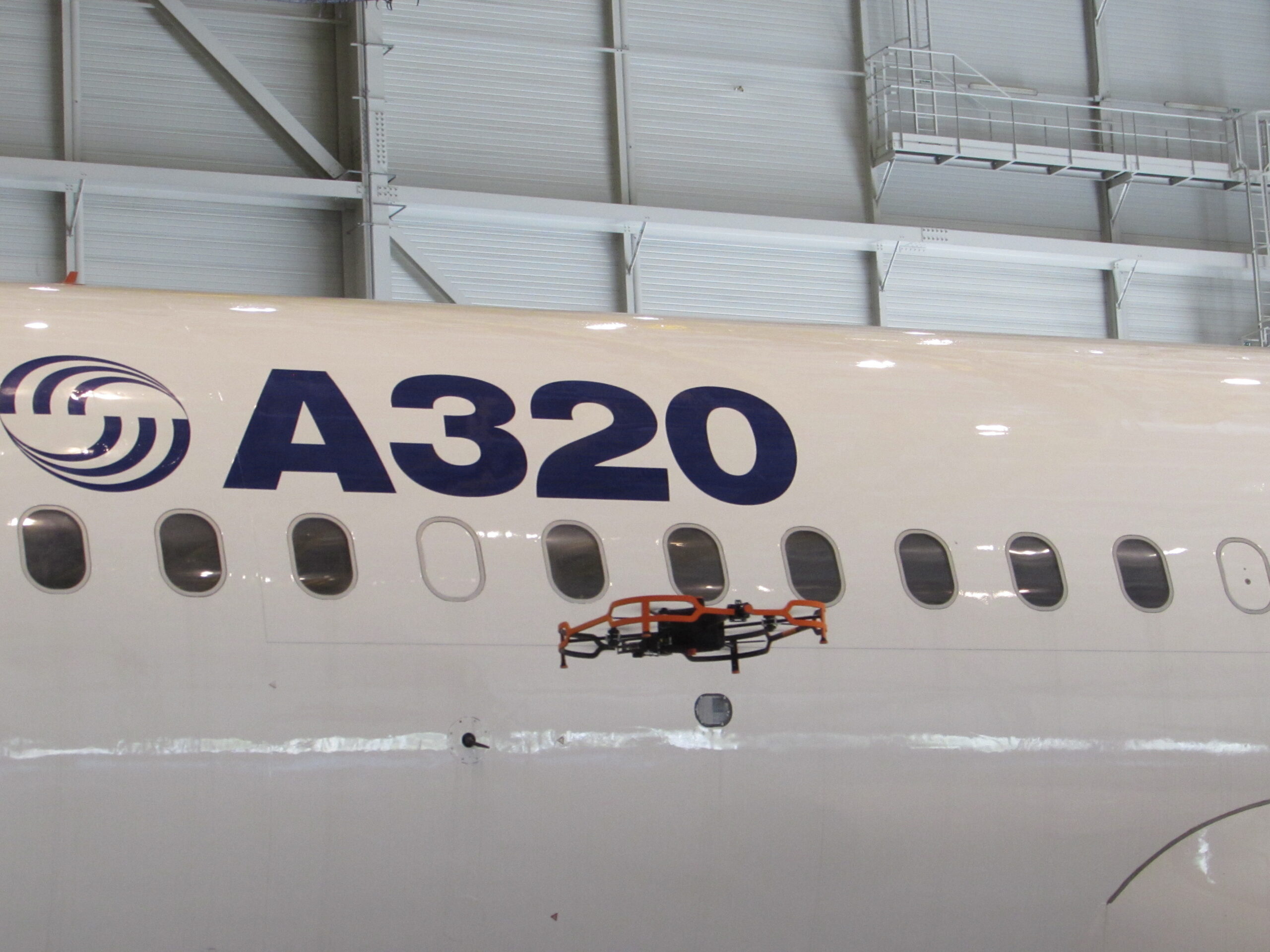
Airbus has adopted the technology for aircraft inspections, according to Narayan. Drones or human engineers take photographs of the aircraft’s exterior, which are then fed to AI software that compares these images against a database to identify potential faults.
At this year’s Farnborough Airshow, Boeing’s chief technology officer said he sees potential in using AI to speed early design work and to analyze large amounts of data to uncover trends or issues with parts.
“The solutions we’re going to put forward always are going to maintain the highest levels of quality and safety, so engineer in the lead,” Lane Ballard told reporters during a July 21 roundtable. “But here’s the beauty of AI: It is able to consume large amounts of data and help you ensure you can pull from gleaned information the powerful stuff that that engineer can use.”
At the same time, companies are readying for more expansive applications. In Newby’s view, AI could revolutionize the design process, specifically by helping engineers explore new technologies — “next-generation systems, fan systems, aerodynamics,” he says — in a way that’s not possible with traditional methods.
“We’re in the foothills to some extent of what we can do on this,” he says. “Can we use that agentic AI to do more of the hard work — not just a pure optimization, but to explore the design space better? It’s not just helping you sift through routine data, it’s helping you explore the design space, the areas that we just simply wouldn’t have the time to do.”
According to a late 2025 report from Kearney, a Chicago-based management consultancy, AI is prompting aerospace companies to rethink how they “discover, test, validate, and optimize materials.”
“Instead of relying solely on laboratory experimentation, AI models analyze patterns across thousands of combinations, identifying which elements and structures could deliver specific required performance outcomes,” the report reads.
White, the Collins executive, also sees AI assisting with the industry’s long-standing workforce shortage by improving productivity.
“You hear about [a] lack of pilots, lack of technicians, lack of all these different skillsets,” she says. “It isn’t that these tools are going to replace technicians, but what it is doing is enabling these technicians to be much more productive with the tools that they have.”
In the long term, industry leaders anticipate a gradual shift toward true human-AI collaboration. Narayan of Airbus says she expects generative AI assistants to one day evolve into “agents” that work alongside engineers like human colleagues. She also foresees AI-driven robotics transforming manufacturing floors.
“We will start to see multitask robots that configure on the fly rather than performing single, hard-coded actions,” Narayan says. “Whether screwing a fitting or sorting precision components, an AI brain allows them to pivot between complex tasks without requiring manual reprogramming.”
For GE, which says it has utilized machine learning in design workflows for 20 years, there are clear benefits to making such a future reality.
“We’re in a long-cycle business,” says GE’s Vinciquerra. “Jet engines are extremely complicated, highly engineered systems. The quicker we can generate designs and physically test them for durability and system-level performance, the better the end result is for the customer.”