
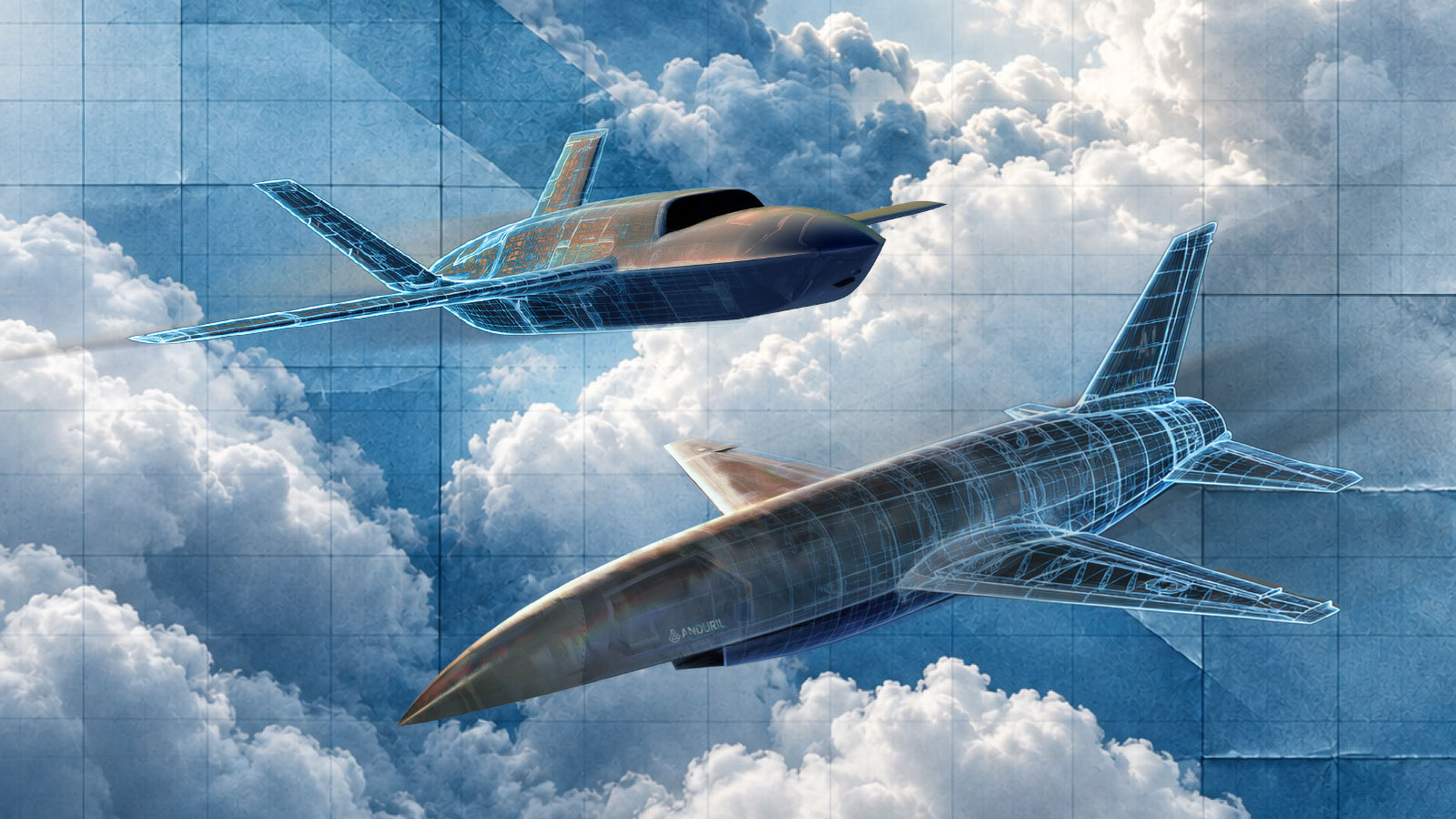
The U.S. Air Force is moving forward with its Collaborative Combat Aircraft program, meant to provide a fleet of drone wingmen to team with conventionally piloted fighter jets. As the CCA concept gains interest around the world, Jen Kirby spoke to service officials and industry executives about the ongoing testing and potential challenges ahead.
When it comes to its Collaborative Combat Aircraft program, the U.S. Air Force wants options.
The first group of these drone wingmen is tailored for air-to-air missions, but future CCAs might be used for surveillance or electronic jamming, or they might just serve as decoys. The service also wants the aircraft to be able to carry different payloads. Future designs might take off from a short runway — or no runway at all.
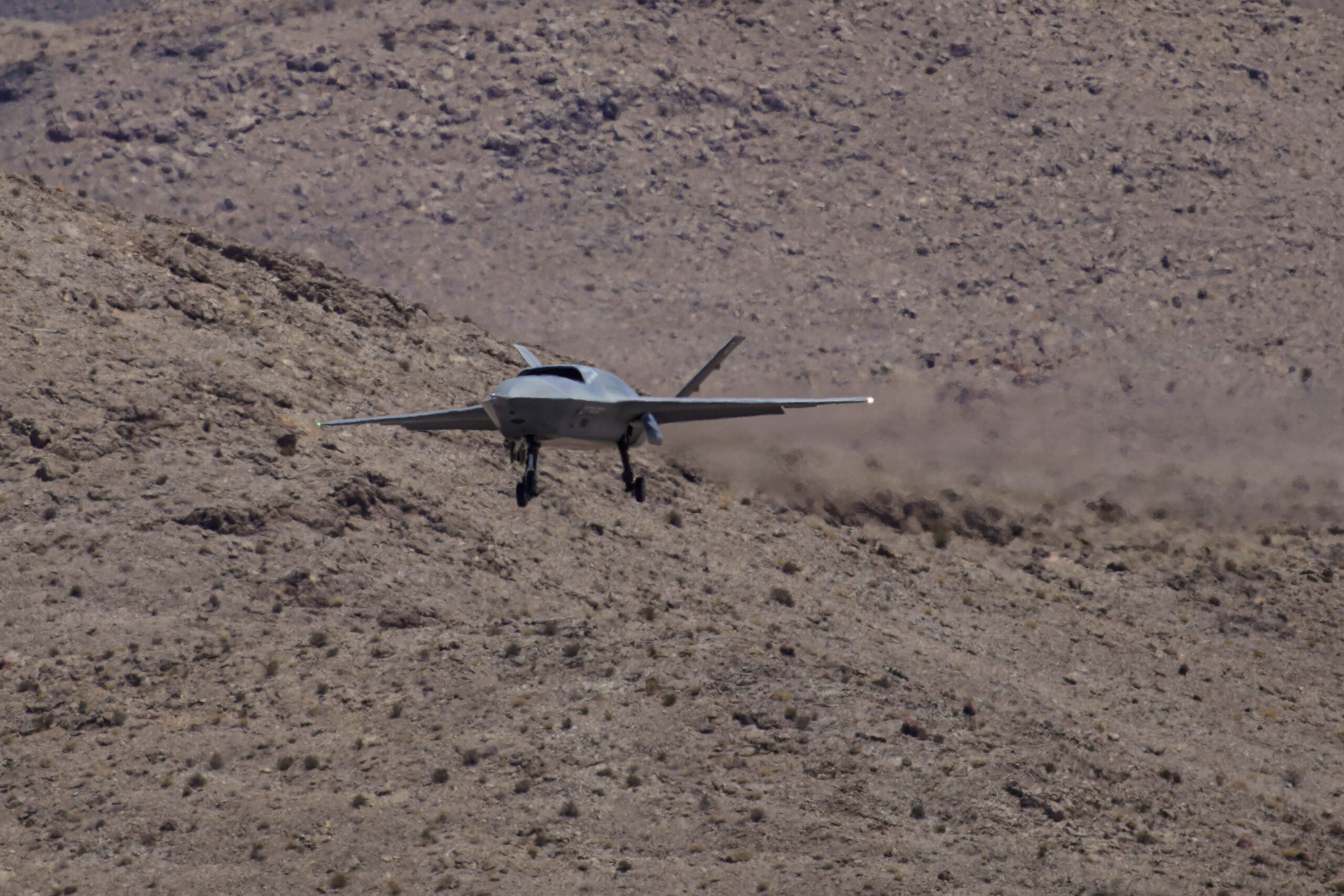
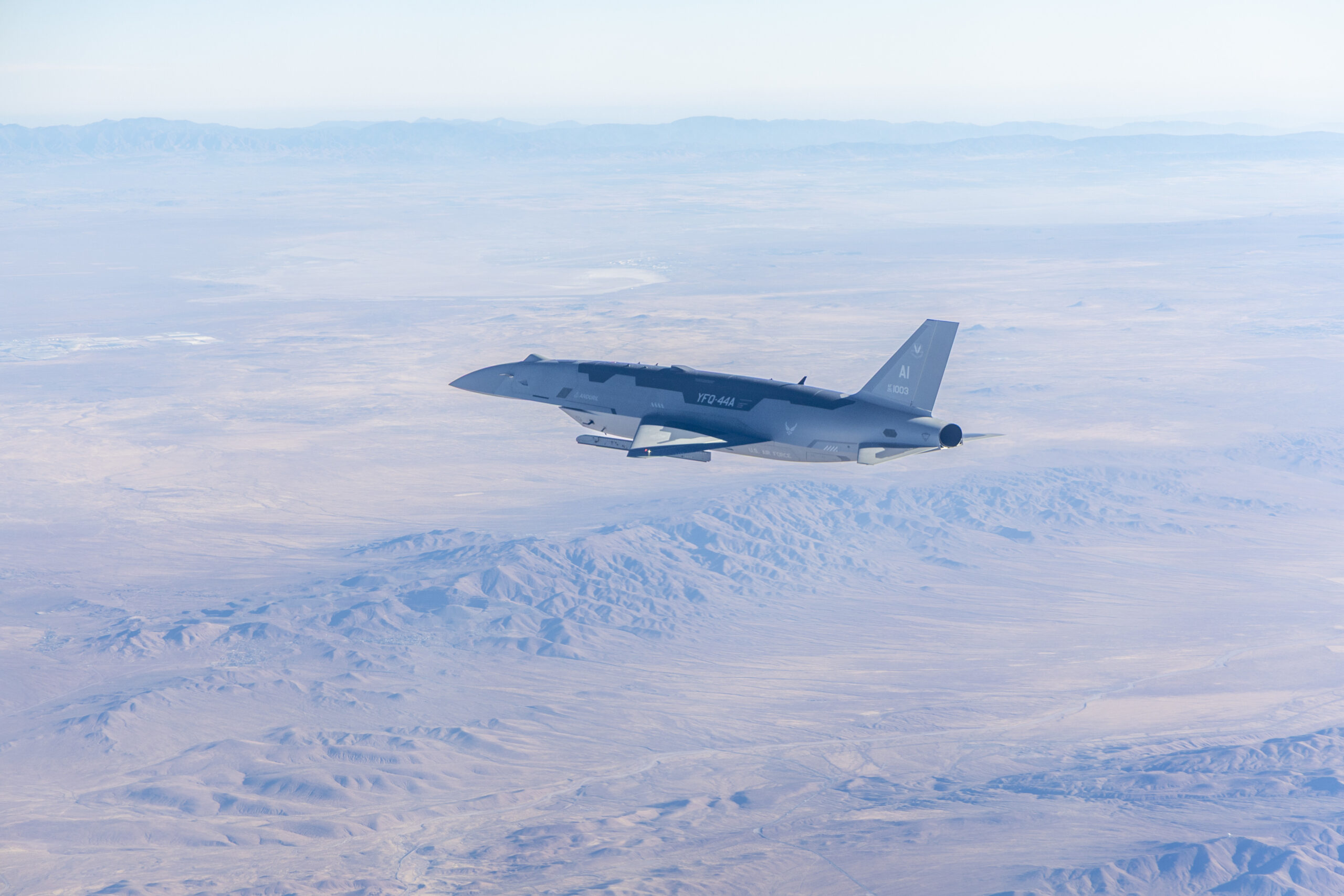
The Air Force is also keeping its options open when it comes to vendors. In June, it selected Anduril Industries and General Atomics Aeronautical Systems to move their aircraft — now known as the FQ-44 Fury and the FQ-42 Vengeance, respectively — into production for Increment 1 of the program.
The service that month also announced it had selected six vendors to provide mission autonomy software and awarded three — Anduril, RTX’s Collins Aerospace and Shield AI — production options to accelerate delivery of that technology.
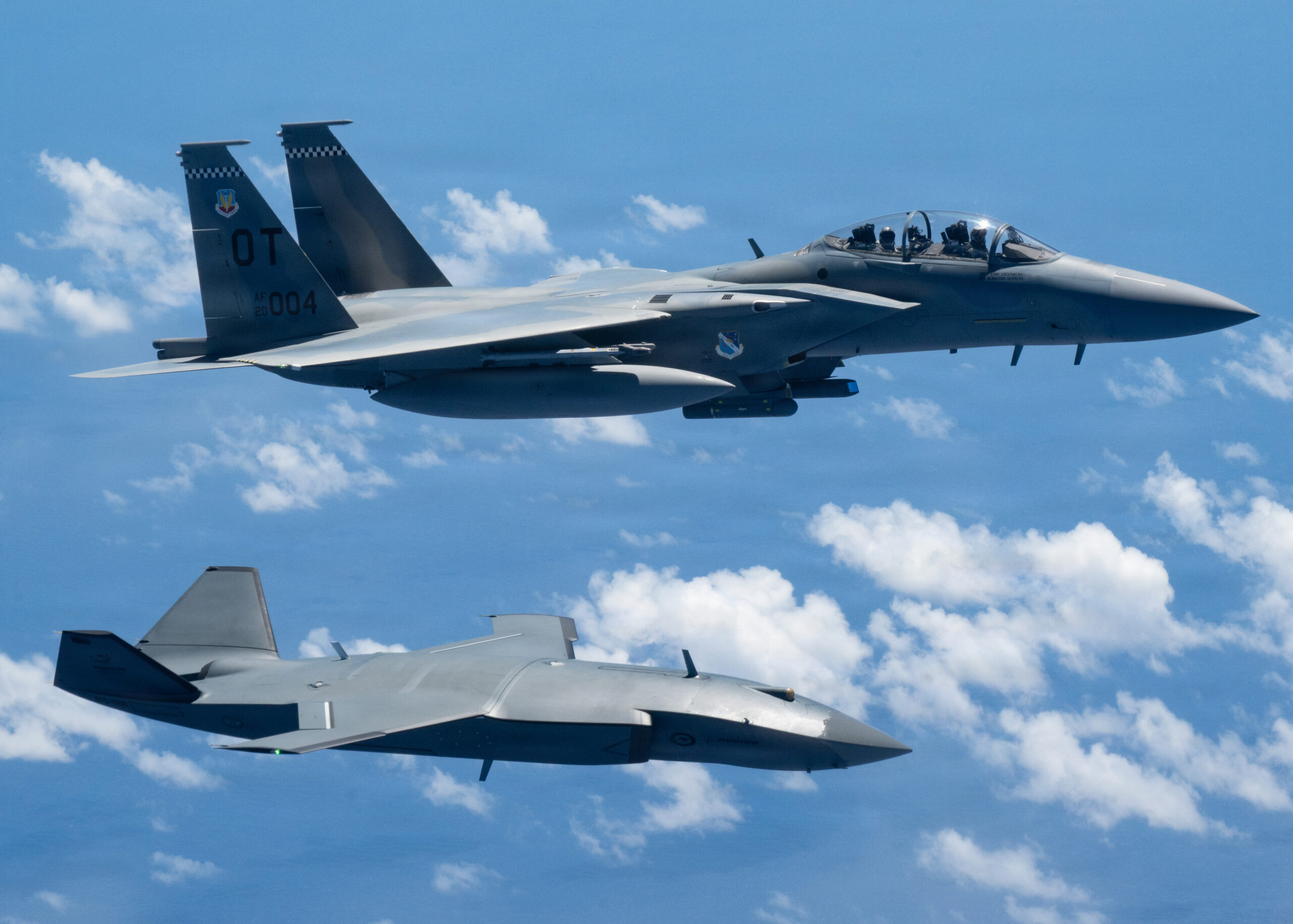
These announcements mark significant steps forward for the CCA program, an effort to build AI-enabled, semi-autonomous aircraft affordable enough to be produced at scale. Plans call for CCAs to work alongside conventionally piloted fighter jets, like the F-22 or the future F-47, creating a new kind of human-machine team.
“Most of us, based on what we’ve seen from artificial intelligence, would assess that there will come a point where a robot fighter is better than a manned fighter,” Lt. Gen. Christopher Niemi, who heads Air Force modernization, told the Senate Armed Services Committee in May. “The question is when will that happen, and I think it would be a tragic shame if the United States didn’t have a better answer if we were facing robot fighters that were better than our manned fighters.”
“So, for all these reasons,” he added, “I’m very bullish on CCAs.”
The CCA concept is gaining traction elsewhere. The U.S. Navy and Marine Corps are pursuing their own versions of collaborative combat aircraft, as are other countries, from Germany to China to the United Kingdom. For instance, Boeing Australia since 2017 has been developing its MQ-28 Ghost Bat for the Royal Australian Air Force. In June, an MQ-28 operated alongside fighter jets in Exercise Valiant Shield, a joint U.S. and allied forces training event in the Indo-Pacific.
“It’s becoming apparent that these capabilities are just the price of admission to being a capable air force in the near future,” says Andrew Hunter, a former U.S. Air Force acquisition chief who helped develop the service’s CCA program.
Air Force and industry officials are now focused on achieving that core capability: seamless teaming between a CCA and a human pilot. Determining how they will work together will make clear how CCAs can be used — and how transformative they might be.
“We need to imagine a world in which fighter planes aren’t the dominant platform, and that the CCAs are not just there to help the fighter planes; they’re actually there to win the war,” says former Air Force Secretary Frank Kendall, who introduced the CCA program. “You’ve got to free your mind of the idea that there will always be a fighter pilot.”
The initial pitch
During his tenure as Air Force secretary, Kendall pitched CCAs as a way to add mass to the U.S. combat fleet at a cheaper price point than crewed jets.
CCAs were intended as an asymmetric capability the service could specialize and tweak by adding sensors or swapping in different weapons systems. The service would develop these aircraft in increments, promoting competition among industry and the ability to adjust capabilities over time.
In early 2024, the Air Force tapped a group of five companies to design and develop prototypes; several months later, it selected Anduril and General Atomics for additional funding to continue refining their aircraft and begin flight testing.
Since their inaugural flights last year, Fury and Vengeance (previously known as Dark Merlin) prototypes have participated in multiple flight tests and exercises, experimenting with techniques and procedures meant to help the Air Force understand how to best deploy and integrate these aircraft.
In July, a Fury struck a simulated target with an AIM-120, a medium-range air-to-air-missile. General Atomics is slated to conduct a live-fire test with a Vengeance before the end of the year, according to company spokesman C. Mark Brinkley.
The Air Force aims to field 500 CCAs by 2032, and for fiscal year 2027, has requested about $1 billion for procurement and $1.4 billion for research and development.
The service is also already preparing for future increments, working with nine contractors to refine the attributes, capabilities and new technologies for Increment 2. Brig. Gen. Timothy Helfrich, the Air Force’s portfolio acquisition executive for fighters and advanced aircraft, said earlier this year the service would likely open that competition up to even more vendors.
Software competition
Key to the CCA program is the AI-enabled mission autonomy software, considered the brains of the aircraft. While CCAs will be equipped with platform or flight autonomy software that oversees the safety-critical functions any aircraft needs, like being able to take off and maneuver, the mission autonomy software is layered on top of that. It gives CCAs the capacity to collaborate and receive and execute commands from a human operator.
The Air Force in June selected six contractors — Anduril, General Atomics, Lockheed Martin, Northrop Grumman, RTX’s Collins Aerospace and Shield AI — to establish what it described as a “competitive marketplace” for the effort. The service also awarded Anduril, Collins and Shield AI production options.
After six months, the service said, it plans to evaluate the progress and initiate a second competitive award, with the plan of selecting a primary mission autonomy provider for Increment 1 by summer 2027.
However, the service hopes to keep multiple vendors working to potentially compete in the future. According to an Air Force spokesperson, the service is planning a “fly-off” approximately three years after the initial contract award, where each mission autonomy maker will get a CCA to prove its software.
“CCA was an attempt to really change the dynamic and say, ‘Listen, we’re not going to buy from just one; we’re going to buy from multiple sources,’” says Jerry McGinn, director of the Center for the Industrial Base at the Center for Strategic and International Studies.
The foundation of this effort is the Autonomy Government Reference Architecture, or A-GRA. Using a modular open systems approach, the government sets and owns the baseline standards and interfaces, allowing vendors to bring in software that matches. It’s a bit like Apple or Android owning the operating system that app developers can then use to build their particular app.
Helfrich calls the approach “software sold separately,” allowing the Air Force to “plug and play” the software that best suits the CCA mission.
“The software can update quite quickly,” Helfrich says. “It will allow our airmen to have something that they can quickly innovate with and find the best way to use it for whatever situation they happen to be in.”
In late February, the Air Force tested the concept, flying a Fury on two mission autonomy platforms. The prototype switched mid-flight between Anduril’s Lattice and Shield AI’s Hivemind. Previously, a Vengeance flew on the Sidekick platform developed by Collins.
Jason Levin, senior vice president of engineering for Anduril’s Air Dominance & Strike business, says the way the Air Force has decoupled the software from the CCA airframe is a net positive, as it enhances competition and allows the best mission autonomy software to win out.
“It will make us a more capable system,” he says. “It’ll make the Air Force as a whole much better.”
Brinkley says “part of the long-term vision for us from the very beginning was to not get locked into anything.”
What’s ahead
The Increment 1 vendors are now manufacturing their first aircraft. Anduril rolled the first Fury off the production line in July. Levin says the company’s Arsenal-1 facility in Ohio is sized to produce up to 150 aircraft per year.
“It’s a modular production line to build at rate and at cost, and so again, very easily [you] see that we could adapt that production line and that scalable manufacturing technique for another CCA,” Levin says.
General Atomics’ facilities are tooled to build about six CCAs a month, according to Brinkley.
The Air Force has not released the value of the contracts or how many CCAs it is ordering in this initial tranche. The service initially estimated the Increment 1 aircraft would cost $30 million each. Officials have not provided an updated figure for either CCA design, but Air Force Secretary Troy Meink testified to the Senate in June that “the platforms are on schedule” and “sticking to their budget targets.”
“With respect to keeping that cost down going forward, we have competition, we have open standards, that allows [us] to bring in several contracts for different pieces of the hardware and bring on additional contractors everywhere from the avionics to the aircraft bodies themselves and engines,” Meink told lawmakers. “We’re really trying to make sure we have a very modular open structure, which would drive those costs down going forward.”
The Air Force said it plans to test a piloted F-22 quarterbacking a CCA later this year, and the aircraft is slated to participate in its first large force exercise in December, according to a service official.
These tests — coupled with the broader experimentation led by the service’s Experimental Operations Unit, which is developing the CCA operational concepts — are meant to ensure service members can shape the CCAs.
“It’s our job to wring them out and make sure that, beyond the technical specifications of it, that we’re
experimenting with the more complex things like logistics and C2 [command and control],” said Lt. Col. Lyndon Bartlett, commander of the Experimental Operations Unit, at the Air, Space & Cyber conference in September.
Hunter, the former Air Force acquisition chief, says “there were specific things that had been modeled to say we think [a CCA] system like this could be extremely useful in very clear mission applications, but there will be many things that we didn’t originally anticipate that it will also be good at.”
“And also, the way in which you accomplish even the applications that we initially anticipated still has to be figured out,” he adds.
The CCA program is also demonstrating how the Pentagon can integrate AI–enabled systems.
“We’re at the front end of really understanding the kinds of functions and missions that AI will be able to perform in the future — not in the middle, not in the back end, we really are in the front end,” says Mark Gunzinger, director of future concepts and capabilities assessment at the Mitchell Institute for Aerospace Studies.
Air Force and industry officials say the program’s most significant hurdle is building pilot confidence the CCAs will work as promised.
“The biggest challenge going forward — but it seems to be going well — will be getting the warfighter to trust the system and use it,” says Anduril’s Levin.
Ryan Bunge, president of missions systems at Collins Aerospace, told reporters in September that pilots’ understanding of the technology will evolve as they train more.
Once “you get an opportunity to get these out in some operational testing and refine the tactics together … you’ll start to see the autonomy actually be able to — using AI — drive rapid recommendations of what to do,” he said.
Several analysts and executives told me there remain plenty of decisions ahead about how best to use CCAs, from understanding the technology to planning the training around them.
“They fly pretty far relative to manned aircraft. They bring sensors to the fight. They do bring kinetic and non-kinetic effects,” says Richard Brisbin, chief strategy officer at Poseidon Aerospace and a former Anduril executive who worked on maritime autonomous air power and collaborative combat aircraft at the company. “But the best and most tactically beneficial way to employ that is still, I would say, still in its infancy.”