

NATIONAL HARBOR, Md. — The U.S. Air Force’s Collaborative Combat Aircraft program is slated to participate in its first large force exercise in December, a service official said this week.
“That’ll be our first tip dip of the toe in an actual force integration,” Lt. Col. Lyndon Bartlett, commander of the Experimental Operations Unit that is determining how to operate the first CCAs, said on a Tuesday panel at the Air, Space & Cyber Conference here.
That exercise will be be the first time CCAs are integrated “in a fourth- and fifth-gen combined OCA [offensive counter-air] push,” he said.
Bartlet said most of the unit’s CCA testing to date “has been done for sortie generation, how easy they are to maintain [and] how small a footprint could be” operationally.
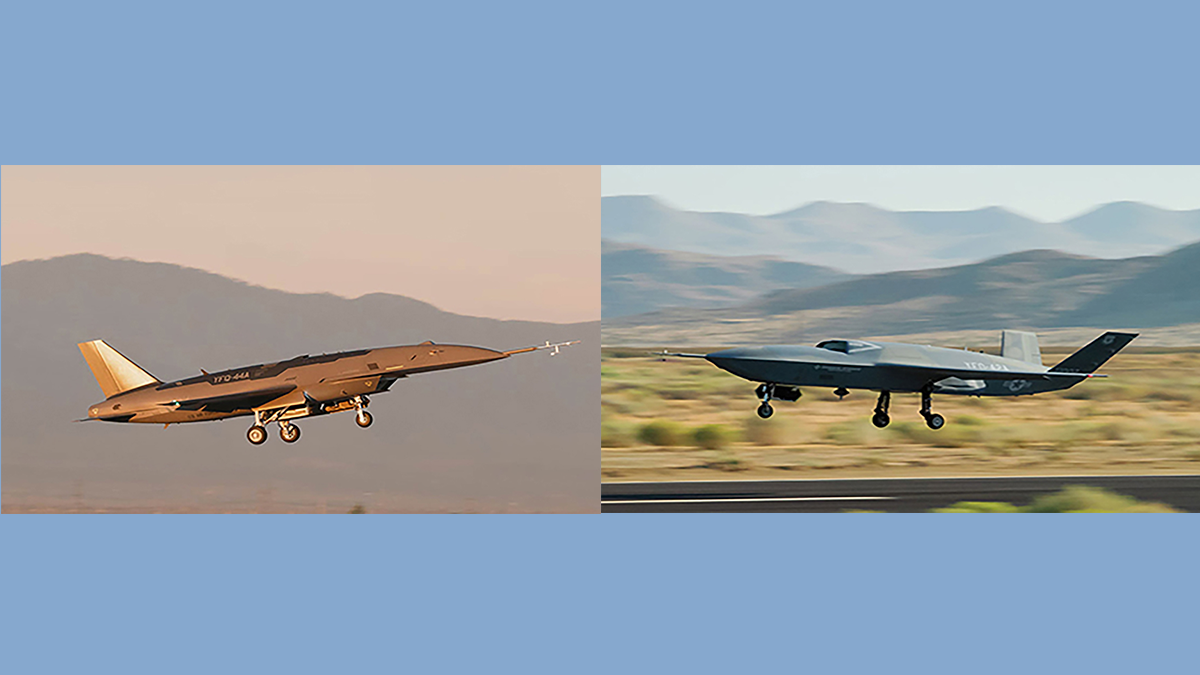
The CCA program is intended to produce “loyal wingman” drones that would fly alongside crewed fighter jets. In June, the service awarded Increment 1 production contracts to General Atomics Aeronautical Systems for the FQ-42 Vengeance (previously called Dark Merlin) and Anduril Industries for the FQ-44 Fury.
Jason Levin, senior vice president of engineering at Anduril, said this week on the sidelines of the conference that he expects the first flight where a Fury is controlled by a fighter jet pilot to happen “in a matter of weeks or months.”
”We’ve already begun doing quarterback integration” — the term for this milestone — “in our hardware-in-the-loop environments, and our software-in-the-loop environments, and even on the aircraft itself,” Levin said.
One of General Atomics’ test aircraft flew in conjunction with an F-5 in July, the company announced Tuesday.
“With this flight,” Michael Roberts, the company’s advanced programs emerging technology director, said in the release, “we moved beyond simply flying an autonomous jet and showed how a manned fighter and an autonomous CCA can work together to find, track, and engage a target using passive sensors and shared autonomy.”
- RELATED READING: Anduril readies to demonstrate CCA’s ‘manned-unmanned teaming’
- RELATED READING: Debriefing CCAs post-flight is a ‘hard problem’ but a necessity, Air Force officials say
The Air Force in June also identified a pool of six contractors for the CCA’s mission autonomy software. The service said in a press release it plans to “execute a second competitive award period” in six months, followed by the selection of a primary autonomy provider for Increment 1 “by summer 2027.”
The companies selected were Anduril, General Atomics, Lockheed Martin, Northrop Grumman, RTX’s Collins Aerospace and Shield AI.
Half of these vendors — Anduril, Collins Aerospace and Shield AI — also received production options in June.
Ryan Bunge, president of mission systems at Collins Aerospace, told reporters at a roundtable in early September the company’s recent work focused on building up the software’s “initial warfighting capability.”
This involves “incorporating a lot of that tactics and mission extensibility” to demonstrate “how you would go prosecute a real mission scenario,” he said.
Todd Wesley, a Shield AI executive, said yesterday on the sidelines of the same conference that “we’re trying to get to the [point where] we fly a sortie, update overnight and fly again the next day with updated software.”
“We’re still proving that out,” he added.
A Lockheed Martin official last week said the company plans to merge its work developing artificial intelligence pilots for the crewed X-62A VISTA testbed into its CCA software.
Ron Fehlen, vice president and general manager of Lockheed Martin Skunk Works, said a VISTA flight campaign earlier this year, done in collaboration with the Air Force Test Pilot School, was “proofing out and building trust in the artificial intelligence that we’re employing on that system that we’re getting ready for Vectis,” the company’s name for both its CCA software and planned aircraft.
Fehlen added Lockheed Martin’s self-funded Vectis aircraft is “on schedule to fly by the end of 2027.” The company received one of the Air Force’s initial CCA study contracts in 2024, but was not chosen to move forward.
A Northrop Grumman spokesperson said today its CCA platform, dubbed Talon Blue, “remains on track to fly in 2026” and “continues to advance autonomy software and mission capabilities.”
Speaking here yesterday, Brig. Gen. Timothy Helfrich, who oversees the Air Force’s Fighters and Advanced Aircraft acquisition portfolio, said, “there’s a huge room for growth in mission autonomy, just as you would expect a pilot to mature over their years.”
Bartlett added: “Mission autonomy is going to be the secret sauce that lets these things become decisive or not.”