
NASA X-59 pilots prepare for next phase: producing a sonic ‘thump’


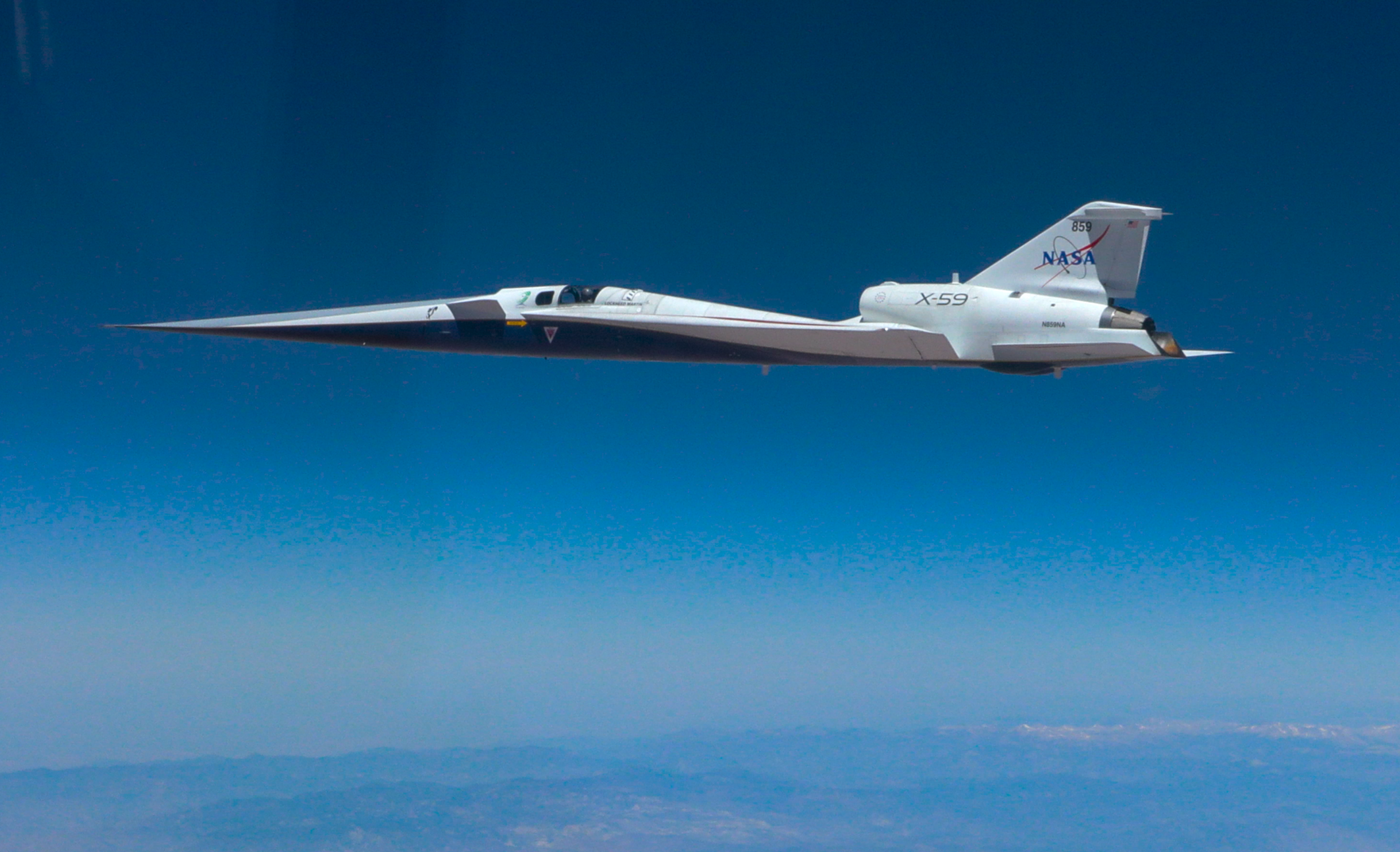
AIAA AVIATION Forum, San Diego — After going supersonic in NASA’s X-59 last week, test pilot Jim “Clue” Less expects to soon demonstrate that this experimental jet can do so while being significantly quieter than other supersonic aircraft — producing a sonic “thump” more like a car door closing than an ear-shattering sonic boom.
On Friday, X-59 reached Mach 1.1, at a top speed of 1,147 kilometers per hour and peak altitude of 43,400 feet over the Mojave Desert in Southern California. Less is to fly the aircraft again in the next few days at similar speeds before taking it up to Mach 1.4, the mission parameter. That could happen as soon as “in the coming days,” Administrator Jared Isaacman said in a press release.
“The significant event really will be Mach 1.4,” Less told me by phone, “because that’s where it’s designed to put down our sonic thump that is not as loud as the sonic boom, and that’s when we’ll really know how this is working, right?”
“Everything we do is leading up to that,” he added.
The demonstrator is the centerpiece of NASA’s decade-long effort to determine whether an aircraft can be shaped to mitigate the sonic booms produced when flying supersonically. During flight tests, an F-15B fighter has been closely following X-59, creating its own sonic boom that masked the sonic profile of the experimental plane. But NASA and Less said they expect the F-15 to eventually drop back far enough to allow sensors and observers on the ground to detect X-59’s sound.
In the meantime, Friday’s flight will help NASA calibrate the aircraft’s onboard instrumentation, Less said, including the airspeed indicator.
“They told me I hit supersonic around the point where my indicator said Mach 1.03, so that will be adjusted,” he said.
Less said he first realized he had gone supersonic because he saw a shadow of the shock wave coming off X-59’s front canard. Such waves aren’t routinely visible to the naked eye, but he said the sun was at precisely the right angle to reveal it.
The X-59, like all aircraft traveling supersonically, continually creates these shock waves when exceeding the speed of sound. The waves build up and coalesce, creating the infamous sonic booms that resemble thunder. But X-59’s slender airframe is designed to spread out the waves to produce a more muffled “thump.”
The current phase of flight testing is meant to verify that capability over the remote testing grounds east of Los Angeles. But eventually, NASA plans to fly the aircraft over multiple U.S. communities, to gather public feedback that will help FAA and the International Civil Aviation Organization craft new regulations permitting overland supersonic flight.
Speaking on a panel here, Cathy Bahm, NASA’s X-59 project manager, said that community exposure is unique for a NASA experimental plane.
“So many X-planes just stay on the range, in very controlled airspace. This airplane is going to go out into communities, so it has to accomplish that with safety,” she noted. “We have to be sure that these systems can be reliable out in the wild and can be trusted to fly over any communities that we plan to test.”