NASA’s X-59 breaks sound barrier in first supersonic flight


This story has been updated with additional flight details.
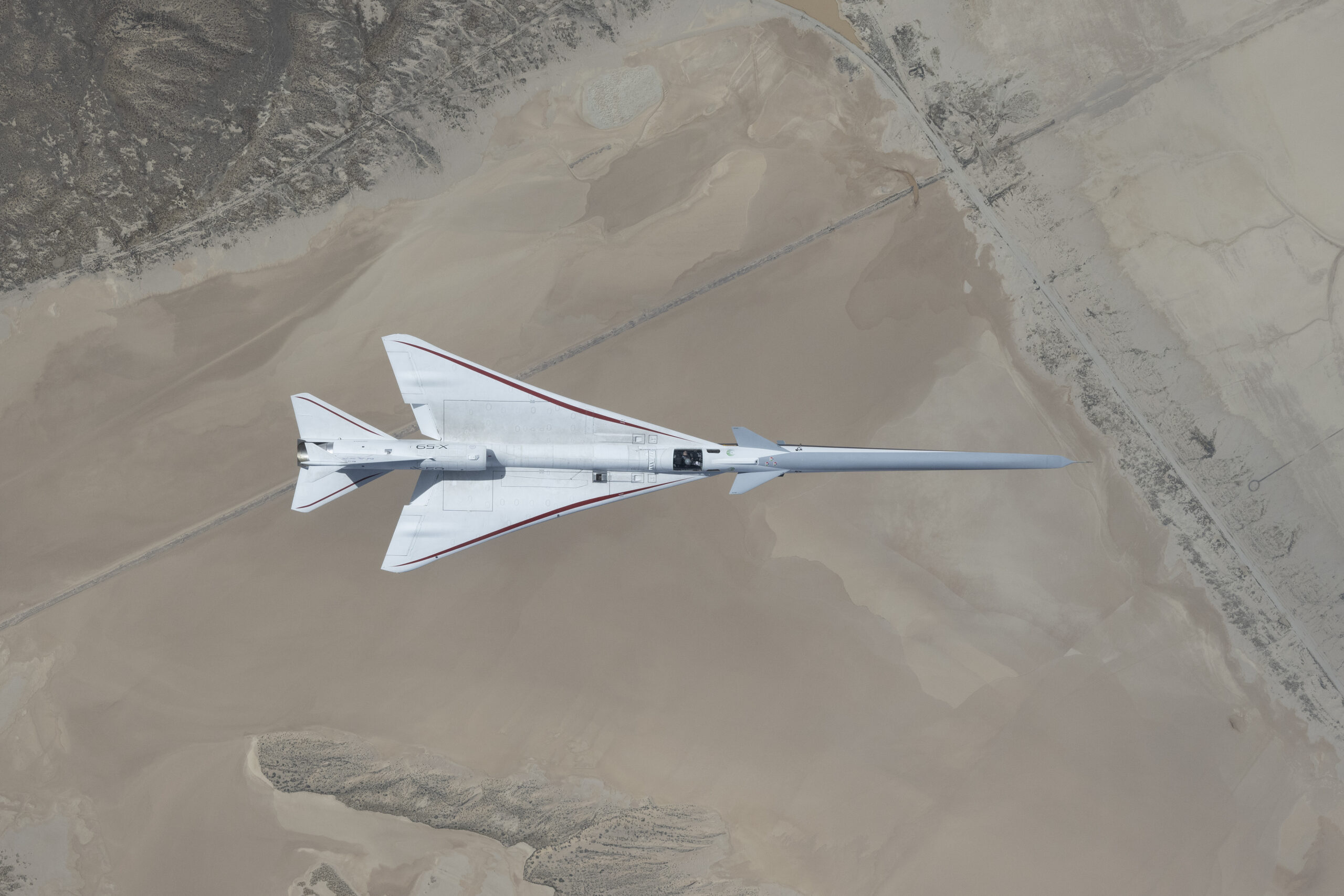
Ten years after its development began, NASA’s X-59 demonstrator on Friday exceeded Mach 1 for the first time, marking the next step in the agency’s effort to demonstrate a quieter form of supersonic flight and help repeal the longstanding regulation that prohibits overland commercial supersonic flights in the U.S.
The aircraft, piloted by NASA’s Jim “Clue” Less, took off at 11:09 a.m. Pacific Time from Edwards Air Force Base in Southern California into the skies over the Mojave Desert, where Chuck Yeager first broke the sound barrier in 1947. NASA said X-59 reached Mach 1.1, hitting a top speed of 1,147 kilometers per hour and peak altitude of 44,340 feet.
The goal for the next flight, slated to occur in a few days, is to reach Mach 1.4 (1,728 kph) and 55,000 ft — the “mission conditions” the agency has set.
NASA aims to demonstrate an aircraft can be shaped to mitigate the thunderous sonic booms produced when exceeding Mach 1 — the result of multiple shock waves that merge. The prime contractor, Lockheed Martin Skunk Works, chose a long, slender airframe and needle-like nose to break up the shock waves, so X-59 would instead produce a quieter “thump” comparable to the sound of a car door closing 6 meters (20 ft) away.
NASA could not capture X-59’s noise on Friday because the nearby F-15B chase plane created its own sonic boom that masked any sound the demonstrator might have made. The agency will focus on isolating the sound of X-59 at supersonic speeds later in the flight campaign, a spokesman told me.
A NASA test pilot and members of the X-59 team are scheduled to speak about the flights at AIAA’s AVIATION Forum in San Diego next week.
In preparation for today’s supersonic attempt, NASA conducted a Block One campaign of 16 subsonic flights to verify the aircraft’s performance and gradually increase its speed and altitude. The next phase of supersonic flights is to follow a similar progression: Pilots will start with short, simple flight patterns over NASA’s Armstrong Flight Research Center in the Mojave, and gradually move to longer flights, according to NASA’s mission description.
To measure the noise X-59 generates while flying supersonically, the F-15B chase plane will have a shock-sensing probe attached to its nose. Additional microphones on the ground are to capture and record acoustic data.
Based on the initial results, NASA plans to adjust the trim and attitude of the aircraft with its control surfaces and also reposition the stored fuel on board, said Mike Buonanno, lead engineer on X-59 development for Skunk Works, during a May interview.
Following the Mojave flights, NASA intends to conduct a community response study, in which X-59 will be flown over various communities across the U.S. to measure the public response to the noise. That data is to be submitted to FAA and the International Civil Aviation Organization “in the hopes of changing regulations prohibiting commercial, supersonic flight over land,” according to NASA.