Boom Supersonic targeting late 2027 for first deliveries of ground turbines, CEO says


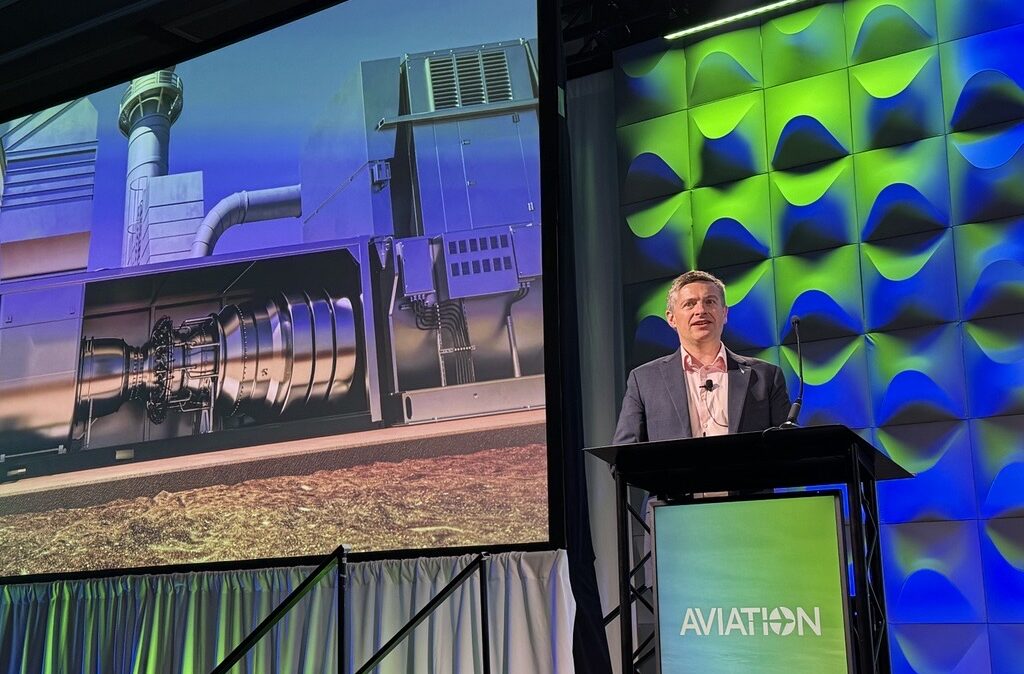
AIAA AVIATION Forum, San Diego — Boom Supersonic is targeting “the end of next year” to ship the first five units of its Superpower ground turbines, founder and CEO Blake Scholl said here.
“There’s a lot of work left to do to make that happen, but nothing impossible,” he said in a Thursday morning keynote.
Each Superpower will generate 42 megawatts, which Boom believes is sufficient power generation for the scores of AI data centers being constructed. The Colorado company previously said it has $1.2 billion in orders for the natural gas turbines, which are derived from the core developed for the Symphony engines that will power its Overture supersonic airliners.
“The revenue and the profits from our Superpower turbine pay for the development of the supersonic jet, and we actually have all the financial resources that we need to build a supersonic airliner,” Scholl said. “At this point, I feel like the world has handed us the football, and if we don’t fumble it, this is going to actually happen.”
Established in 2016, Boom is targeting 2029 for the first deliveries of its Overtures, 60-80-passenger airliners that are designed to cruise at a maximum of Mach 1.7. The company forecasts at least 600 routes for Overture and has received orders from airlines including United Airlines, American Airlines and Japan Airlines.
U.S. President Donald Trump last year signed an executive order directing FAA to lift the long-standing ban on commercial overland supersonic flight and draft new rules permitting such operations, provided no sonic booms reach the ground. A bill to that effect, the Supersonic Aviation Modernization Act, has passed the House and is pending a Senate vote.
Boom’s XB-1 subscale demonstrator aircraft broke the sound barrier in January 2025, the first time a privately developed, American-made civilian jet achieved supersonic flight. The company followed up with additional flights over the Mojave Desert in California, near Edwards Air Force Base, to demonstrate its “boomless cruise” concept for silent supersonic flight.
A pilot manually kept XB-1 at the correct speed and altitude for the shock waves to refract away from the ground — a phenomenon known as Mach cutoff. The company intends to develop software for the Overtures that will do those calculations.
Scholl today fielded questions about how Boom’s techniques compare to those used for NASA’s X-59. That demonstrator, which went supersonic for the first time last week, was designed in a slender aerodynamic shape to spread out the shock waves generated when exceeding Mach 1. If all goes as planned, X-59 should generate a quieter “thump,” rather than a ear-splitting sonic boom.
Scholl acknowledged that X-59 will be “quieter than a conventional supersonic configuration” and can perform that quieter flight at higher speeds than Overture. The boomless cruise technique requires Overture to fly between Mach 1.1 and 1.3, slightly slower than X-59’s mission parameter of Mach 1.4.
However, he noted the demonstrator won’t be completely silent. “Reasonable people are going to differ on how quiet is quiet enough,” Scholl said. “One of my fears about X-59 is it’s very quiet on one condition, but the data I’ve seen says as you get off condition, even by small increments of like angle of attack, you quite rapidly climb the loudness curve.”