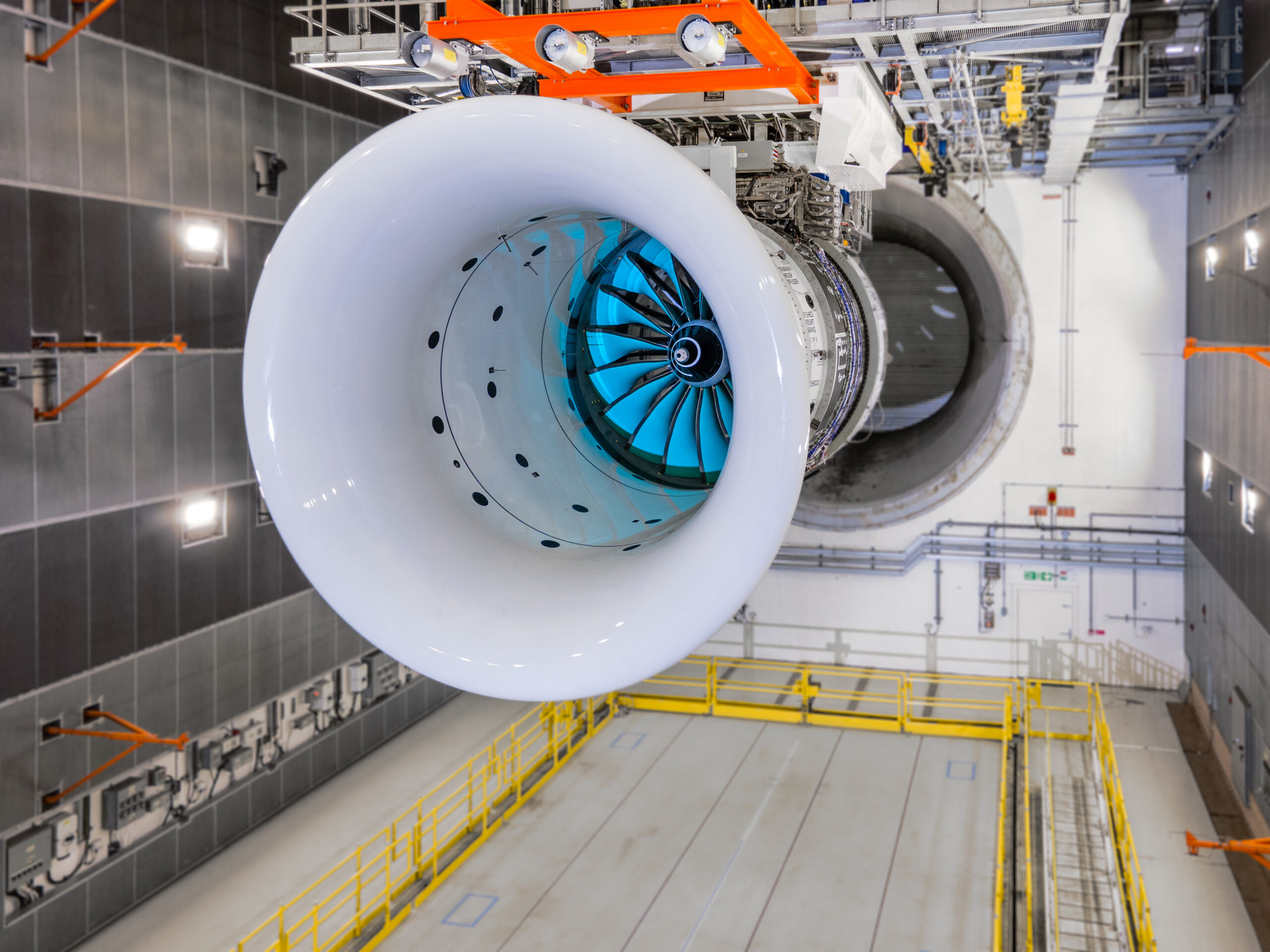
With UltraFan design, Rolls-Royce is betting turbofan has further to go



In the race to develop the next-generation jet engine, two distinct teams have emerged: the open fan concept, led by Safran and GE’s joint venture CFM and backed by Airbus; and the turbofan, as championed by Rolls-Royce and Pratt & Whitney and favored by Boeing.
Turbofans are the latest iteration of conventional gas turbine engines, relying on a large fan to draw in air, burn fuel in the engine’s core and create powerful thrust. While modern turbofans are very efficient, the industry consensus is that the technology is nearing its maximum fuel efficiency, as efforts to further improve performance bump up against engine size limits. This has given fresh energy to efforts to develop new architectures like the open fan, which removes the engine’s outer casing.
But not everyone is ready to write off traditional engines.
“There is a narrative in the market that the ducted gas turbine has had its day,” said Alan Newby, Rolls-Royce’s head of research & technology, in an interview. “My view is: far from it.”
Indeed, Rolls-Royce in February unveiled the UltraFan 30, a higher-bypass-ratio turbofan for next-generation narrowbody jets. The company believes the UltraFan concept — which has been in the works for a little over a decade — can achieve an efficiency gain of 25% over the first generation of its Trent engines, thanks to a small core and large composite blades, which allow more air to flow through the engine.
In March, the European Union’s Clean Aviation Joint Undertaking awarded Rolls-Royce 64 million euros ($74.1 million) in funding to support development and ground testing of the UltraFan 30 demonstrator. (Clean Aviation is also funding CFM’s competing open fan effort.)
In an interview, Newby said there are multiple ways conventional engines can make additional strides. As well as pushing the bypass ratio higher, Rolls-Royce sees room for improvement in the engine’s casing, or nacelle, and is examining everything from the design of this component itself to how tightly the nacelle fits around the engine and how it’s installed on the aircraft. The company is also seeking efficiency gains from the low-pressure system that generates the vast majority of the engine’s thrust.
And Rolls plans to focus more on how the engine is integrated into the aircraft. As engines continue to grow in size in comparison to the airframe, Newby said, engine makers and airframers will have to work more closely to ensure the aircraft performs as it should.
The combined effect of these incremental improvements, he said, will allow UltraFan to reach the 20% fuel efficiency gains required for the next generation of aircraft engines.
Rolls has long planned to construct UltraFan variants for both narrowbody and widebody jets, scaling up from 25,000 to 100,000 pounds of thrust. The widebody effort is further along, as the UltraFan 80 demonstrator — whose 140-inch-diameter fan is about the size of a VW Beetle — was completed in 2021 and did a first round of testing in 2023.
For the UltraFan 30, Newby said the goal is to show the technology still works at a reduced scale: a fan 90 inches in diameter, comparable to the width of a large flatscreen television.
The concept was informed in part by discussions Rolls held over the last year with a variety of potential customers, Newby said. In response to follow-up questions, a company spokesperson said these customers include “potential aircraft manufacturers and a range of airlines, covering a large spectrum of possible operators from low cost through to traditional full service carriers.”
Now Rolls is working on the demonstrator design. Plans call for utilizing the core from the existing Pearl 10X engine, which closely resembles the core the company plans to develop for the production version of UltraFan.
The demonstrator is mainly focused on testing the low-pressure system, made up of the gearbox, fan, low-pressure unit and high-speed turbine.
The goal, Newby said, is to get to preliminary design status by the end of the year, then design and deliver the major components by the end of 2027. This sets up the company to build the demonstrator in the first part of 2028 and ground-test in the second half.
Rolls is assuming a next-generation jet will enter service sometime between 2035 and 2040 and so is aiming to finish engine development by the end of this decade.
“We’re taking the view, let’s get the technology ready,” Newby said. “The market will do what the market will do, but when the flag drops, we need to be ready to go.”
He said the company now expects the smaller UltraFan variant to debut first.
“It’s the next-generation product and, when we started this, I suspect we thought that was more likely to be widebody than narrowbody,” he said. “Now the way it feels from a market perspective, it feels more like a narrowbody comes first. That’s where our focus is.”
That timeline lines up with the target Airbus has laid out for its next-generation narrowbody. The planemaker, along with GE and Safran, is assessing the open-fan design (a term often used interchangeably with “open rotor”) and plans to test the engine on a modified A380 toward the end of the decade.
Although Boeing hasn’t committed to a firm timeline for its own next-generation airliner, media reports indicate the company has begun working on a successor to the 737 MAX and could make initial technology decisions as soon as next year.
Whether the planemakers select a turbofan or open-fan engine could have far-reaching implications for the air transportation sector, said Leeham analyst Bjorn Fehrm.
“There hasn’t been such a high-stakes game in the engine industry in the last 50 years,” he said, referring to the shift in the mid-1900s from turboprops to jet engines.
That transition was led by Boeing, which bet on a jet engine for its 707 narrowbody that debuted in 1957. It was another two years before McDonnell Douglas introduced its DC-8, a delay that contributed to Boeing becoming one of the biggest airplane manufacturers in the world as it scooped up orders while the DC-8 was still in development.
Airbus’ choice of engines for its next-generation jet could be just as decisive, said Fehrm.
“It’s an incredibly important decision, and if Airbus decides to go open rotor, I don’t see that Boeing can do anything else,” said Fehrm. “If they go for turbofan, they have put their stake in the ground, and if the Airbus is 5% more efficient, that will kill Boeing in the market.”
Airbus and Boeing have historically preferred to have at least two engine options to drive down price and mitigate the risk of supply shortages, but selecting an open-fan design would require redesigning the whole aircraft to accommodate the large open blades. As a result, if either or both manufacturers select open fan, it could shut any other engine maker out of that segment of the narrowbody market.
Rolls’ strategy with the two UltraFan variants is to ensure it can still target the widebody market, even if it loses the narrowbody. Meanwhile, CFM is quietly working on a backup conventional engine that utilizes some of the open-fan technology, Reuters reported in February.
A spokesperson told me CFM is “advancing innovative new technologies to meet our customers’ needs and believe Open Fan is the most promising path to achieve a step change in efficiency and durability.”
According to Newby, while Rolls sees turbofan as the right technology, it will be up to the aircraft manufacturers to decide which team ultimately wins in the race to power the next narrowbody.
“Our view is that you either you opt for a ducted solution, in which case you may have some choice, or an unducted one, in which case today you’ve got one choice,” said Newby. “If you’re in Airbus’ shoes, that’s the choice they’ve got to make, and Boeing indeed as well.”