Test time for this hybrid-electric engine concept
 By Keith Button
 By Keith Button
This story has been updated to correct the current generator customers for Collins Aerospace.
Engineers in Rockford, Illinois, have spent about six months testing the guts of a planned hybrid jet fuel and electric engine — which they hope will become another option for future single-aisle airliners.
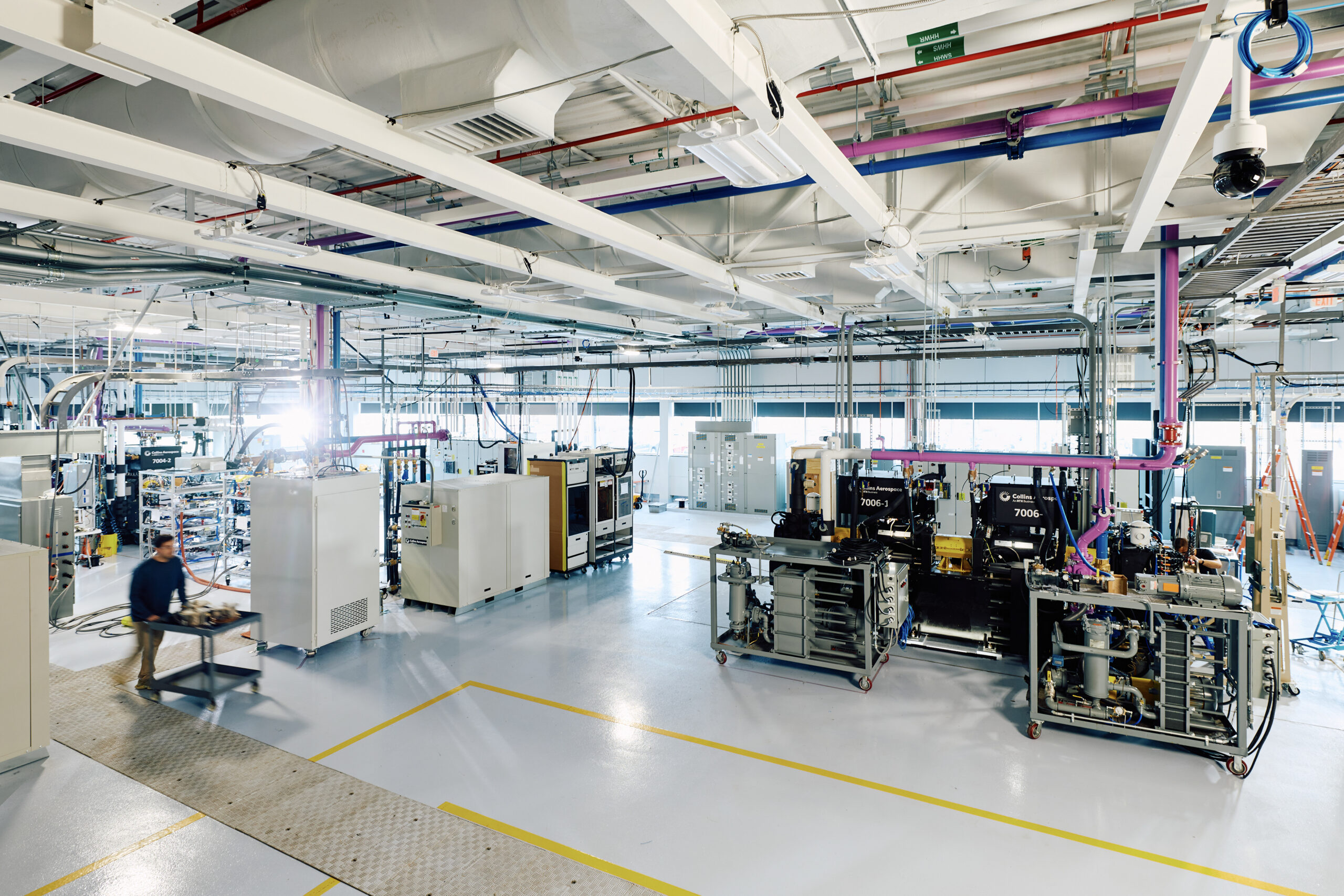
On the brightly lit, high-ceilinged test floor of the Collins Aerospace laboratory, the jet turbine piece of the engine is absent. Instead, two minivan-sized dynamometers contained in black cabinets stand in for the high- and low-pressure drive shafts of a full-sized Pratt & Whitney geared turbofan engine (GTF).
Purple and blue cooling water pipes and gray and black electric cables connected to the various cabinets and racks hang from the ceiling.
“It does not look like an engine at all; it looks more like a factory or a computer server room,” said David Kucharski, director of business development for electric power systems at Collins, an RTX company.
This testing is part of SWITCH — short for Sustainable Water Injecting Turbofan Comprising Hybrid-Electrics — a collaboration between Collins, its sister company Pratt & Whitney, Airbus, GKN Aerospace, MTU Aero Engines and European research institutions.
The project, funded in part by 48.5 million euros ($56.3 million) awarded in 2022 by the European Union’s Clean Aviation program, aims to build and demonstrate a Pratt & Whitney GTF featuring the hybrid-electric technology at the Collins lab in Illinois and a steam injection technology for the combustion side of the engine.
The engineers want to demonstrate the engine can produce a 20% fuel burn savings and a 50% reduction in carbon dioxide and nitrogen oxide emissions than the engines powering today’s passenger planes, and that these new technologies could be adopted for short and medium-range passenger jets ranging from commuter planes to single-aisle aircraft like the Airbus A320.
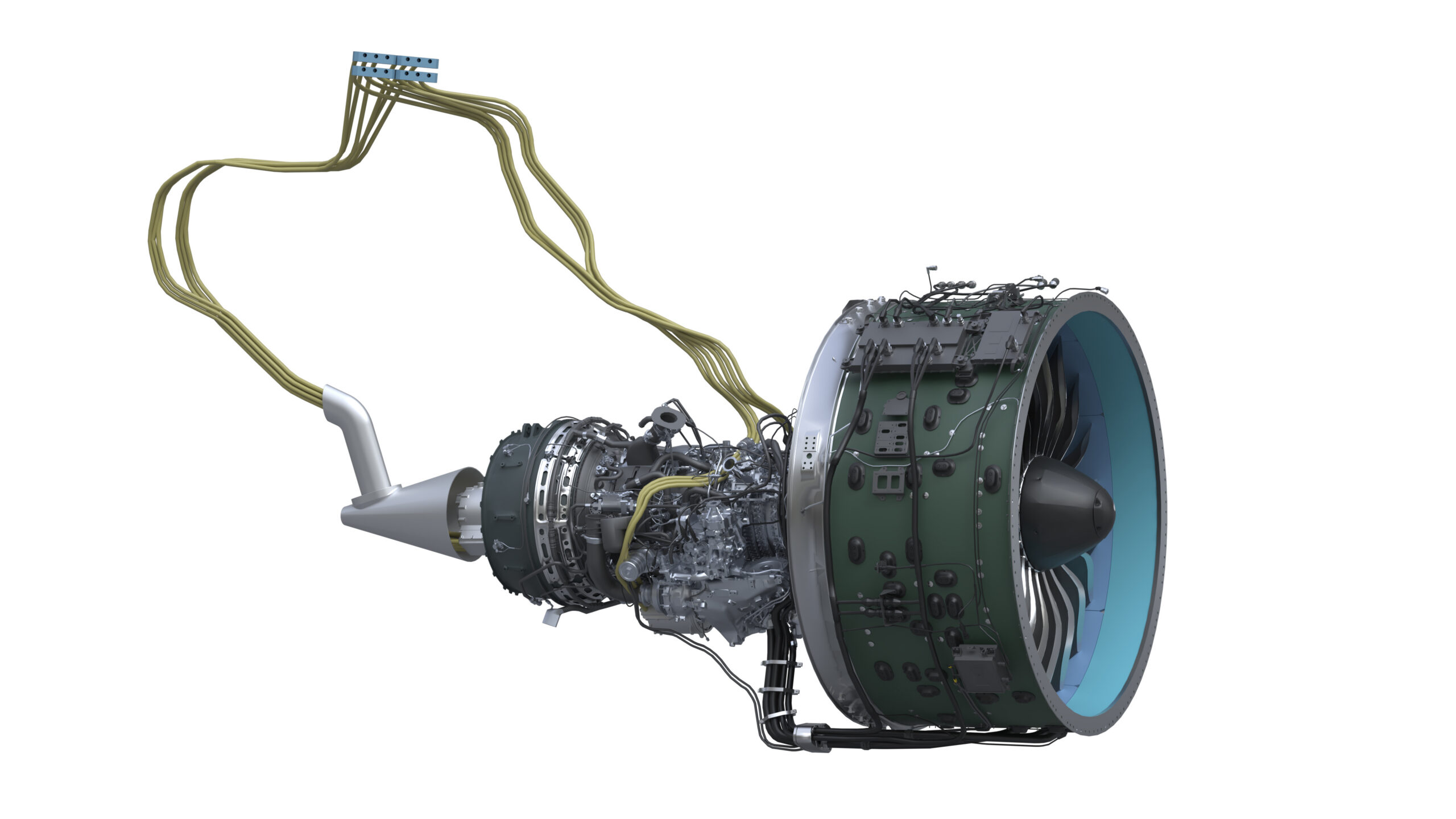
In addition to hosting the current testing for SWITCH, Collins built the motor generators capable of taking power from the turbine’s driveshafts — to generate electricity for battery storage, for example — or adding power to the turbine to boost propulsion, such as during takeoff. The company also built the power electronics and motor controllers that convert voltage for battery storage or for driving the electric motors, while GKN contributed high-voltage wiring for the demonstration engine.
Collins currently supplies secondary electric starter-generators for jet-fueled aircraft including the Boeing 787 and F-35 fighter jet, and auxiliary generators for the Airbus 350. For its electric propulsion research and development, the company has adapted concepts originally developed for those generators, said Todd Spierling, principal technical fellow for electrification.
“We use that as a backdrop,” Spierling said. “That gave us the basic building blocks of power generation, distribution, conversion.”
The largest secondary generators for commercial planes are aboard 787s, which have six of the 250-kilowatt generators. For electrified propulsion, Collins is developing motor generators as large as 1 megawatt, roughly four times larger. The SWITCH engine will feature two of them.
When the actual demonstration engine is built, the electrical equipment will be mounted on the exterior of the full-sized Pratt & Whitney jet-fuel turbofan, with the motor generators connecting to the two turbofan drive shafts through its gear boxes, Spierling said.
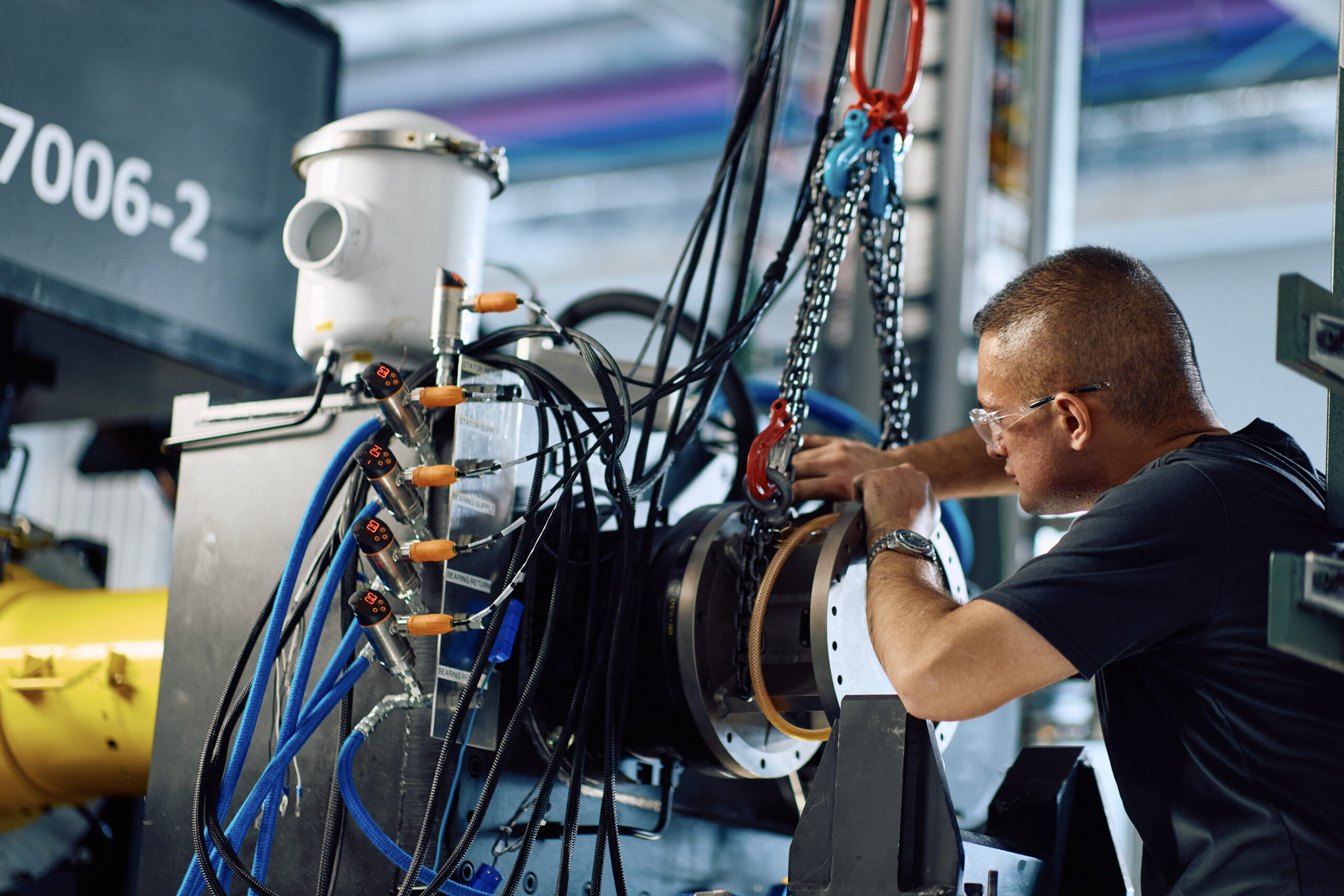
Starting at the end of 2025, engineers from the SWITCH partners built and began testing the combined electrical components for one of the engine drive shafts in the Collins lab. They started with basic tests to see if the components worked together as designed, Kucharski said. “You don’t just jump into the meat of the testing with a complex test.”
“Eventually, we work up into simulated flight scenarios, where we will have in our control room a simulation of the rest of the aircraft, essentially, and automatically take the system through various different flight phases and different conditions,” he said. “We’re trying to make sure: Is the system operating as we expected?”
In some cases, the engineers conduct a test simulating a fault in the system — such as a short circuit in a specific wire — to see if the components safely communicate with one another about the fault and react as they should, and in the right sequence.
“We may find that those timings were not what we expected, and we need to then go in and either change the sequence of events or we need to change the timing of events,” Kucharski said.
If a fix is needed, “it’s really great if it’s software; then we can change it much quicker,” he added. “Obviously if it’s hardware, it’s a little bit more difficult” and may require one of the SWITCH partners to send an updated component. Engineers from each of the companies are at the Collins lab evaluating the results and whether design changes are needed.
The plan is to start with short scenarios, such as an engine start, repeated with different electrical situations — such as with high voltage and the lowest system drag, or low voltage with the highest system drag, or variations in between, and with various fault scenarios, Kucharski said. They’ll ultimately group the short scenarios into longer flight segments or types of flight.
“We have to explore the boundaries,” he said, “not just how we perform under a single set of nominal conditions, but across the entire range.”
Many of the SWITCH engineering challenges stem from the need to create new electrical hardware that is much larger than anything the partners previously worked with, Spierling said. “How do we get the efficiency levels that we need? And if the efficiency was different than we expected, how did that change another element of the system?”
For instance, the engineers knew larger electrical systems would produce electromagnetic noise that interfered with wired signals or radio signal communication between components. But they couldn’t accurately predict beforehand how and where that interference would take place, so they had to come up with shielding or grounding design changes to fix the problems after conducting physical tests.
“That’s an area that is difficult to model effectively,” Spierling said. “You expect there to be something; you just don’t know what the something is.”
He added: “There are some of the effects that don’t show up when you’re at low power that become more apparent as you push the boundaries of performance. It’s a continual chase to expose the problem, see it and figure out how to fix it.”
By the end of April, they had completed testing that established the baseline capabilities for the electric side of the SWITCH engine. By the end of 2026, they plan to finish running through their testing scenarios, incorporating any necessary design changes based on the results — mostly through software changes, Kucharski said.
The components will then be shipped to an Airbus testing site in Germany, where Airbus will test the same flight mission scenarios, this time with the actual batteries that were simulated by specialized load banks and power supplies for the Illinois testing.
“As you grow in confidence and maturity, you replace simulation with hardware over time,” Spierling said.
The SWITCH funding expires at the end of 2026, and the plan for testing the completed hybrid Pratt & Whitney engine is still undefined, dependent on future funding from the Clean Aviation program.
From the perspective of airlines and aircraft manufacturers, hybrid electric-and-combustion engines will be a tough sell for future planes, said Bjorn Fehrm, an aircraft industry analyst for France-based Leeham Co.
Hybrid concepts are appealing for vertical takeoff and landing aircraft with distributed propulsion across multiple lifting surfaces — in many cases they’re more efficient and quieter than traditional helicopters, he noted. But hybrid engines “have a very hard case” to make for replacing today’s combustion-only engines on twin-turbofan or twin-turboprop planes, he said.
That’s because for those designs, in most cases, the added weight of batteries needed for the electric propulsion portion of the engine greatly exceeds the weight savings and engine efficiency improvements on the combustion side, he said.
“That just doesn’t work, at least until the batteries are about 10 times better than they are today.”
However, “mild hybrid” engines can make economic sense for airplane designers, he said. That term refers to an engine with a relatively small electric core and small battery because they are engaged only when the plane is in full throttle — perhaps for a maximum of 10 minutes per flight.
“The formula is: mild hybrids, small batteries,” he said. If you’re an airplane designer, “you sell your grandmother for 10 kilos” of weight savings.