

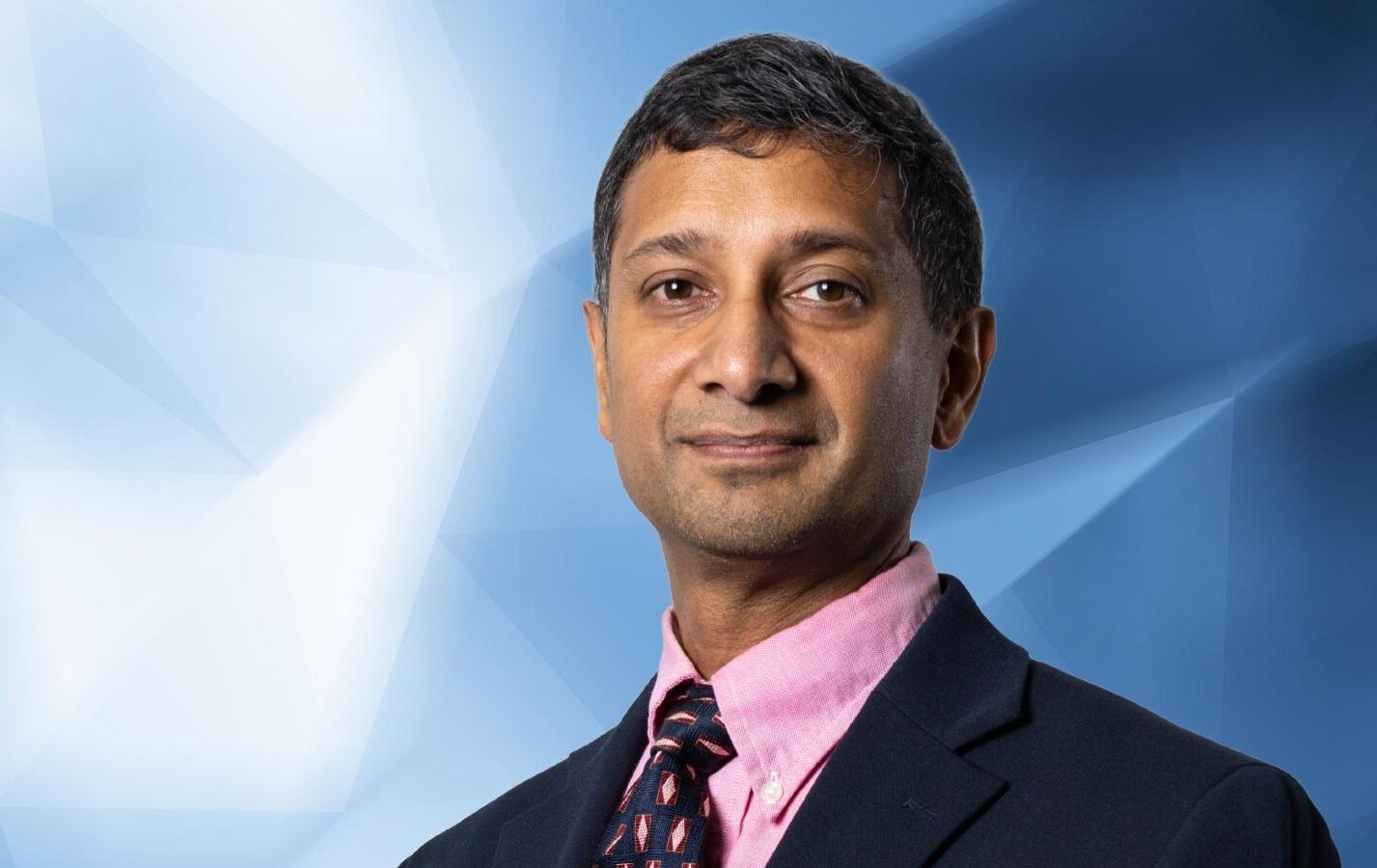
Arun Seraphin, director of NDIA’s Emerging Technologies Institute
For more than 20 years, Arun Seraphin worked in Congress and at the White House, focusing on how changing legal processes and structures can help national security efforts better leverage science and technology.
Now, as director of the National Defense Industrial Association’s Emerging Technologies Institute, he spends his time assessing how artificial intelligence will affect the defense sector, facilitating conversations among the increasingly diverse actors of the sector and evaluating whether today’s research investments will be sufficient to meet tomorrow’s challenges. NDIA’s membership comprises 1,700 defense and national security companies, as well as 66,500 individuals.
“NDIA brings together government, industry, small businesses, academia and new commercial companies and tries to discuss how to improve partnerships between the public and private sector to deliver the best product for national defense,” he told me in an April interview. “Our mission is the same thing as applied to emerging technologies.”
Our conversation about the state of the defense innovation ecosystem has been condensed and lightly edited for space and clarity.
Q: What drives ETI’s research, and how do you determine what to focus on?
A: Some of it is signals that we get from our membership. We also get signals from the Pentagon, like when the Pentagon told us they’d love for us to start figuring out how to bridge what they’re doing and what venture capital and private equity want to do. We’re the perfect place to do that.
The Pentagon did not issue a formal request to ETI; Seraphin said he was referring to “informal feedback and themes” coming from the department. — AP
Sometimes we get signals from the Hill, when they say, ‘We’d love for someone to think about a particular issue.’ ETI can start to put together events or papers on that. The signals come from all over and, truthfully, from ourselves as well.
Q: What are your current focus areas?
A: The use of advanced software, artificial intelligence and digital engineering to improve the way the Defense Department buys is one big focus area. Another focus area right now is that question of how private capital is influencing the shape of the defense sector and how the Pentagon should best position itself in a world of billions of dollars of private capital. We’ve got another set of research going on trying to track how basic research investments of the past are now manifested in operational capabilities. We’re kind of uniquely positioned to draw the line between the academic research and the defense contractor that’s creating and selling those systems to the Pentagon.
Q: You have a long background working in the Senate and the White House. How does watching what comes out of Capitol Hill and the White House influence ETI and your work?
A: You have to get signals for a couple of things. One is, what are their priority areas? The Pentagon, for example, has listed six areas that they feel are the highest priority for their research and engineering portfolios.
That list comprises applied artificial intelligence, biomanufacturing, contested logistics technologies, quantum and battlefield information dominance, scaled hypersonics and scaled directed energy. — AP
When they signal something like that, the industry and academic world is going to vector toward them, and then that’s going to drive what we think is useful to stimulate a conversation between those two groups.
Another thing is the messaging they want. For example, speeding up acquisition. That’s a signal coming from both them and our industry members, and so we can contribute to that through our work.
Q: Are there ways you think Congress or the White House could better support industry research?
A: I think both Congress and the White House, working with the Pentagon, can do more to send out market signals as to what they’re going to buy because then that helps drive where industry needs to position itself and where [the] private sector should be making investments.
Another end of the spectrum is that we have to get from the Congress and the White House and the Pentagon strong and stable funding for the research community. Making sure that those funding levels are adequate for the number of good ideas that we want generated to create the capabilities of the future and adequate to maintain that important part of our industrial base, which is that innovation base that resides at government laboratories and research universities. That’s an important part of the industrial base that we can’t forget. Of course, things like passing appropriations bills and keeping the government open always help.
Q: What’s the right balance of private investment and public investment? And how has that balance shifted over time?
A: I think everybody understands that, on the development of technology side, the balance has swung far over from government to the private sector, and that’s pretty healthy and good. On the other hand, on the basic research side, the balance is going to forever be on the government. A private-sector-style of expectation of return and a private- sector-style of risk tolerance is never going to let them invest in the people, in the long-term research and in the infrastructure required to have that science base needed for military development and procurement. You’re going to have to see the government investing in those kinds of systems that have no commercial alternative, like hypersonic weapons or tactical vehicles for combat. A bunch of other things, or even subsystems for those larger systems, could be over on the commercial side.
My attitude would be: The government should try to send the right signals to attract as much private capital as it can, but when those private sector market failures occur, it’s the government’s duty to step in and make those investments.
Q: What emerging technologies do you think will be most impactful for defense within the next decade?
A: No. 1 is easy: artificial intelligence. It’s going to be the way that the Department of Defense sorts through
tactical data and makes decisions on the battlefield. It’s going to be the way it runs its back office. It’s going to be the way it does everything.
The other thing that will drive everything is biotechnology, whether we’re talking about the food side of it or whether we’re talking about the chemical and biological defense world that the military has traditionally been in, whether we’re talking about the medical side or even the new areas like using biomaterials for structural things, like building runways or for information processing.
I’ll just pick one more: additive manufacturing. The spread of parts which can be built using additive manufacturing methodologies of all different types is reshaping the way we build our military, we repair our military, we resupply our military.
Q: Let’s talk AI more specifically. What do you think the impact will be on defense technology?
A: There is a possibility that AI can create situations where you’re able to project power using autonomous systems that can learn in ways we’ve never imagined before. The ability to create deterrence through the use of unmanned systems or automated systems, the ability to process threat information so quickly and be able to deter adversaries as a result is going to be a huge change.
At the same time, AI could create all kinds of new threats because of its ability to process information. Those threats can be in the physical world or on the virtual side. Think AI-based cyberattacks against AI-based cyber defenses.
This ability to sift through data and learn and then control things at incredible speed will absolutely change the shape of warfare in the future, which then all leads to the issue of regulation. This is yet another technology that is evolving really fast, but the regulatory regime surrounding it is not evolving very fast.
Q: Do you see any potential risks in embracing AI in this realm? And if so, what safeguards are needed to address those risks?
A: AI could create the ultimate autonomous systems, and any time you take people out of the loop in combat military situations, it creates concern. The idea would be to put together the right groups of people, hopefully internationally, that can address: What are the potential uses of AI in these military kinds of situations? And what are we comfortable with and not comfortable with?
That kind of discussion needs to be a four-sided table. You need a person who knows how to write treaties and regulations and laws — a lawyer type. You need an actual user of the technology; in this context, it’s the military user. You also need somebody who would build and sell the AI capability — that business viewpoint with a sense of what the markets are and what the regulatory environment has to be in order to keep those businesses alive. Then the last side of the table is someone who actually knows how the technology works. That often is missing in these conversations, that person with the technical knowledge who can balance what the policy maker or the user who just wants it or the guy who just wants to sell it is saying.
We’ve lived in this world in previous technology areas. For example, landmines are a form of primitive autonomy used on the battlefield that have some regulatory structure around it. There are models for how we
develop that regulatory structure, and maybe those could be used again.
Q: What do you think are the current weak points or challenges for the Pentagon’s innovation ecosystem?
A: Right now, the Pentagon is doing a really good job in trying to embrace the ability for technology to move rapidly and change the way our forces can fight, and they’re doing a really good job in adjusting their buying and management practices to keep up with the speed of technology. There’s really healthy outreach to a larger set of the industrial base.
My concerns are: first, the [White House] budget request that we just saw. I don’t think it prioritizes science and technology investment as much as it should in order to drive all the innovation that we seek to keep up with our peer adversaries and to just keep up with technology. We need to think about a healthier investment in basic research and applied research.
Second, I worry about are we investing in research infrastructure and people — whether they’re inside the government or in the university community — enough. Our innovation system has been built off of these
universities and government labs, and we can’t forget about them as we’re investing in the future.
Q: Given your experience on Capitol Hill, what are you watching in the fiscal year 2027 defense budget request?
A: I’m watching that issue of science and technology spending. I’m also interested to see whether the
appropriations committees will go along with what the Pentagon is requesting and completely endorse it — which has never happened, so I doubt that will happen. Then, if they make adjustments, what are they going to adjust to? What I’ll be watching, basically, [is] are the appropriators going to play a big role in reshaping this request and strengthening the science, technology, emerging technology pipeline that leads to the good and necessary procurement of these technologies?
ARUN SERAPHIN
KEY POSITIONS:
- •Since 2023, director of NDIA’s Emerging Technologies Institute.
- 2014–2022, a professional staff member on the Senate Armed Services Committee for Sen. Jack Reed (D-R.I.).
- 2010–2014, held several assistant director positions within the White House Office of Science and Technology Policy and was special assistant for policy initiatives with DARPA.
- 2001–2010, a professional staff member on the Senate Armed Services Committee for Sen. Carl Levin (D-Mich.).
- 1996–2001, a research staff member at the Institute for Defense Analyses.
NOTABLES:
- Beginning in the late 1990s, helped create and expand the legal authority for the government to offer prizes in technology competitions, a mainstay in today’s innovation ecosystem.
- Helped expand the use of Other Transaction Authority, an acquisition approach meant to simplify the process. Also helped establish Commercial Solutions Openings as a way for the government to solicit ideas from industry, a key tool for responding to the COVID-19 pandemic.
- Wrote a number of authorities aimed at improving the way the federal science workforce is hired, paid and retained.
RESIDES: Centreville, Virginia
AGE: 56
EDUCATION: Bachelor’s degree in engineering science and American government, Stony Brook University, 1991; Ph.D. in electronic materials and nanotechnology, MIT, 1996.