Space Force to demonstrate GEO refueling, orbit transfer in upcoming demos


The U.S. Space Force’s program office for servicing, mobility and logistics is looking to two upcoming demonstrations to validate the technology needed for on-orbit satellite refueling and towing. With most of the involved spacecraft slated for launch in early 2027, the missions will test different yet complementary answers to the question: How can the service increase the maneuverability of its satellites?
“A satellite which is locked in a predictable orbit is fighting from a fixed position, and it’s a target,” Gen. Stephen Whiting, commander of U.S. Space Command, said in April at Space Symposium. “A force that can maneuver, however, and not be limited by the fuel that it was launched with and reposition as operationally needed is the one that holds the initiative.”
Overseen by the Space Force’s System Delta 80, the two demos could move the service closer to
realizing this vision.
The Space Force will test a depot-servicer-client model of operations in geostationary orbit, Col. Scott Carstetter, director of servicing, mobility and logistics for Space Systems Command’s System Delta 80, told reporters in May.
“We view that as a potential structure that could scale,” he says.
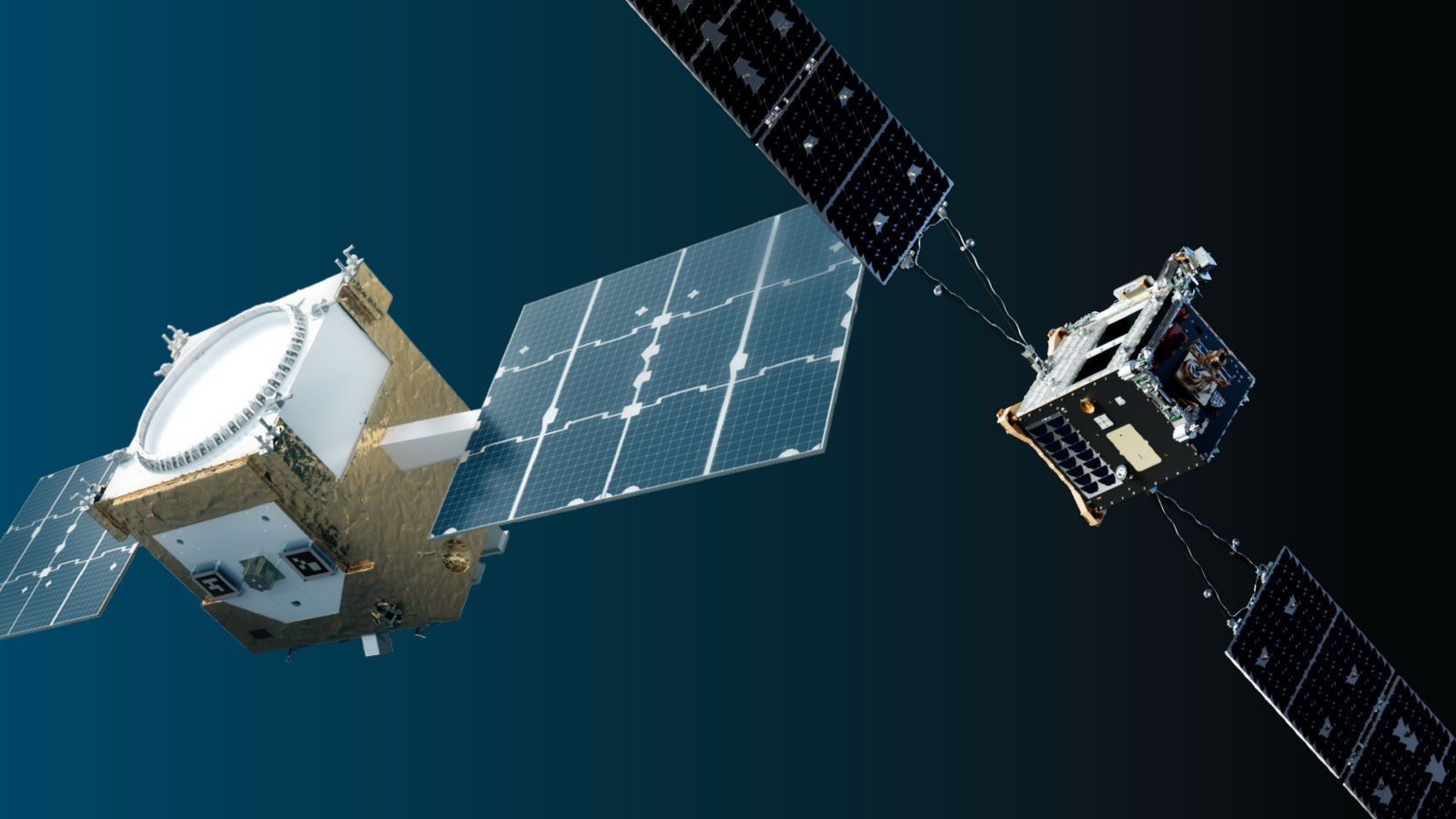
First to be launched are the Tetra-5 client satellites, built by Colorado-based Orion Space Solutions through a combined SSC-Air Force Research Laboratory program. The satellites are to expend fuel during separate anomaly resolution tests before the launch of the other spacecraft: a Provisioner servicer from Denver-based Astroscale U.S. and a fuel depot from Colorado-based Orbit Fab.
This staggered timeline will prove out “the rendezvous from multiple launches,” says Adrian Wheelock, AFRL’s program manager for Tetra-5, “because you can’t guarantee that all of your refuelable systems go up together, and that’s also not a desirable logistics end state.”
The two identical Tetra-5s will “have the ability to coordinate amongst themselves,” says Chad Fish, chief technology officer of Orion Space Solutions. Walkie-talkie-like communications units will allow the satellites to “coordinate and make sure that they’re talking and thinking together.”
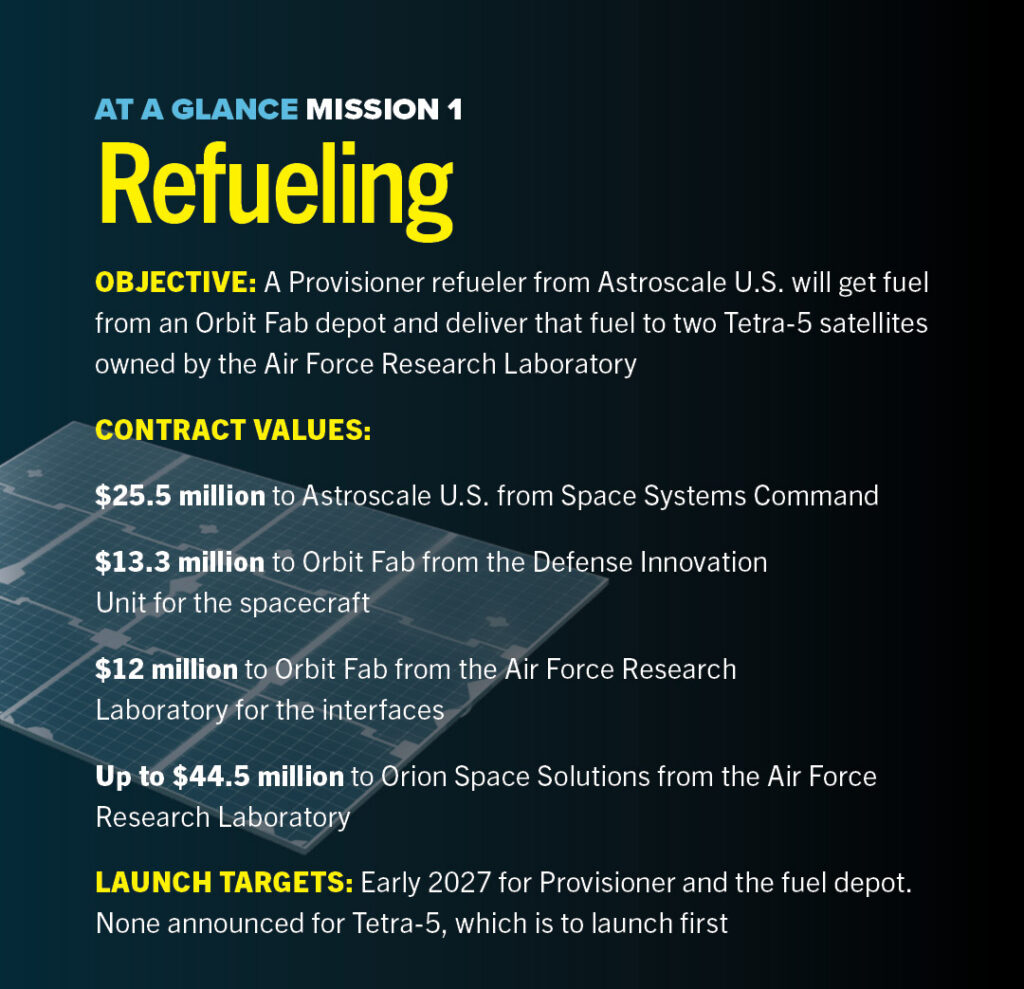
Once all four spacecraft arrive in geosynchronous orbit, “it’s basically just orbit phasing to get everyone close,” Wheelock says. The refueling operations will initially take place above GEO in a disposal orbit “so that if there is a problem, we’re already in a safe space.”
From there, Wheelock says plans call for conducting several refuelings in different configurations. In one scenario, says Carstetter, “the servicer is going to first mate with the AFRL client vehicle and refuel it, then go back to the depot, get more fuel itself, and then go back and meet with the [second] Tetra-5 again to refuel that.”
“This is really trying to work an ecosystem,” Wheelock says.
To facilitate these close-up interactions, the satellites will have fiducials — “basically QR-code-type” labels, Wheelock says — on their sides so any approaching spacecraft can scan and orient to the docking target.
Additionally, the spacecraft will be equipped with standardized docking valves from Orbit Fab. The passive side of these Rapidly Attachable Fluid Transfer Interfaces offers a connection point, whereas the active side “has four grapple hooks that kind of reach out,” says Jeff Lints, the company’s chief commercial officer.
Wheelock likened it to “one of the claws that you would see at an arcade to grab your stuffed toy.”
The planned dockings will likely be the most technically challenging part of the mission, says Sarah Law, Astroscale U.S.’s spacecraft design team lead. In any scenario where Provisioner initiates the docking, the servicer will have to complete much of its final approach autonomously because of the communications delay between Earth and GEO.
For that reason, “we’re going to be very, very slow [and] very, very gentle,” Law says. “The last few meters might take like 40 minutes.”
Wheelock says “the whole [refueling] experiment is designed to try to find as many problems with how we currently have things conceived as possible — and find ways to work through them.”
The second demo will test another method for increasing satellite mobility: augmented maneuver — “essentially a space tug,” Carstetter says.
For this, Seattle-based Starfish Space is providing one of its Otter spacecraft, which are about the size of a “super big oven,” says Ari Juster, the company’s chief operations officer, like those “in an old French kitchen.”
Unlike the spacecraft involved in the refueling mission, Otter “has the ability to dock with unprepared clients,” Carstetter says, meaning “satellites that were not designed necessarily to have a space tug dock with them and maneuver them.”
“That’s really critical,” says Juster, “because 99% of all the satellites that have been launched to space in history were not prepared for docking.”
This capability relies on a combination of docking hardware and autonomy software. The hardware is a “robotic claw,” called Nautilus, that was designed to latch onto “all kinds” of common satellite features, Juster says.
Once operators have selected the docking point on the client satellite, Otter is “able to autonomously rendezvous and dock using solely electric propulsion,” Juster says.
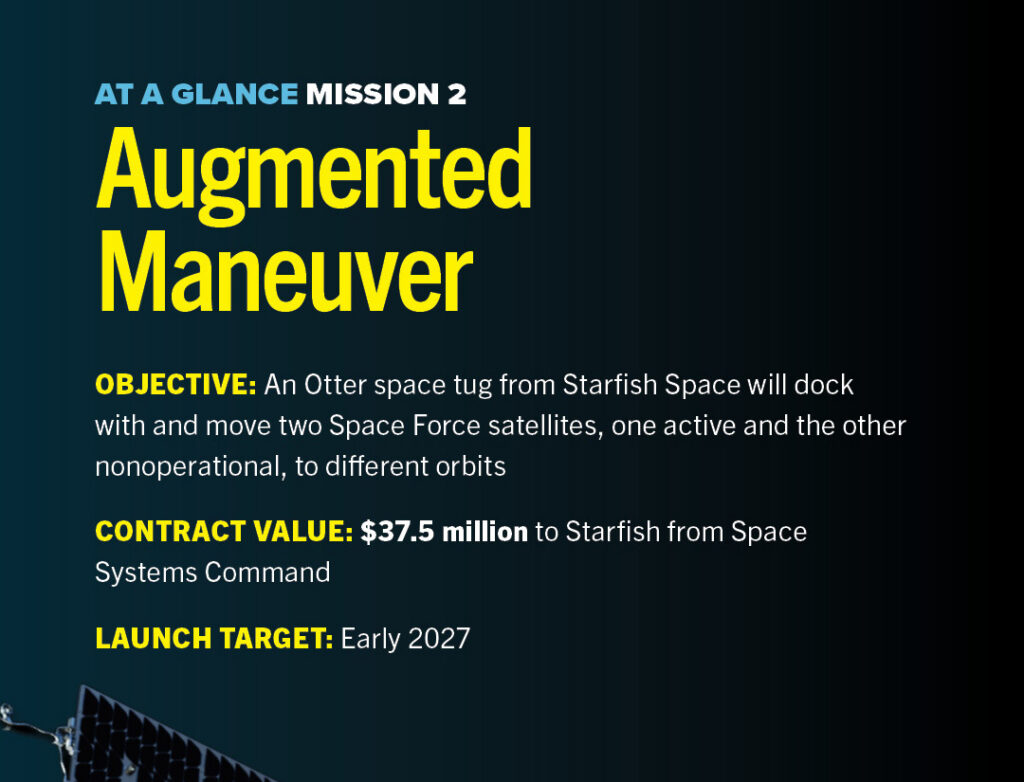
For the Space Force mission, Otter will spend two years in GEO demonstrating orbital transfers in different configurations.
“The first vehicle that we’ll mate with is a nonoperational vehicle that we’re going to move to a disposal orbit” using low thrust, Carstetter says. “Once we demonstrate that capability, then we can mate an operational satellite to conduct things like life extension.”
“Ultimately,” Juster adds, this mission will “help bring us closer to the interactive future that we want to build in orbit.”