
By Larry Bell and Rushabh Mehta, University of Houston’s Sasakawa International Center for Space Architecture
NASA’s evolution from lunar return to sustained lunar evolution and human Mars missions makes the relationship between orbit and surface newly consequential. The central issue is no longer simply how a spacecraft reaches the moon, but how an interconnected architecture can support occupancy — first on the moon and ultimately on Mars.
Although canceled, the Gateway program remains an important reference point in that evolution, but the larger architectural objective should extend beyond any particular station or vehicle. Orbital staging, surface infrastructure, transportation, habitats, power, communications, mobility and human operations must be conceived as parts of a progressively expanding system.
Architecture, in its fundamental sense, is the organization of a complex environment around human purposes and constraints. In space, those constraints include orbital mechanics, mass, energy, radiation, thermal conditions, life support, launch envelopes, propulsion, terrain, robotics, economics and human performance.
We recommend defining a common framework driven by six strategic imperatives to illustrate how interfaces can be considered before individual technologies are locked into an architecture.
1. Separate crew and cargo priorities
Crew transportation prioritizes safety, reliability, redundancy, abort capability and habitability. Cargo transportation prioritizes mass, volume, packaging flexibility and delivered cost. Treating them as the same problem can force compromises on both.
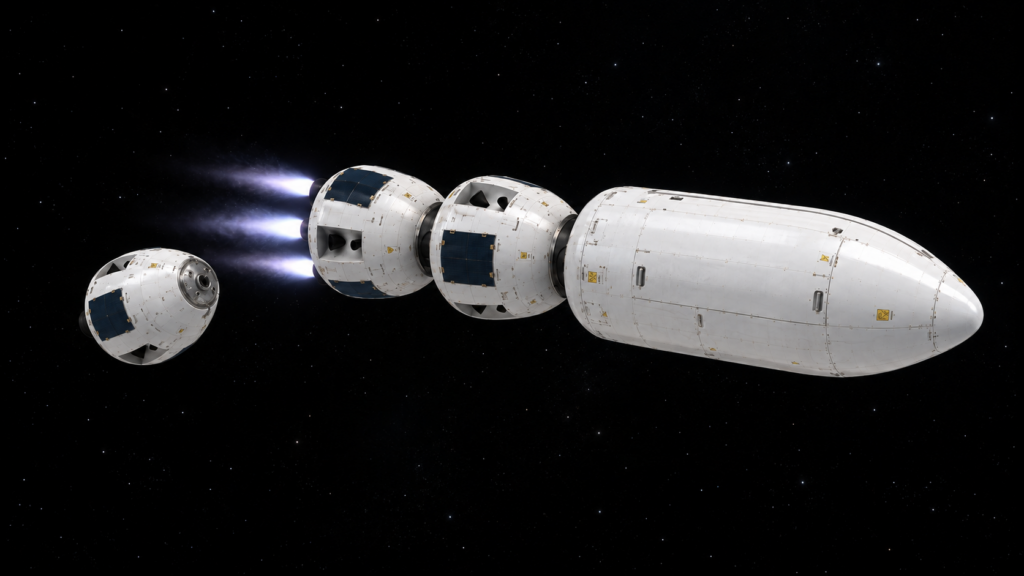
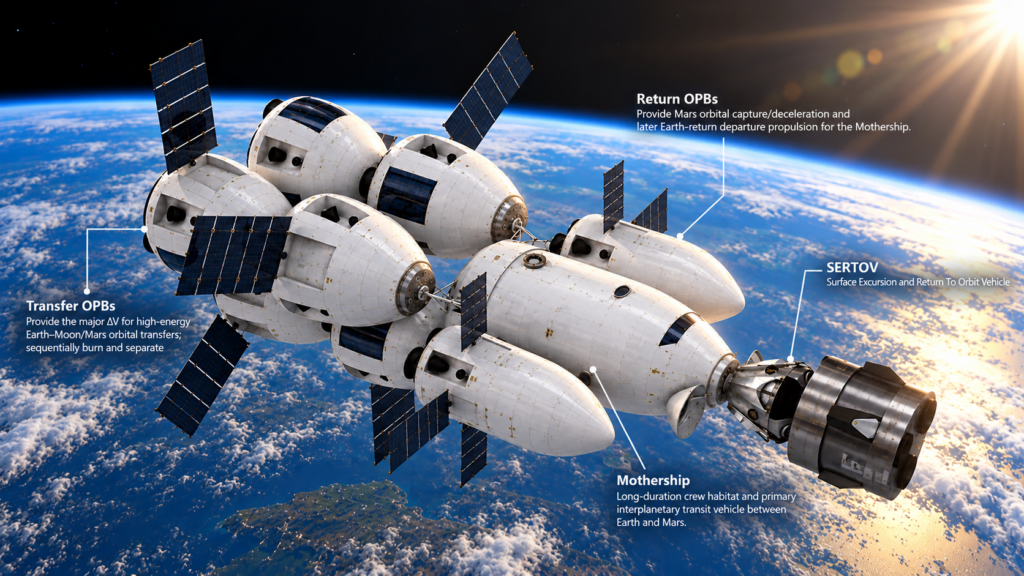
Our Orbital Propulsion Booster concept proposes an alternative. Under the concept, modular propulsion units are mechanically attached to specialized cargo carriers or to a dedicated Mars crew “Mothership.” The objective is to use powerful launch systems to place mass in orbit while allowing downstream vehicles to be optimized for their particular missions.
2. Do not make the orbital vehicle the surface habitat by default
Weightlessness and partial gravity impose different requirements. On the moon and Mars, fluids settle, floors matter, vehicles interact with terrain, and habitats must address dust, thermal cycling, radiation and surface logistics. An excellent long-duration transit vehicle need not be an equally effective surface habitat.
Our Mars Mothership concept would keep the long-duration crew environment in orbit and use smaller Surface Excursion and Return-to-Orbit Vehicles for descent and ascent. The principle is specialization with interoperability, rather than forcing one vehicle to do everything.
3. Establish “lights-on” capability before crew arrival
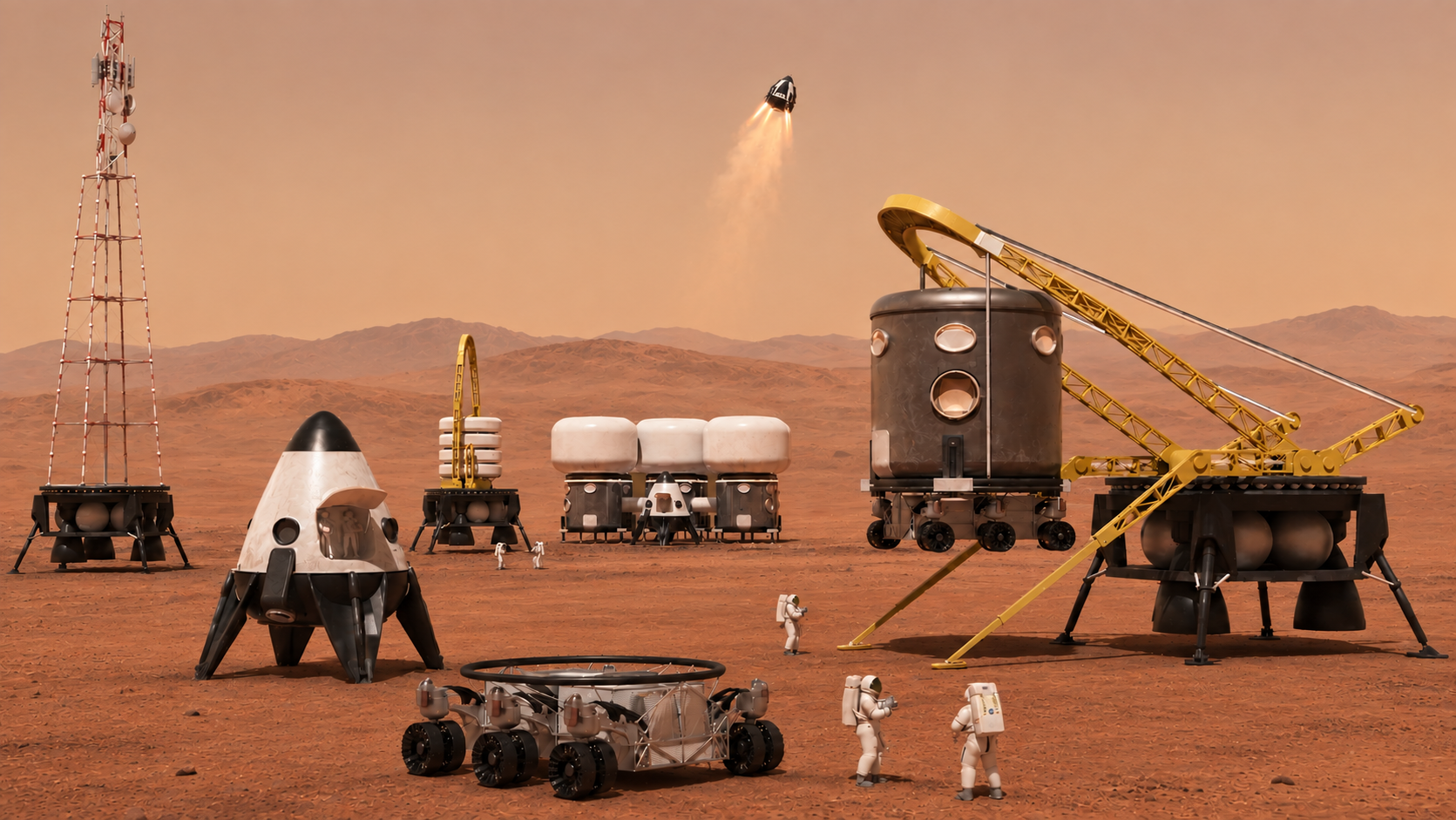
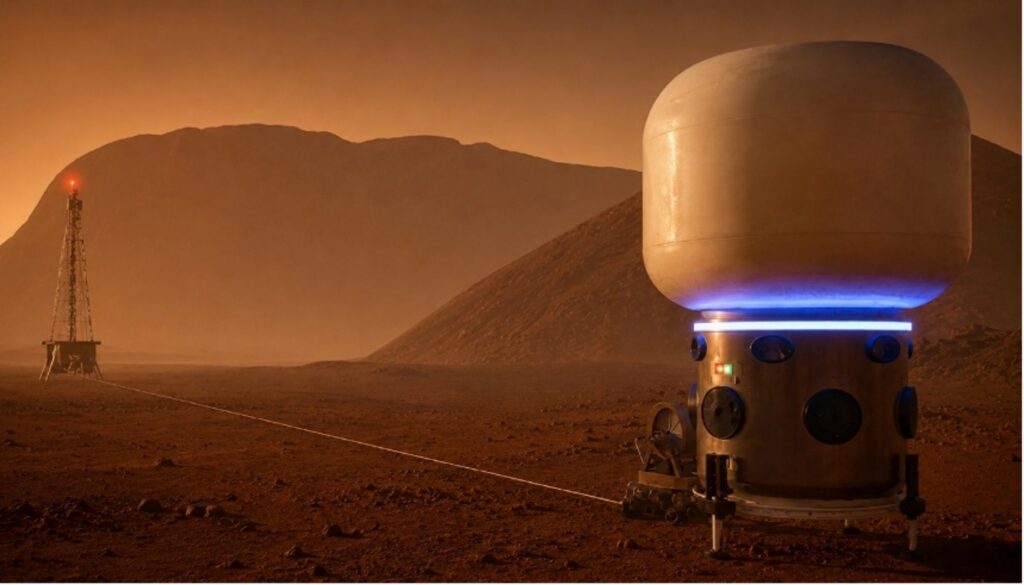
A surface settlement becomes meaningful when its delivered components become a functioning system. Power, communications, mobility, habitat functions and logistics should be deployed, positioned, connected and tested before crews depend upon them.
This is especially important for Mars, where long travel times and restricted launch opportunities make improvisation after arrival especially difficult. Our studies therefore envision precursor cargo autonomously establishing a “lights-on” condition before initial crew arrival.
4. Treat landing and surface deployment as architecture
Landing is not merely the end of transportation. Rocket plume ejecta can damage previously deployed assets, particularly in an airless environment. As a settlement grows, landing zones, protected areas, terrain, mobility routes and infrastructure locations must be planned together.
The lunar south pole makes this particularly important because NASA identifies its challenging terrain and extreme environmental conditions as important considerations for sustained surface operations. A landing site is therefore also a future settlement node.
5. Design the surface as an expandable network
A settlement should not have to be redesigned whenever a new capability arrives. Modular power, communications, habitats, cargo elements and mobility systems can allow the architecture to grow incrementally.
Our conceptual habitat work explores hybrid modules combining hard utility cores with deployable living and working volumes, along with specialized modules for fabrication, biology, health, food production, maintenance and logistics. The architectural objective is not that each module be complete by itself, but that modules can become useful parts of a larger system.
6. Make the moon a pathway to Mars occupancy
NASA’s Moon to Mars Architecture explicitly links sustained lunar evolution with a Humans to Mars segment that will establish human presence on Mars and prepare for progressively longer and more complex missions. The value of lunar infrastructure therefore extends beyond the moon if its interfaces and operating concepts are designed with future interoperability in mind.
Technologies for autonomous cargo deployment, distributed power, communications, mobility, habitat interfaces and surface operations can be developed and matured on the moon before facing Mars’ greater distance and operational constraints. The same approach can broaden international participation by allowing partners to contribute specialized capabilities within a common architecture.
Larry Bell is founder and director emeritus of the Sasakawa International Center for Space Architecture and endowed professor of space architecture at the University of Houston.
Rushabh Mehta is a space architecture professional at the Sasakawa International Center for Space Architecture.