Airbus UpNext wraps up initial ground tests of automated taxiing software
 By Keith Button
 By Keith Button
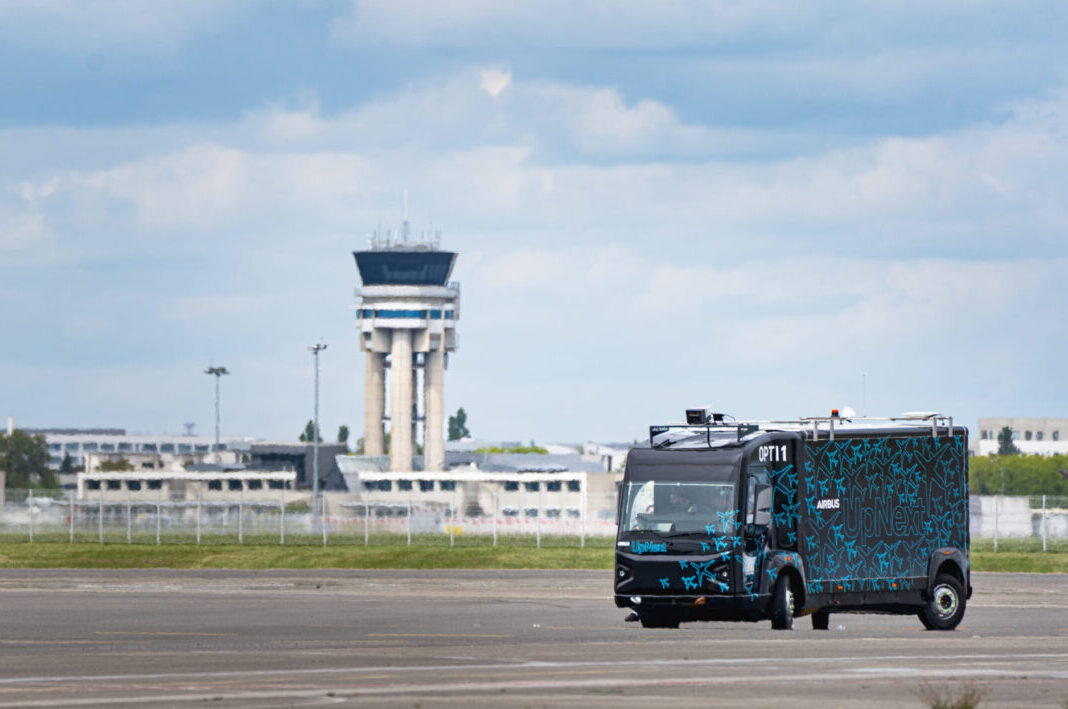
Passengers flying in and out of Charles de Gaulle International Airport in Paris lately might have seen the bright yellow truck that an Airbus subsidiary was using to test the future of automated taxiing.
Airbus UpNext this month concluded tests with this delivery-van-sized vehicle, named “Optibus,” which was equipped with autopilot software UpNext is developing. The software is meant to prevent collisions by keeping aircraft from driving off taxiways or crossing runways with oncoming traffic — features akin to cruise control, lane assist and automatic braking in cars, said Jonathan Rigaud, demonstrator leader for this Optimate test program, which launched in late 2023.
During the airport testing, the truck’s ADS-B transponder made the vehicle appear on the screens of air traffic controllers as a plane or ground vehicle, depending on the particular test, with the call sign “OPTI-1.” The pilots in the truck pushed back from terminal gates and followed taxiing instructions from the controllers, moving through ground traffic like a passenger plane would. They also tested traffic prediction software that proposed the best taxi routes for Optibus to take — similar to the Waze app for cars — with the ultimate decision still left up to the human air traffic controllers.
Today’s passenger planes are autonomously controlled for nearly the entire flight, starting 5 seconds after takeoff, with human pilots still in charge of navigating, communicating and decision-making. The idea behind Optimate is to test technologies that would extend that concept to the ground, where pilots now must manually steer their planes to taxi between terminals and runways, following routing instructions called out by air traffic controllers.
“With all that we have, does it make sense to have more automation in this space? That is what we are looking at,” said Pierre Bizet, an Optibus pilot and flight operations engineer for UpNext.
Automation for taxiing has historically been a difficult problem to solve, partly because plane wingspans have grown larger and larger to maximize fuel efficiency. This means that any software needs to know the exact positions of planes on the ground down to the centimeter, compared to the meters precision sufficient for in-flight collision avoidance, Bizet said.
“If you do an automation, you need to be very precise, robust and with very high integrity, knowing your position and the position of what you have outside,” he said.
Despite the difficulty, Airbus sees a growing need for automation. The company projects that while the global aircraft fleet will double over the next two decades, the number of airports won’t keep up. That means congestion will worsen if airports don’t find some way to shorten today’s taxiing times — about 20 minutes on average for a 2-hour flight, Bizet said. A quarter of the world’s largest airports are now considered congested.
Then there’s the navigation challenge. It used to be that planes could take a simple, direct turn from a runway to a terminal, but as airports layouts have grown more complex, now “you could lose yourself,” Bizet said. For example, Charles de Gaulle, one of the world’s busiest airports, has 200 kilometers of taxiways and runways — roughly equivalent to the distance between Washington, D.C., and Philadelphia.
Though testing in a real aircraft is usually preferable, UpNext considers Optibus the next best thing, said Bizet. The truck is street-legal with a steering wheel for driving on the road, but with the push of a button can switch into simulated airplane mode. Two pilot seats are outfitted with Airbus passenger plane controls, each with a pilot tiller, foot pedals for braking and lateral control, and simulated cockpit displays. The truck also has lidar, two cameras, a 5G antenna and satellite communications antenna, all of which can be monitored from an engineer’s seat in the back of the truck.
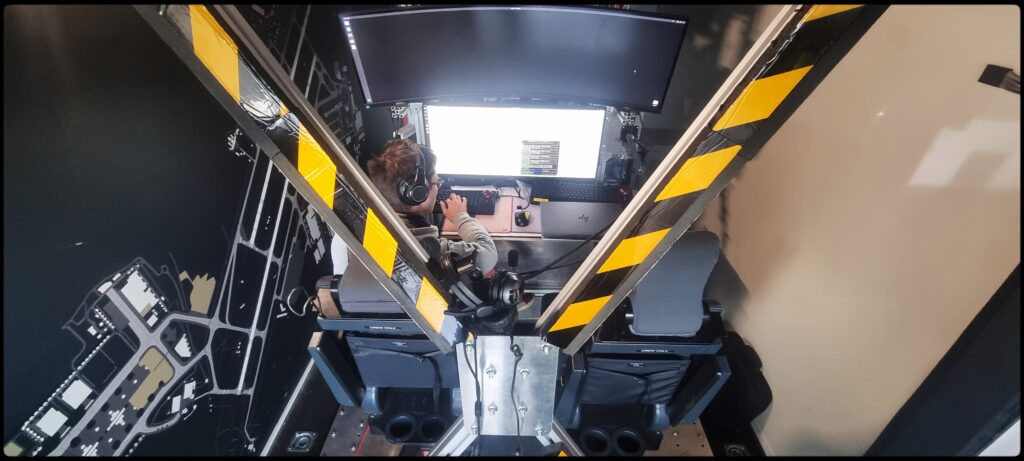
Think of Optibus as a step up from a flight simulator, Bizet said, with the next step up being the company’s A-350 dash 1000 test plane: “It’s our intermediary platform between simulators usually and the aircraft itself, which allows us to go into the real world.”
It’s not yet clear whether the autonomous taxiing and anti-collision software will take that next step. UpNext must now evaluate the Charles de Gaulle test results to determine whether to conduct more truck testing in airport traffic before the Optimate program wraps up next year.
Company representatives declined to share any of the initial test results or describe metrics for success. In all, the Optibus logged a total of 250 hours between testing in ground traffic at Charles de Gaulle, the medium-sized Toulouse-Blagnac Airport and the Airbus private airport adjoining Toulouse.