Test time for these moon drills
 By Keith Button
 By Keith Button
For future moon outposts, scientists expect to get water, oxygen and hydrogen from lunar regolith.
But first, that soil would need to be excavated and delivered from the bottom of permanently shadowed craters to rovers or to feed tall processing plants.
Technology in the works by NASA-funded engineers in South Dakota aims to help. They are developing an auger-like device to carry soil vertically and a second similar tool to transport the soil horizontally while extracting its water. Both concepts are derived from the turning screw conveyors commonly used by grain suppliers and farmers.
“If you went to school in South Dakota, you’re well familiar with the agricultural augers,” said Gordon Niva, CEO of South Dakota-based AeroFly. The company is developing the technologies with subcontractor South Dakota State University, from which the two founders and all seven employees graduated. “They’re a fact of life here.”
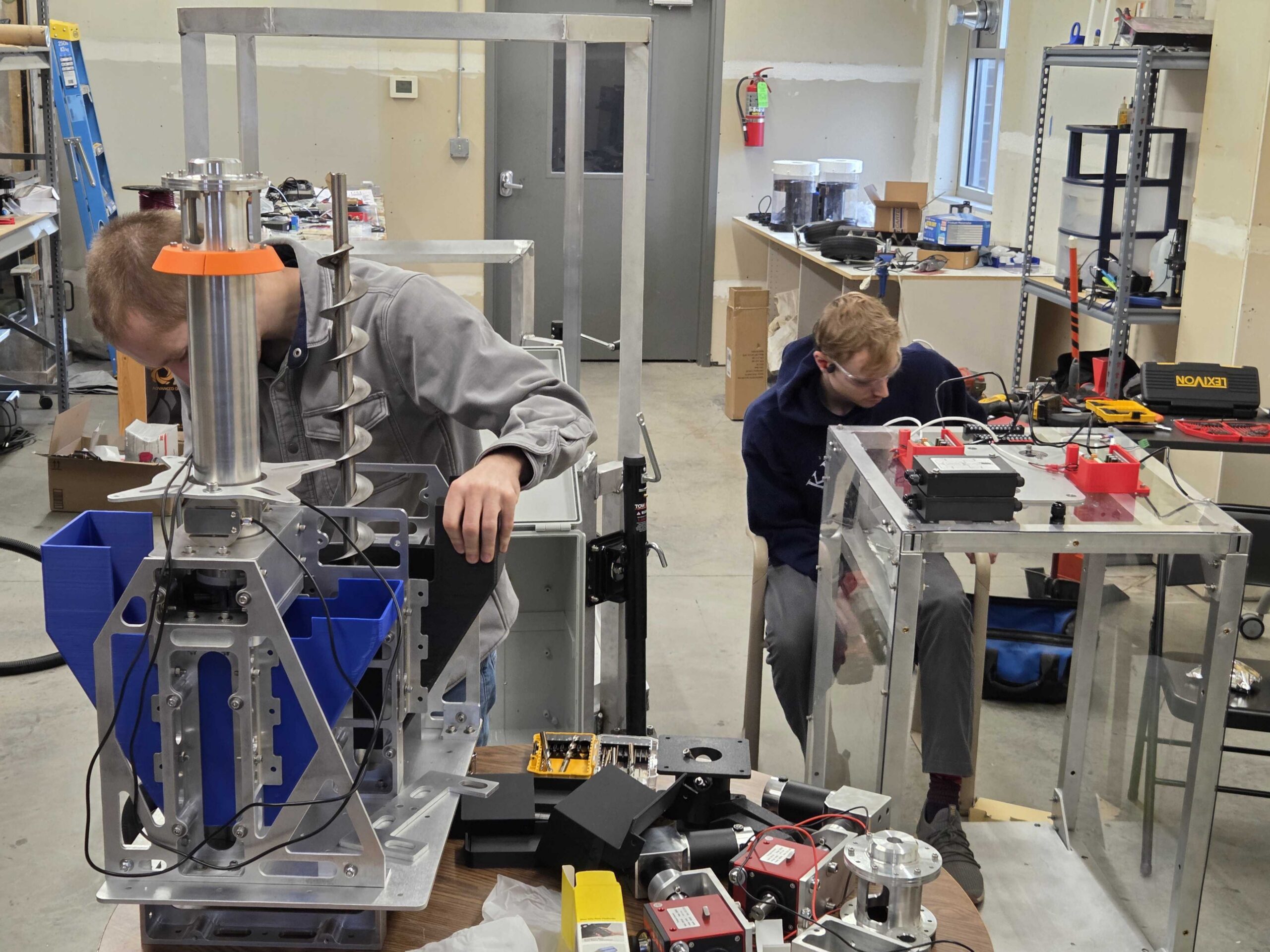
AeroFly’s two auger projects have received a combined $1.7 million in NASA funding. For the LEONA project — Lunar Extraction Of Near-Earth Aquifers — engineers built a horizontal auger dryer prototype set for demonstration in the last week of April.
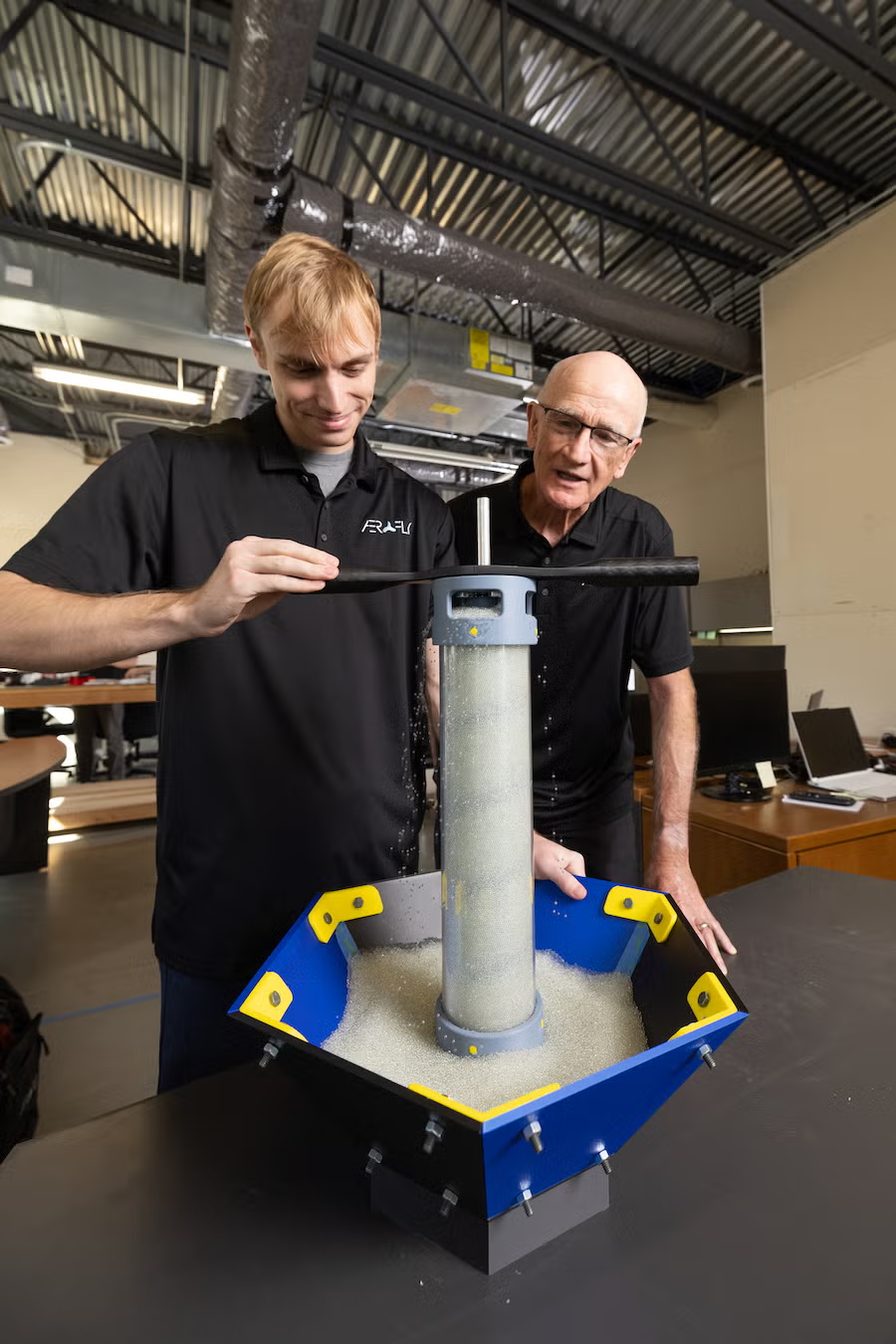
Under the Rego-LIFT project — short for Lunar ISRU (in-situ resource utilization) Feedstock Transporter — the team has built small-scale vertical augers that are to be tested in September aboard an airplane to simulate the moon’s gravity. These parabolic tests are to be followed by a nonstop two-week demo in July 2027 of a full-scale Rego-LIFT prototype, which is being designed to lift artificial lunar soil 10 meters vertically.
NASA has made it a priority to develop technologies for moving lunar regolith and extracting its water, oxygen, and potentially helium and metals — part of a master list of tech shortfalls the agency has identified that must be overcome for future surface missions under the Artemis program.
The moon’s permanently shadowed “cold traps” capture volatiles, and “the volatile that you’re interested in mostly is water. But it can and will be almost anything that gets delivered to the moon,” said Daniel Britt, an asteroid and lunar surface geologist and professor at the University of Central Florida. “A lot of the sources in these things are going to be comets and volatile-rich asteroids.”
Any design for lunar-soil-moving equipment must account for the regolith’s unique properties, Britt said, such as the friction among its particles.
Tech developers “can’t just plop their piece of hardware in a beach volleyball court and think that they’re simulating the surface of the moon,” he added.
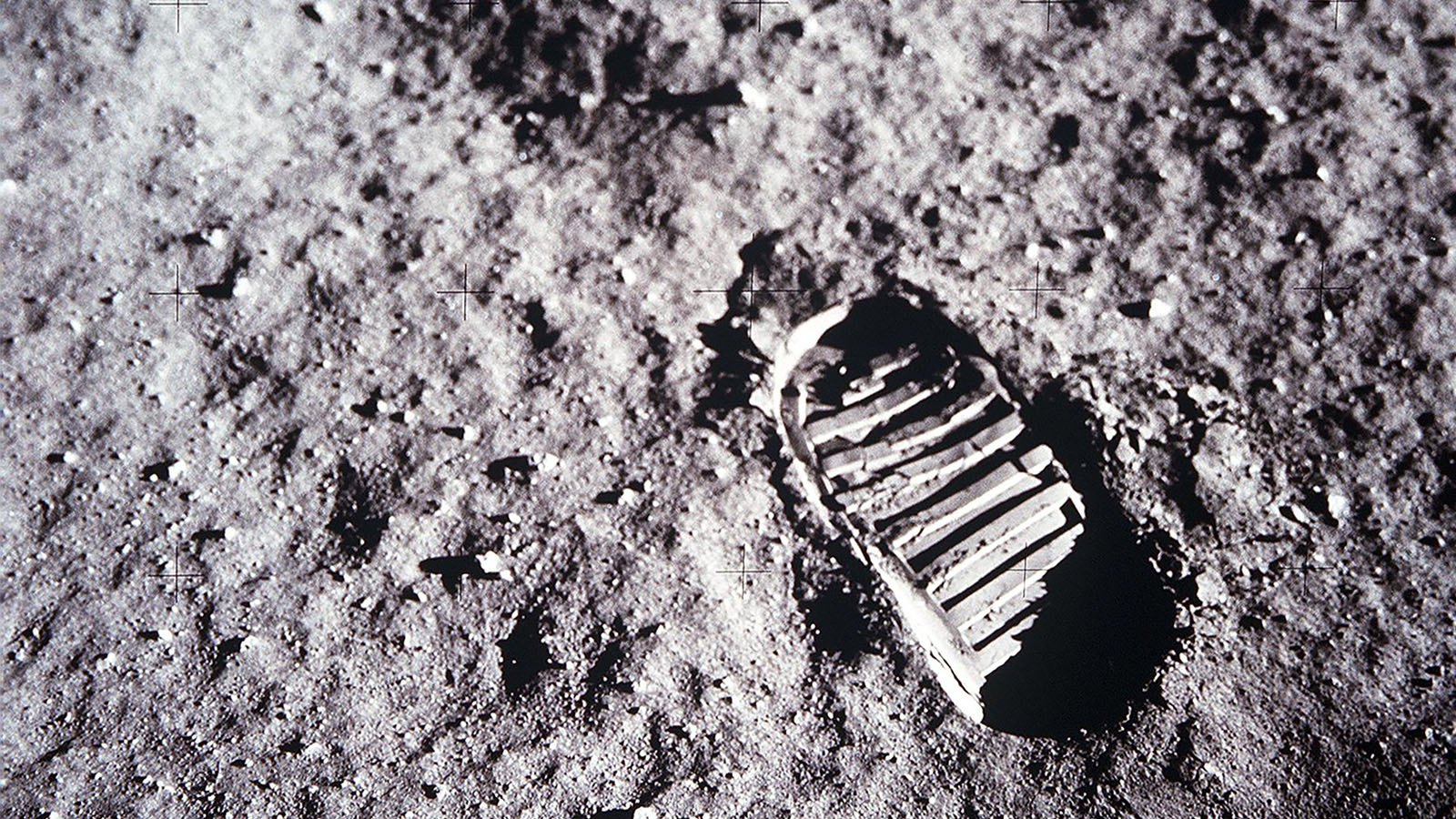
On Earth, fine particles in the soil have been rounded by water, like grains of sand on a beach that resemble tiny ball bearings. But on the moon, those particles are jagged from millions of years of micrometeor impacts smashing volcanic rock to bits.
That can stress regolith-moving equipment or even hand tools. During the Apollo missions, astronauts complained about how hard it was to turn their hand drills into the soil just to collect 2.5-centimeter core samples, Britt said.
As for the technologies needed to isolate specific components of lunar water, Britt said these separators will likely also have to remove “nasty” volatiles, like mercury, hydrogen sulfide and chlorine. Data collected from previous missions indicate all of these compounds have accumulated in the moon’s permanently shadowed areas, where temperatures drop to minus 230 degrees Celsius.
AeroFly isn’t addressing contaminant removal at this stage, but it is testing its augers with artificial lunar regolith that mimics the particles and the mineral makeup of the real thing.
For LEONA, engineers this month will test a 2-meter-long horizontal auger, with the tube that contains the auger also serving as a vacuum chamber to simulate the absence of air on the moon. As the auger turns, it will move simulated regolith pre-mixed with water ice through a heated section of the tube.
There, the ice should sublimate into vapor and escape through an orifice to a cold trap, which will then turn the vapor into liquid. The distance between the auger blades is smaller at the ends of the device than in the middle, which creates soil plugs at the ends to contain the vapor in the middle section.
For Rego-LIFT, the team determined a stationary auger with a rotating tube can move more material vertically than a rotating auger in a stationary tube.
For the September flights, engineers have built four 60-centimeter-high vertical augers for side-by-side tests on a plane yet to be determined. For these flights, the plane will follow a rollercoaster flight path, creating 30 or so 15- to 20-second periods that mimic the moon’s lesser gravity.
Plans call for six engineers — three each on the two planned flights — to fly along with the scaled-down vertical augers. They will record two augers moving simulated lunar regolith and two moving 2-millimeter-diameter glass beads, which will provide a uniform density and particle size to match digital models, said Carter Waggoner, lead engineer for Rego-LIFT.
One pair of augers will operate inside a vacuum chamber and a control pair in ambient air. For now, Rego-LIFT is testing without icy regolith so the engineers can determine its potential capability to carry dry lunar soil to molten regolith electrolysis processors, which would extract oxygen and metals by melting the regolith.
Test data from the flights will be fed into a digital twin computer model; engineers can then simulate how tweaks to the auger design will affect its regolith flow rate or the amount of power it will require, said Liam Murray, AeroFly’s business development lead.
“Then you can extrapolate, try different geometries, try new things in simulation without having to actually prototype it,” he added.
By the middle of next year, AeroFly hopes to have enough test data to make the case for sending a scaled-down version of Rego-LIFT on a lunar lander mission.
“That ought to be a very compelling story for payload to go to the moon for a real test,” Niva said.