Industry panel: Moon base essentials include transportation, surface power
 By Cat Hofacker
 By Cat Hofacker
SPACE SYMPOSIUM, COLORADO SPRINGS, Co. — Reliable transportation, persistent communication relays and surface power are among the technologies and capabilities needed for NASA’s planned moon base to succeed, an industry panel told attendees here on Thursday.
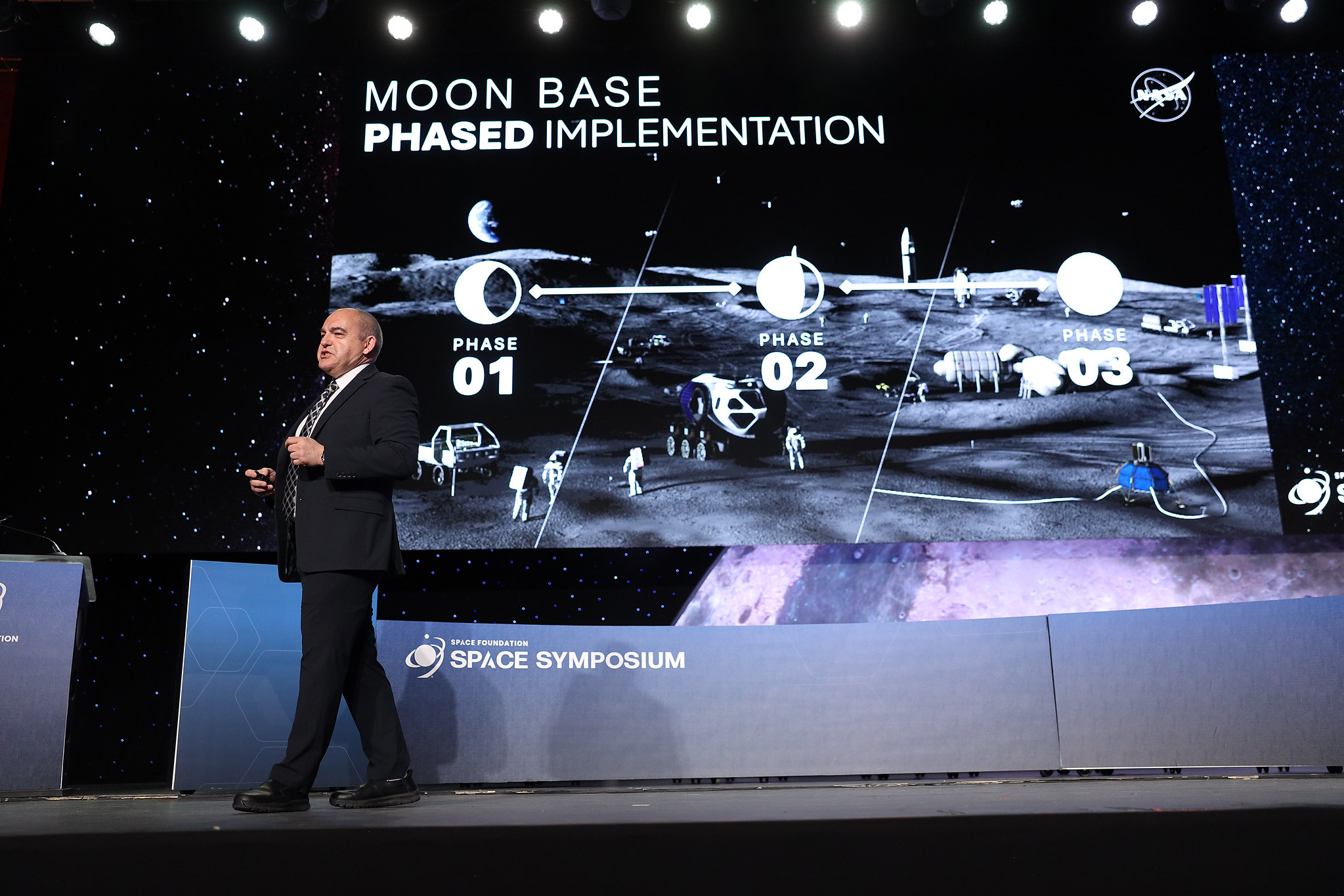
The agency last month outlined a high-level strategy for establishing a lunar surface base by 2030, as directed by the Trump administration. The first phase, which spans through 2028, calls for conducting nearly monthly launches of robotic spacecraft to the lunar surface to begin testing early versions of the instrumentation and equipment required for “permanent habitation,” said Carlos Garcia-Galan, NASA’s moon base program manager, in on-stage remarks before the panel.
“What we envision is really hundreds of square miles with different assets that are serving different purposes,” he said, “some of them prospecting the moon, some of them going to areas where there’s permanent shadows.”
For Phase 1, “it’s all about experimentation and reliable access to the surface,” he added.
For the transportation piece, “we need to at least be able to transport things to the moon and people to the moon as regularly and reliably and affordably as we do for space station today,” said Nick Cummings, SpaceX’s senior director of program development.
Think of it like air travel, said Jacqueline Cortese, Blue Origin’s vice president of civil space. “You don’t need a massive jumbo jet” for every flight and destination. “It’s really a need for all classes of access and return.”
Persistent surface operations will also require constellations around the moon to provide uninterrupted communications, said Tim Crain, chief technology officer of Intuitive Machines, which is planning to launch its first lunar relay satellite later this year.
“We’ll always want more time. There will always be more things to do,” he said. A dedicated lunar constellation “really enables you to utilize that time effectively.”
Then there’s surface power. Cortese noted that although “there’s a lot of camps” advocating for various methods — nuclear, solar and fuel cells, just to name a few — there’s no reason the moon base can’t utilize all of them.
Crain agreed, noting that on Earth, “we didn’t come up with gas-powered turbines and everything else went away.”
At the end of the day, all of these technologies are “interrelated,” Cummings said. “None of these things are one or the other.”
He added: “You’re going to hear these things come up over and over and over again, because it’s just fundamental infrastructure.”