Axiom Space readies for yearlong spacesuit qualification testing
 By Cat Hofacker
 By Cat Hofacker
By this time next year, NASA will likely have a much clearer picture of whether its spacesuits will be ready to support Artemis crewed lunar landings in 2028.
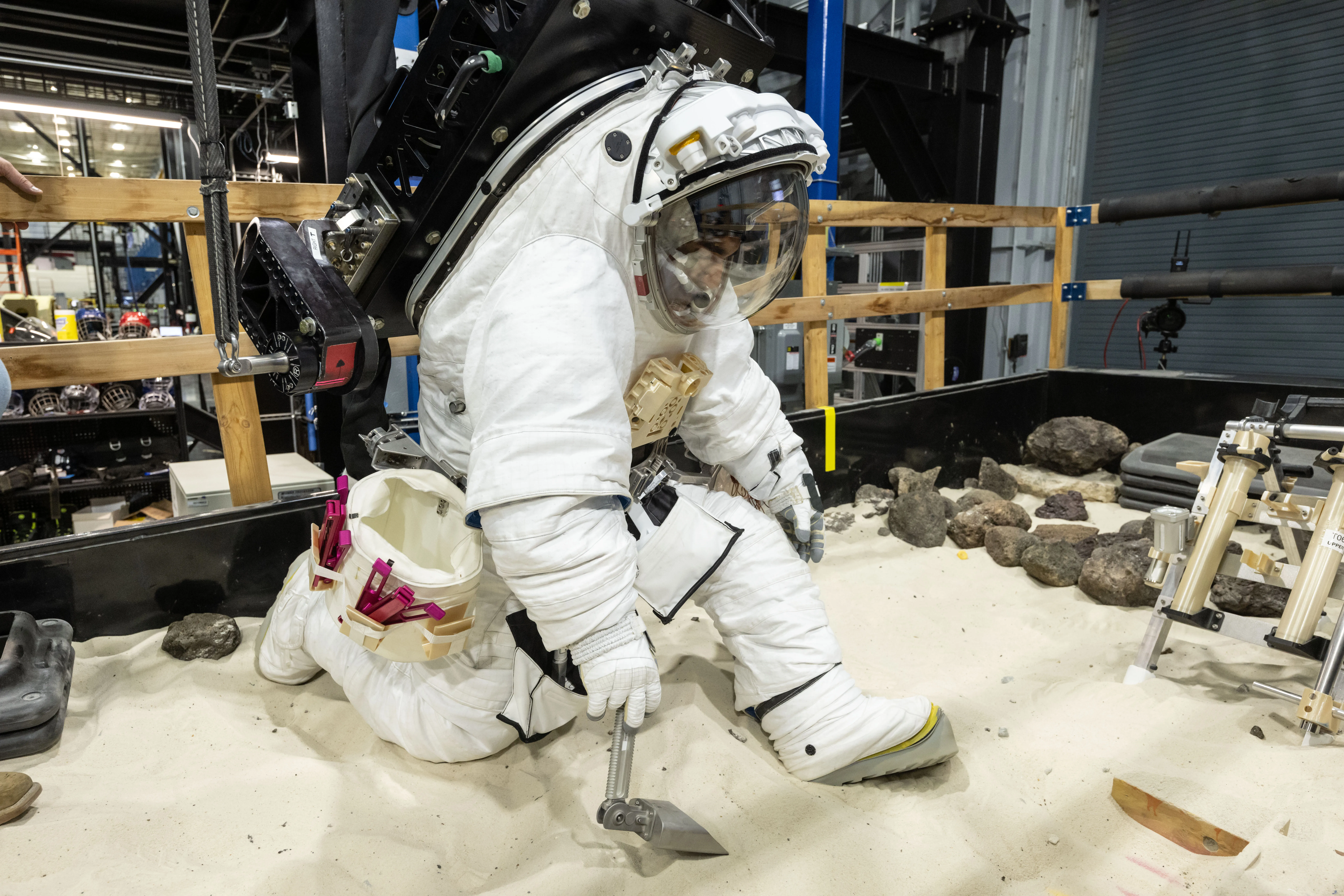
The agency’s contractor, Axiom Space of Texas, is preparing for qualification testing, an approximately yearlong campaign designed to test one of its Axiom Extravehicular Mobility Unit (AxEMU) lunar surface suits in environments that replicate the conditions in orbit and on the lunar surface. The company has a $228.5 million task order to deliver four suits for the Artemis IV landing, targeted for early 2028.
“The whole intent is to test the suit like it will be flown, to make sure when we get on orbit we don’t have any surprises,” said Russell Ralston, senior vice president and general manager of extravehicular activity at Axiom. I spoke with him in mid-April on the sidelines of the Space Symposium in Colorado Springs about the company’s progress and the next steps.
If the schedule holds, qualification testing will wrap up in mid-2027 — a target Ralston acknowledges could very well slip, but that “we feel pretty good” about.
“We’ve done a tremendous amount of testing on this design, and I think we have good reason to be optimistic,” he added.
NASA plans to send the first Axiom suit to orbit in 2027, either to the International Space Station or aboard a lander for the Artemis III test. This crewed flight aims to demonstrate that an Orion crew capsule can rendezvous and dock with one or both of the commercial lunar landers in development, as a stepping stone for one or two lunar surface landings in 2028. NASA expects both lander providers, SpaceX and Blue Origin, to be ready for that demo in “late 2027,” Administrator Jared Isaacman told a congressional committee last month.
Whichever option NASA chooses, “you’re going to learn a lot,” Ralston said. He also noted Axiom should know “way before” mid-2027 if the suit will participate in Artemis III “because there’s a lot of planning that has to go on.”
When we spoke, Axiom was in the midst of assembling the suit that will be used in the qualification testing, which includes a vibration test, Ralston said. “We’ll take the suit, we’ll put it on this vibration table, and that will shake the suit similar to how it will experience launch and then landing on the moon.”
Another major milestone is a planned thermal vacuum test, in which a person will don the suit and step inside a chamber that replicates the drastic temperature swings at the lunar south pole. Because the angle of the sun creates permanently shadowed regions, the south pole gets much colder than the equatorial sites the Apollo crews visited.
“That’s about as close as we can get to the environment of space before we’re going to space,” Ralston said.
In parallel, Axiom is working with SpaceX and Blue Origin on how the suits must interface with the landers for the surface missions — and there are “a whole lot of interfaces,” Ralston said.
For each surface mission, the suits are to be launched aboard a lander, “so we [have] got to have a place to stow them,” he said. Once in lunar orbit, the lander will rendezvous and dock with the Orion capsule carrying the crew, so the astronauts can come over to prepare for the landing.
Once on the lunar surface, the astronauts must be able to service the suits inside the lander for moonwalks, which require additional interfaces. “So when we’re talking about things like recharging batteries or refilling oxygen tanks, the HLS [human landing system] systems have to provide those consumables back to the suit,” Ralston said.
Most of the qualification tests will be hardware agnostic, “but there will be some unique ones to verify interfaces unique to the space station, or maybe one of the HLS,” Ralston said.
The results of this campaign will help NASA determine if the suit will be ready in time for Artemis IV in early 2028 and the Artemis V mission, targeted for later that year. In interviews and media briefings during Space Symposium, Ralston and other Axiom officials expressed confidence it will.
“We still have some risk going forward, as usual,” Ralston told me, “but we’ve done, I think, an appropriate amount of testing to get the risk posture to a place where it should be for a program that’s trying to go as fast as we’re trying to go.”