Startup readies for first launch of microgravity pods
 By Keith Button
 By Keith Button
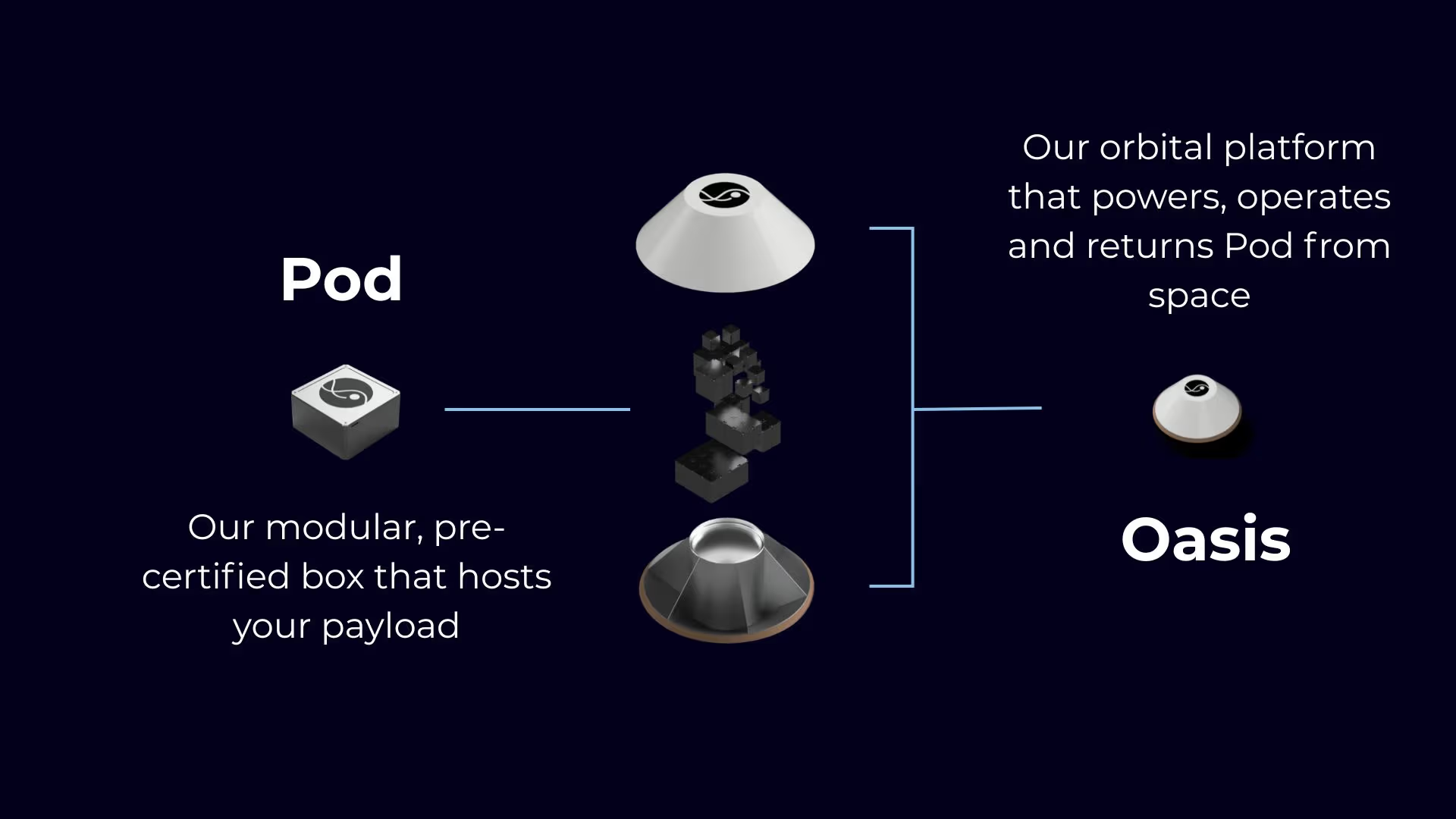
When SpaceX’s next rideshare mission lifts off, among the payloads onboard will be a cubesat containing four soda-can-sized pods that represent an Austrian startup’s first step toward making microgravity as accessible as terrestrial mail service is today.
Tumbleweed is among the handful of companies developing spacecraft meant to loiter in low-Earth orbit for extended periods, allowing customers to utilize the microgravity environment for research, manufacturing and other purposes.
“The ultimate goal is to make microgravity an industrial resource,” said Julian Rothenbuchner, who co-founded Tumbleweed in 2024 with two colleagues from Tumbleweed Mars, a space technology company he established in 2016. “You have to make it ubiquitous and make it trivial to access.”
“People get really worried about: ‘Well, how long is it going to take me? Do I need to build up all this expertise in aerospace?’” he said. “It’s our job to remove all the impasses that come with doing space things.”
While other companies targeting this market have introduced capsules that can return cargo to Earth, Tumbleweed’s inaugural demo will end up with the satellite burning up upon reentry. That satellite, carrying four of the company’s rectangular pods with various customer research payloads inside, is currently slated for launch in late July aboard the SpaceX Transporter 17 rideshare mission.
Step two — sending pods into orbit and attempting to return them to Earth intact — is planned for an undetermined date in 2027.
Ahead of the July demo, Tumbleweed obtained precertification for its pods for the worst-case scenarios that could occur within them, Rothenbuchner said. The company says it has demonstrated to the launch provider and regulators — SpaceX, FAA, the U.S. Space Force and the Austrian government, in this case — that its pods can prevent any potential payload explosion, chemical leak, magnetic disturbance or vibration inside them from affecting the launch vehicle and its electronics.
If all goes as planned, the company will expand the precertification for a wide range of potential customers. This will eliminate the need to conduct a risk analysis and risk mitigation strategy for every individual payload on future launches while also reducing the amount of paperwork and time to launch for customers, Rothenbuchner said.
“By focusing purely on fault containment and being able to contain worst-case failures, we can allow a lot more freedom in design” of the payload by the customers, he said. “That means a lot less information exchange; it means a lot less back and forth.”
On the customer side, the Tumbleweed prelaunch paperwork is a single spreadsheet certifying that the payload meets a set of criteria, similar to a packing list for sending a parcel, Rothenbuchner said. He contrasted this with the traditional risk certification process that can produce 230 kilograms of paper when printed.
Precertification can also reduce the lead time required for a launch to a few months, instead of a year or longer, he added.
This precertification now covers most of the potential risks from common biopharma and space technology research payloads; for subsequent flights, Tumbleweed plans to extend precertification to cover additional specialized payloads.
And the company is already looking ahead to the 2027 demo, in which it will attempt to recover the microgravity pods. The key challenges so far have been building the computer tools to simulate reentry conditions, Rothenbuchner said, as well as designing the reentry capsule that will house the pods to manage the extreme heat, to open its parachute at the correct time and to navigate to its intended landing location. As part of future parachute testing, engineers plan to drop a dummy capsule from an airplane.
Given the challenges, the company won’t be disappointed if the recovery efforts fail, Rothenbuchner said. The main goal will be to test the design of the initial reentry capsule. Tumbleweed’s engineers expect to complete two to five reentry flights with that design before building a more advanced capsule that customers can count on to safely return their payloads, he said.
Tumbleweed’s operational timeline could line up well with the planned retirement of the International Space Station in 2030, said Ioana Cozmuta, chief executive officer of G-SPACE Inc., a software provider for prospective microgravity manufacturers. She predicts that after the station’s retirement, microgravity flight customers will at first turn to “free flyer” launches into orbit with capsule returns. Later, another segment of microgravity services will catch up: that of orbiting commercial space stations that more closely mimic the ISS dock-and-return concept, she said.