


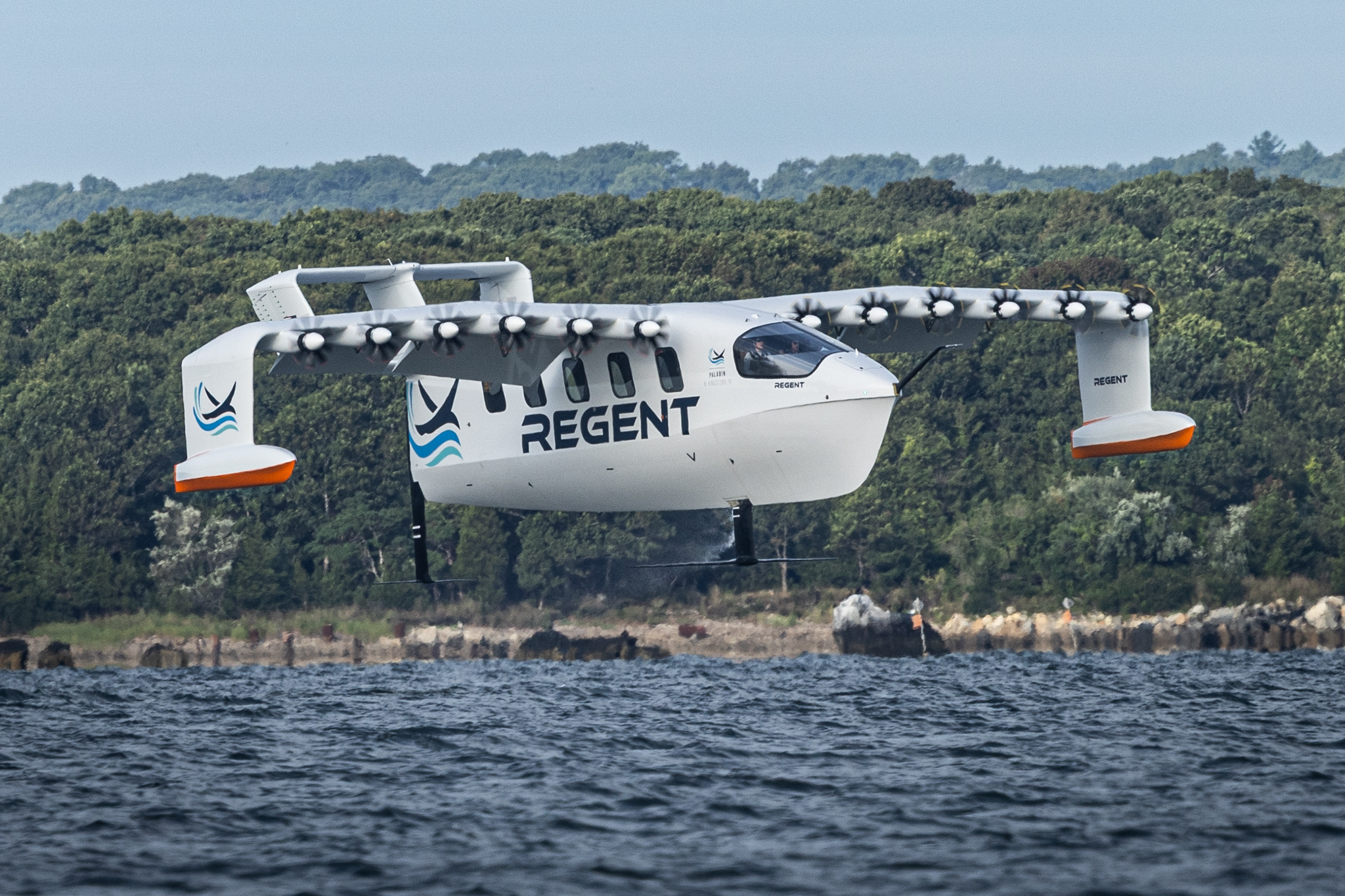
Rhode Island startup Regent Craft is targeting 2027 to begin manufacturing its all-electric seagliders, the first commercial aircraft to leverage the “wing-in-ground-effect” aerodynamic phenomenon.
The design, named Viceroy, is classified as a flying boat under U.S. regulations. Designed to fly 10 meters above the water’s surface, it will be certified by the U.S. Coast Guard.
Earlier this month, a crew of two conducted the inaugural flight of the full-size Viceroy prototype, flying the vessel for 30 seconds above the surface of Narragansett Bay near the company’s headquarters.
Regent is now planning expanded testing of that prototype while pursuing certification, company CEO and co-founder Billy Thalheimer said in an interview.
“We’ve been moving quickly,” Thalheimer said. “We’re expecting our first vehicles to come off our manufacturing line by the end of next year, and we’ve been working really diligently with the Coast Guard to support that timeline. And certainly, we expect the FAA will be involved in a technical advisory role on the certification process.”
Since its founding in 2020, the company has raised $340 million and tested several smaller prototypes.
The Viceroy initially moves like a boat on the surface of the water. As it gains speed, the hull lifts off the surface, but two stabilizers, formally called hydrofoils, remain submerged. The stabilizers then retract into the hull, and the craft ascends roughly one wingspan above the water’s surface. At this altitude, there is a cushion of air between the craft and the surface the Viceroy can take advantage of to remain airborne.
Combined with the blown-lift effect of 12 propellers along the wing, the Viceroy becomes more fuel efficient than a boat and extends its range on battery, Thalheimer said.
Wing-in-ground effect, or WIG, has been researched and demonstrated a handful of times since the Cold War. The Soviet Union flew two such craft, known as ekranoplans. Howard Hughes’ massive Spruce Goose plane — which flew only once, briefly — was designed to take advantage of WIG for portions of its flight. Most recently, DARPA had contracted Aurora Flight Sciences to build a seaplane called Liberty Lifter that would utilize WIG. The agency concluded that program in 2025 before the demonstrator was flown.
With the Viceroy, Regent hopes “to replace or supplement traditional coastal ferry operations” and airline services for “coastal routes such as Boston to Nantucket or Miami to the Bahamas,” according to the company’s website and press releases.
The company is also developing a hybrid-electric variant for military applications, Thalheimer said. That smaller drone variant, dubbed Squire, is undergoing testing and development too. One advantage of Squire’s low-altitude flight profile is evading radar, he noted.
One potential application for Squire is a medevac for deployed troops, he said. The company has received $15 million in contracts from the U.S. Marine Corps Warfighting Lab to test and demonstrate its all-electric seaglider technology for defense operations.
Given that FAA already has a long line of electric aircraft in the certification process, working with the Coast Guard might help Viceroy get certified more quickly, said analyst Sergio Cecutta.
“We think there is a market for wing-in-ground craft,” said Cecutta, whose company SMG Consulting produces the AAM Reality Index of electric aircraft rankings. “We see an interest from the defense sector, especially for their drone. The size of the commercial market will be limited as these vehicles will supplement ferries and replace some island helicopter routes. I think more opportunities — and consequently the size of the market — will open up once much larger vehicles are available.”