


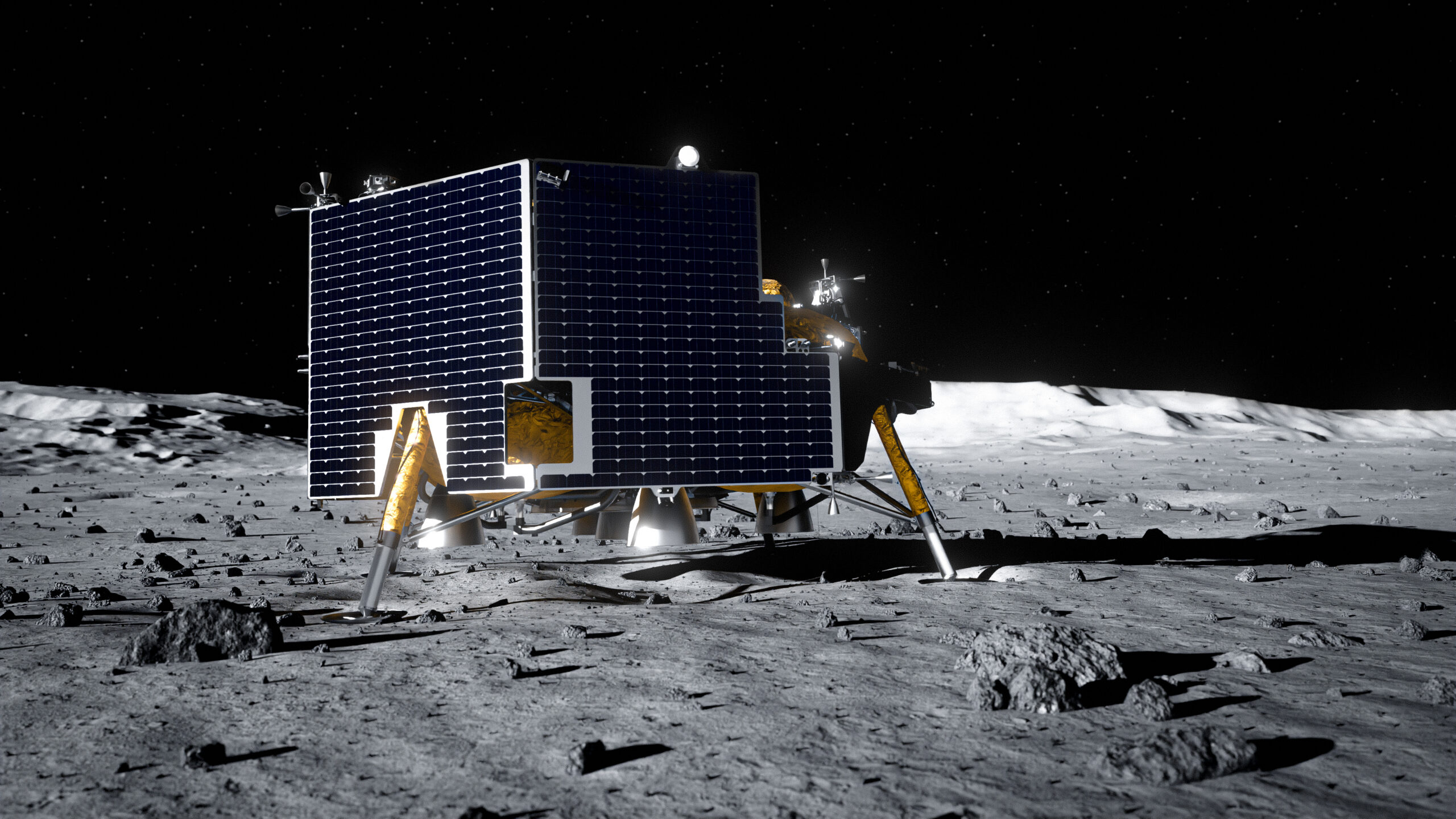
Voyager Technologies’ first Griffin lunar lander is on track to launch no earlier than November, but a handful of the agency’s robotic landings have slipped to 2027, NASA’s Moon Base program manager said today at the Glenn Space Technology Symposium in Ohio.
Griffin was one of four landers NASA had been planning to send to the lunar surface this year. The next two — Blue Origin’s Mark 1 Endurance and Intuitive Machines’ Nova-C Trinity — are now slated to launch in “the first part of 2027,” said Carlos García-Galán, who is overseeing the agency’s lunar surface base initiative.
The fourth, Firefly Aerospace’s Blue Ghost 2, is scheduled to launch later in 2027, he added at the event, which was hosted by the American Astronautical Society.
NASA and Blue Origin officials have attributed the Mark 1 delay to the May explosion of a New Glenn rocket on its Florida launch pad. Blue Origin CEO David Limp last week posted on X that the company is making “incredible progress” at rebuilding that infrastructure. NASA Administrator Jared Isaacman said in June that launching Mark 1 aboard New Glenn is still “Plan A,” but the agency is assessing alternatives.
Intuitive Machines CEO and President Steve Altemus said during an August earnings call the Nova-C launch would slip to “the first quarter of 2027.”
Voyager’s lander is to touch down at Mons Mouton, a high point near the lunar south pole, García-Galán said, carrying a robotic FLIP rover from Astrolab to test hardware for a future crewed rover to “prove reliable access, if we can get there successfully, and to get ground truth data from the lander,” he said.
As for the next two landers, Intuitive’s Nova-C is “basically in final assembly,” he said, and the “spacecraft has already been powered on” for a journey to the “Reiner Gamma area in the first part of 2027.”
Blue Origin’s Mark 1 “is pretty much fully assembled,” he added.
During the same panel, Jacki Cortese, Blue Origin’s senior director of civil space, said the next milestone for Mark 1 is fueling the lander “to do a test prior to encapsulating this thing and flying it in early 2027.”
“Obviously, this is a high-risk, high-reward mission. The first flight of any lunar lander is,” she said.
The Mark 1 and other landers are to demonstrate technologies for NASA’s Moon Base, the initial elements of which are to be in place by 2030. For the first phase, which extends to 2029, García-Galán said NASA is focused on those technology demonstrations while also scouting for a site for the base. After that, he said, Phase Two will be about building out the infrastructure.
“Phase One is going to look like a scattered set of assets across hundreds of square miles,” García-Galán said, “because we need multiple landers to demonstrate that we can land reliably and to get the ground truth data from different locations, so we can pick an area that we think is going to be amenable to a habitation site because of the lighting or thermal conditions and a direct line of sight to Earth.”