

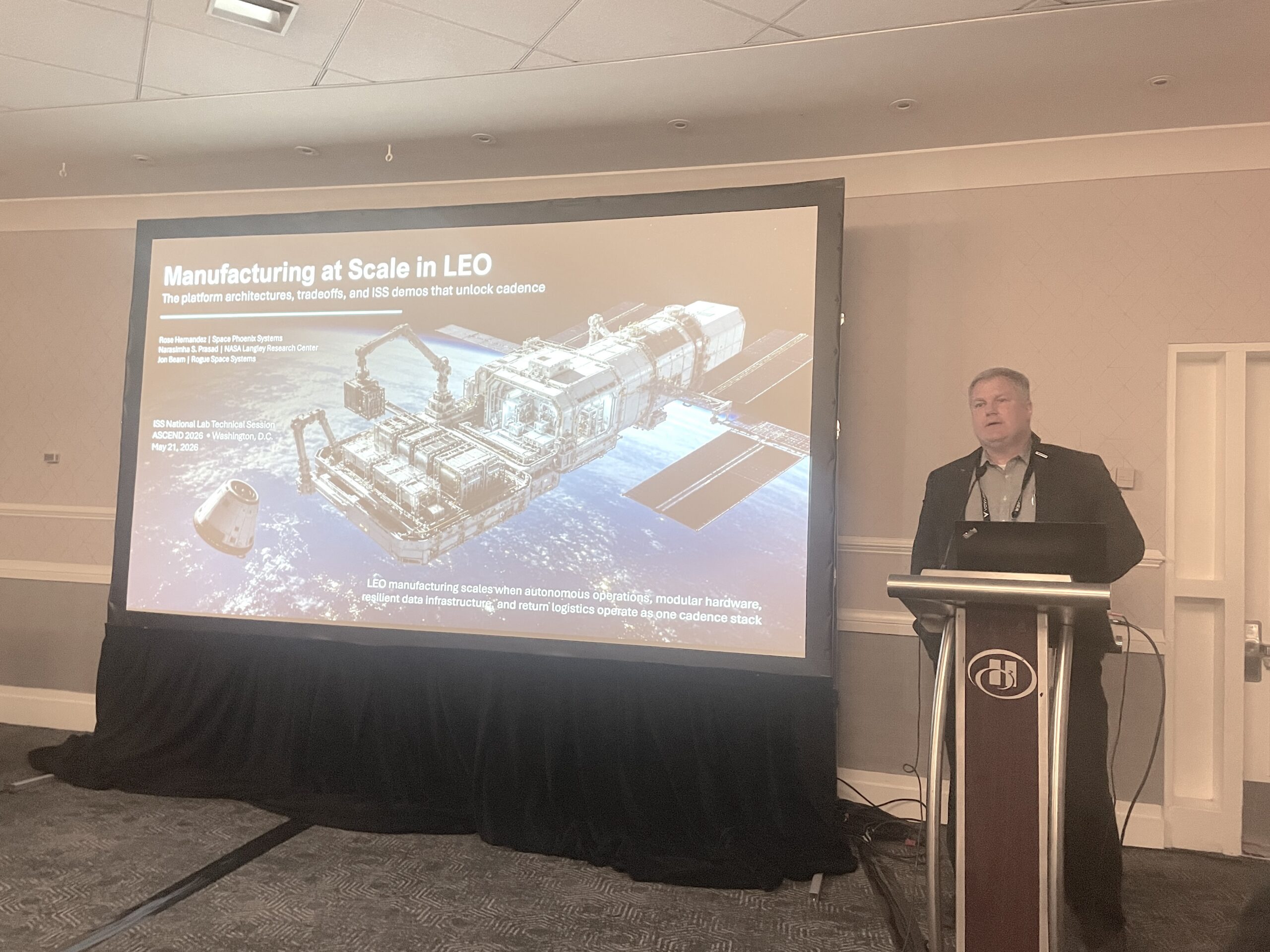
WASHINGTON, D.C. — Six companies gathered at an ISS National Laboratory technical session at ASCEND 2026 to describe their progress in in-space manufacturing, commercial space station development, and the computing and logistics infrastructure that will underpin a low Earth orbit economy. Taken together, their presentations reflected an ecosystem still being built — but one with real hardware, real data, and real customers. AIAA explores these efforts in a three-part series.
Ecoatoms Targets the Control Problem Holding Payloads Back
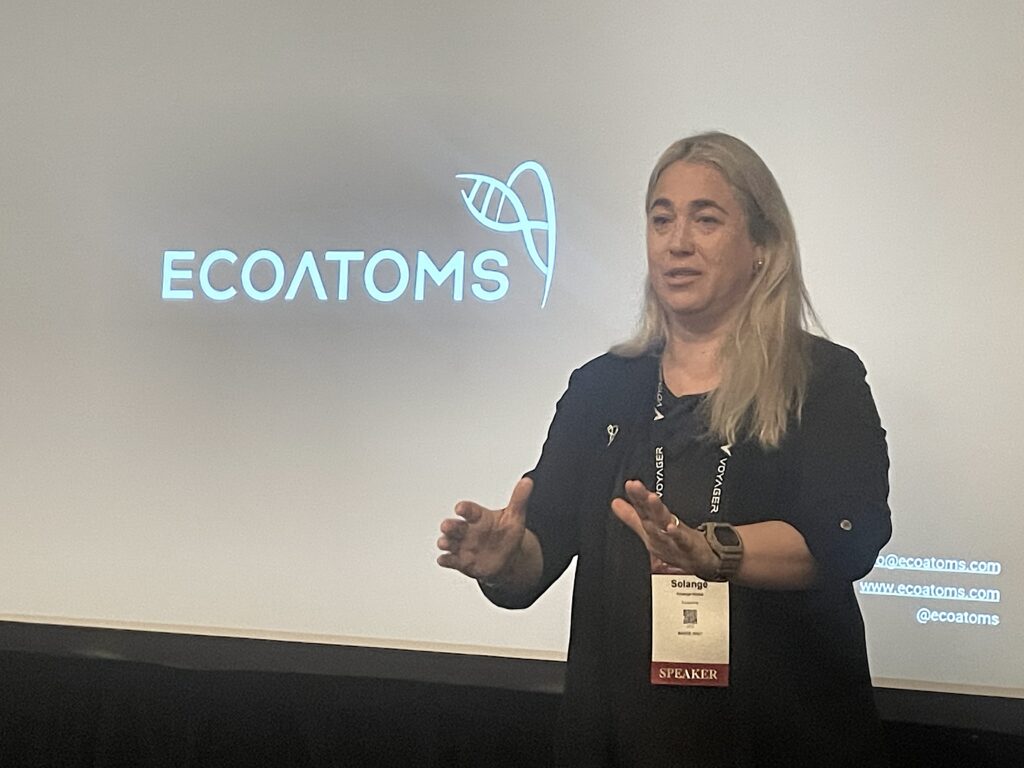
Solange Massa, CEO and founder of Ecoatoms, argued that in-space manufacturing will not reach its potential until the industry upgrades the computers running its experiments. Today, every payload and vehicle combination requires custom engineering for power, communications, and control.
“The big problem is that all the payloads are different,” she explained, adding, “Every experiment needs different peripherals, connectors, etc.”
Massa noted that people must adapt their payload not only within but also to different vehicles: “You have commercial LEO destinations, rockets, capsules, and some of us are also building toward lunar landers…every single time we have to do that, it is engineering on the side of the vehicle or on the side of the payload. I firmly don’t believe in that.”
Her answer is A.N.I.M.A., a universal high-performance onboard computer she describes as the “soul” of a payload. Compatible with power profiles from more than 20 NASA-provided vehicles, A.N.I.M.A. can manage communications and directly drive heaters, pumps, motors, cameras, and even DNA sequencers. Built around field-programmable gate arrays (FPGAs) and system-on-module architectures, it enables picosecond-scale decision-making and onboard machine learning.
“I am so tired of seeing Raspberry Pis run expensive missions,” Massa said. “Let’s start using Ferraris.”
Ecoatoms has flown four payloads to date and is planning a bio-focused lunar mission. Michael Roberts, chief scientist of the ISS National Laboratory, noted after the session that technologies like A.N.I.M.A. carry applications well beyond space — including remote ground-based instrumentation for infectious disease monitoring. “So many of these technologies are not just spin-off technologies,” he said. “They’re informing things that have a premise here on Earth.”
Building the Orbital Factory Floor: Logistics as the Missing Layer
Jon Beam, co-founder, president, and chief strategy officer at Rogue Space Systems; Rose Hernandez, chief science officer of Space Phoenix Systems; and NASA Aerospace Technologist Narasimha Prasad addressed the infrastructure needed to turn microgravity manufacturing into a repeatable industrial operation. Their central message was that commercial cadence requires a “cadence stack” combining autonomous operations, modular campaign hardware, resilient data infrastructure, in-space logistics, and predictable return pathways.
Rogue is developing the in-space logistics layer needed to support that transition: containerized payload and mission modules, autonomous orbit-servicing and logistics vehicles, hosted operations, inspection, orbital transfer, and edge compute capabilities. The goal is to let manufacturers access orbital infrastructure without each payload developer having to build, launch, and operate a dedicated spacecraft bus.
“Microgravity manufacturing at commercial cadence will not scale by way of inhabited stations alone,” Beam said.
Space Phoenix Systems focuses on the return side, building downmass capability to bring finished products reliably back to Earth. Hernandez, whose background includes terrestrial manufacturing, argued that the conceptual gap between orbital and ground-based industry may be wider than the technical one. Autonomous operations, modular hardware, and return logistics, she noted, are not exotic space concepts; they are the same kind of scale-enabling principles that would belong in any serious manufacturing presentation on Earth.
Prasad pointed to ISS results as validation: defect-free insulin crystals, ZBLAN optical fiber with two to five times lower attenuation and twice the mechanical strength of its terrestrial equivalent, and novel drug polymorphs with therapeutic potential.
Transportation cost remains the central challenge — one audience member noted it accounts for roughly two-thirds of station budgets. Beam pointed to commoditized launch, small-lift vehicles, and containerized payloads as the levers most likely to change that equation.
Roberts framed the broader transition plainly: “We’re obviously at a very interesting time in the transition from a government-owned operated station to what comes next. It requires investment from private equity. It requires strategic vision from governments to identify what is important to those nations, and how they want to work with other nations.”
Related Reading: From the Lab to Low Earth Orbit (Part 1) and From the Lab to Low Earth Orbit (Part 3)